111days a year reach 100°F or more at Sky HarborNOAA climate normals
0.6nights a year drop to freezing at Sky Harbor, so heat and water, not frost, drive most damageNOAA
June 15 to September 30 is monsoon seasonNational Weather Service
Phoenix treats up to 10.5 ft of concrete drive past a roll curb as on-site work, with no separate driveway permit
Concrete for a residential driveway in the Phoenix right-of-way is 6-inch Class A
Last Updated:
Phoenix concrete sealing puts a protective treatment on a concrete or paver driveway so water, oil and dirt soak in less and color lasts longer in the sun. It is surface care, not repair: a sealer doesn’t close cracks, level pavers or strengthen weak concrete. Sundial Driveway Repair is a service company offering and managing concrete and paver sealing across Phoenix and the surrounding Valley, for homes and commercial properties, with the work fulfilled by licensed and insured contractors. Asphalt driveways take a different product altogether, covered on the driveway sealcoating page.
Whether sealing is worth it depends on the surface and what you want from it. Plain broom-finish concrete in good shape can go unsealed for years and do its job. Stamped, colored and exposed-aggregate concrete, and pavers, lean on a sealer for their look. And any drive where oil drips or irrigation water sits benefits from a surface that sheds both.
What happens on the first visit
The first visit looks at the whole drive: surface, joints, edges, where water runs, and the garage, sidewalk and street transitions. Before sealing is discussed, the surface is checked for problems a sealer would only cover up. Cracks are checked for width, offset and whether they cross panels. On concrete, flaking and scaling are noted; on pavers, sunken or rocking units and washed-out joints. Any old sealer is identified, because a new product has to be compatible with it or the old one comes off first.
The estimate names the sealer type, the area, the cleaning and prep, and what the work excludes, such as removing deep oil stains completely or matching the color of a repaired section. Anything that should be repaired before sealing is listed separately, so you can see what sealing alone would and wouldn’t do.
Penetrating sealers and film-forming sealers
Concrete sealers fall into two families, and the choice between them is most of the decision.
Penetrating sealers
Silane and siloxane water repellents soak into the pores of the concrete and react there, lining the pores so water beads off instead of soaking in, while vapor can still escape. They leave little or no change in color or shine, and because they sit inside the concrete instead of on it, sun and tires don’t wear them off the surface. They suit plain concrete driveways where the goal is less staining and water uptake without a glossy look. They don’t deepen color, so they do little for faded stamped work.
Film-forming sealers
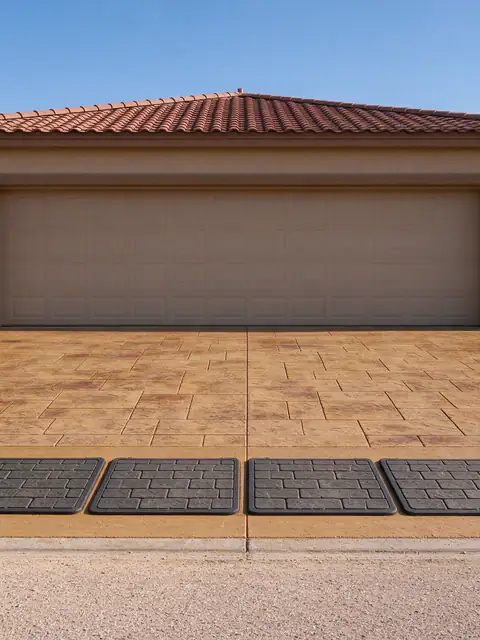
Acrylic sealers, solvent- or water-based, form a thin film on the surface. That film darkens and enriches color, gives a satin or gloss finish and seals pavers and decorative concrete against stains. It also wears: tires scuff it, and ultraviolet light breaks it down over time. A film that goes on too thick, over damp concrete or in heat can trap moisture and turn white. Polyurethane coatings are tougher, and epoxies, which yellow in sunlight, belong indoors. The stamped concrete repair page covers how failed film sealers are stripped and replaced.
What sun and heat do to a sealer here
The Valley is hard on surface films. Phoenix Sky Harbor reaches 100°F or more on 111 days a year (NOAA climate normals), and a driveway in full sun runs hotter than the air. A film sealer on a south- or west-facing drive breaks down faster than the same product in shade, so resealing is judged by the surface: when water stops beading and the color looks dry, the film has worn thin. Heat also affects application. A sealer put on a hot slab can dry too fast at the surface, trapping solvent or air as bubbles and pinholes, which is why sealing is planned for the cooler hours and kept within the temperature range on the product’s data sheet. The guide to how heat affects driveways explains the wider effects.
Freeze-thaw and de-icing salt, which drive much of the case for sealing in colder climates, barely apply here: Sky Harbor averages 0.6 freezing nights a year. The case for sealing in Phoenix rests on stains, dust and color, and on slowing the water that monsoon storms and sprinklers put on the slab. The National Weather Service defines the monsoon as June 15 to September 30, and a sealer that sheds that water at the surface helps, though it does nothing for water entering through cracks and joints. Flaking from a weak top layer is a finishing problem a sealer can’t reverse; the guide to what causes driveway spalling explains why.
Sealing pavers
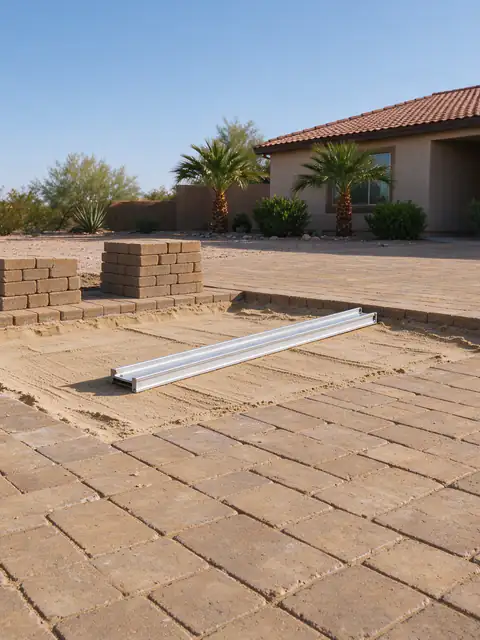
Concrete pavers and stone such as travertine are sealed for color, stain resistance and to help hold the joint sand. The pavers are cleaned, stains treated, and efflorescence, the white salt deposit carried up by moisture, is removed rather than sealed in. Open joints are refilled first, often with polymeric sand, which firms up when wetted and resists washout and weeds. Then the sealer goes on: a film-forming acrylic for a richer, wet look, or a penetrating sealer for a natural finish. Natural stone, which is porous and varies piece to piece, often takes a penetrating sealer so moisture can still move through it. A typical Phoenix-area range for cleaning and sealing pavers is about $1 to $3.50 per square foot. Sunken or broken pavers are reset before sealing, and paver driveway repair covers that work, with the paver repair cost guide setting out budgets.
What sealing doesn’t fix
A sealer doesn’t repair cracks, fill voids, raise sunken panels or rebuild a failed surface, and no sealer makes concrete waterproof. Cracks are cleaned and sealed with a flexible crack sealant before the surface is sealed, as driveway crack repair explains, and failed joints are handled by expansion joint repair. A worn or scaled surface on a sound slab may need driveway resurfacing rather than sealer. Sealing a surface with those problems mainly makes them shinier.
Cost and payment notes
Concrete sealing is priced by area after measuring, and the price moves with the sealer type, how much cleaning and stain treatment comes first, whether old sealer has to be stripped, the number of coats and access. Paver sealing adds joint re-sanding where the joints have washed out. Small areas carry a minimum charge. In Arizona, paver and stone driveways fall under the Registrar of Contractors’ R-21 hardscaping class and concrete under R-9, and a license is generally required when a job tops $1,000 or needs a permit. When you’re ready, ask for an estimate.
VIIVIVIVIIIIII
02
What's included
A look at the whole drive and a check that the surface is sound enough to seal
A sealer type chosen for the surface: penetrating for plain concrete, film-forming or penetrating for pavers and decorative work
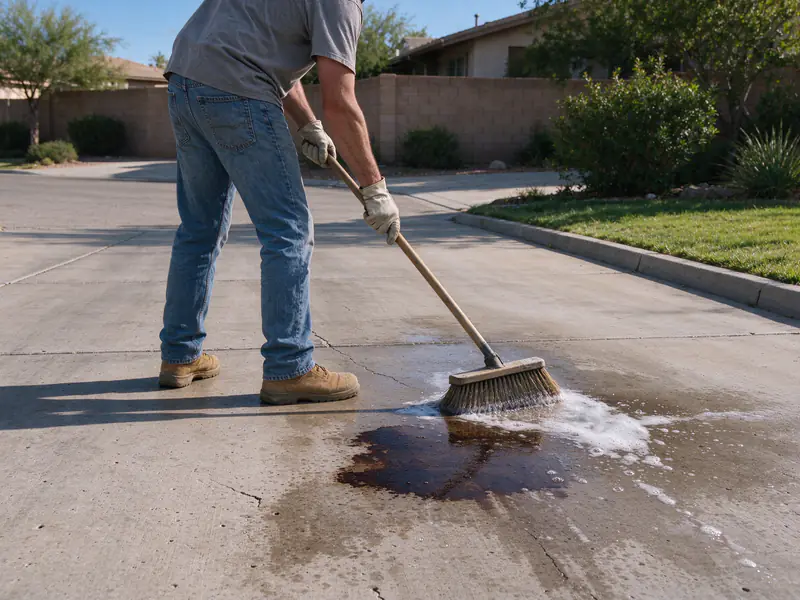
Cleaning, with oil and tire marks treated before sealing
Stripping or reactivating old sealer where it has whitened or peeled
Re-sanding open paver joints before sealing, where the joints need it
Application in the cooler hours, within the sealer's stated surface-temperature range
A stated dry time before foot and car traffic, given before the work starts
VIIVIVIVIIIIII
03
Driveway sealing options compared
Driveway sealing options compared: what each does, what it won't do, and a budgeting range
Option
Best for
Won't do
Budgeting range
Penetrating sealer on concrete
Plain broom-finish concrete where you want water and oil to bead without a shine
Change the color much, or fix cracks and flaking
Priced by area after the drive is measured and cleaned
Film-forming acrylic on concrete
Stamped, colored or exposed-aggregate concrete where depth of color matters
Last as long in full sun as a penetrating sealer, or hide damage
Priced by area; stripping old sealer adds to it
Clean and seal pavers
Faded or stained concrete pavers and stone with sound joints
Level sunken pavers or rebuild a failed base
$1 to $3.50 per sq ft (typical Phoenix area)
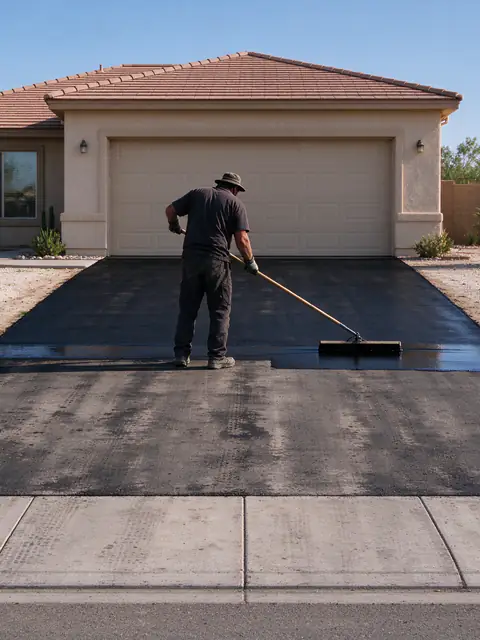
Asphalt sealcoating
Asphalt driveways only
Anything on concrete or pavers
See the sealcoating page
Leave it unsealed
Sound plain concrete with no staining concerns
Resist oil and dirt staining
No cost
04
Related resources
Guides that go deeper on concrete & paver sealing decisions in the Valley.
The physics of a slab that grows and shrinks every day, why heat does its worst damage to concrete in the first hours, how asphalt binder softens and ages under Valley sun, and what owners can do through a long summer.
What swapping damaged pavers, resetting a sunken section and cleaning and sealing a paver driveway cost, why the base under the pavers sets the price, and what to look for on a quote.
Why the freeze-thaw explanation found in typical driveway advice rarely fits the Valley, the finishing, curing, steel and joint problems that do, and how the depth of the damage sets the repair.
05
How the work runs
First call or estimate request
Describe the surface, what changed and roughly where the property is. Photos of the damage and the street edge help. The published ranges give you a budget to think about before any visit.
A look at the whole driveway
The visit looks at more than the damaged spot: the slab or asphalt, the joints and edges, where water runs, and the transitions at the garage, sidewalk and street. The damaged area is measured, and anything found that changes the scope, such as soft base or caliche, is explained in the estimate.
Work timed for the heat
Hot-weather practice from the American Concrete Institute caps concrete at 95°F at discharge for general work, so summer pours are planned for the cooler part of the day. Where the job crosses into the street right-of-way, the city's permit is part of the scope.
Cure and handover
How long the car stays off depends on the material and the temperature. That wait is set out before the work starts, so you can plan around it.
VIIVIVIVIIIIII
06
What this work looks like
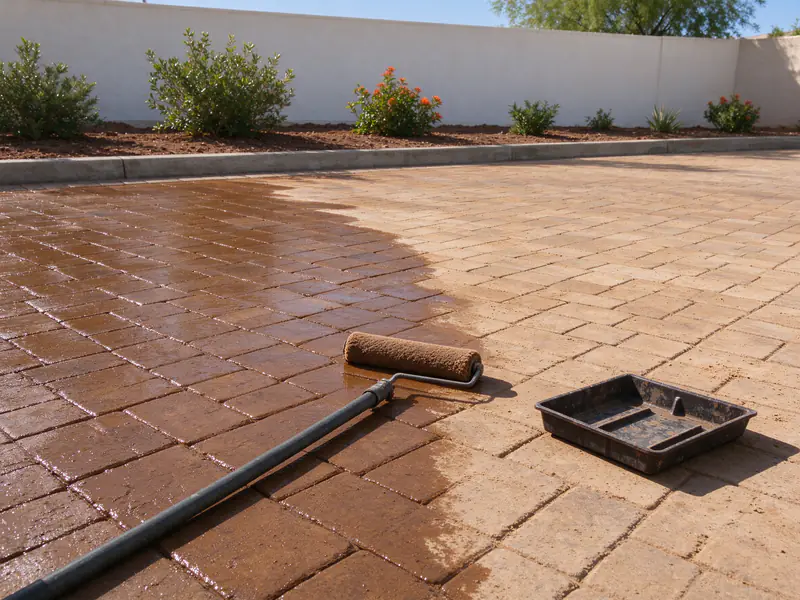
Paver driveway in Tempe half sealed, the sealed pavers richer in color
Oil stain being scrubbed from a Tempe concrete driveway before sealing
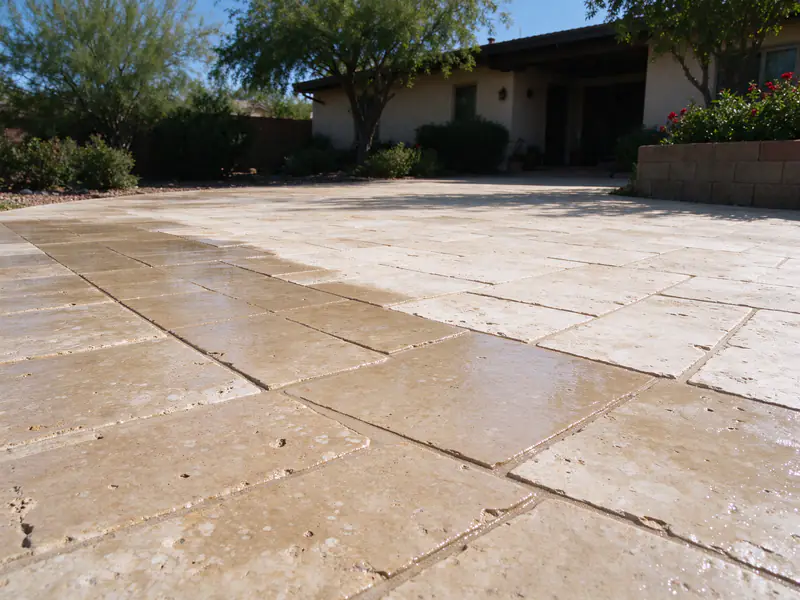
Travertine paver driveway in Tempe partly coated with fresh sealer
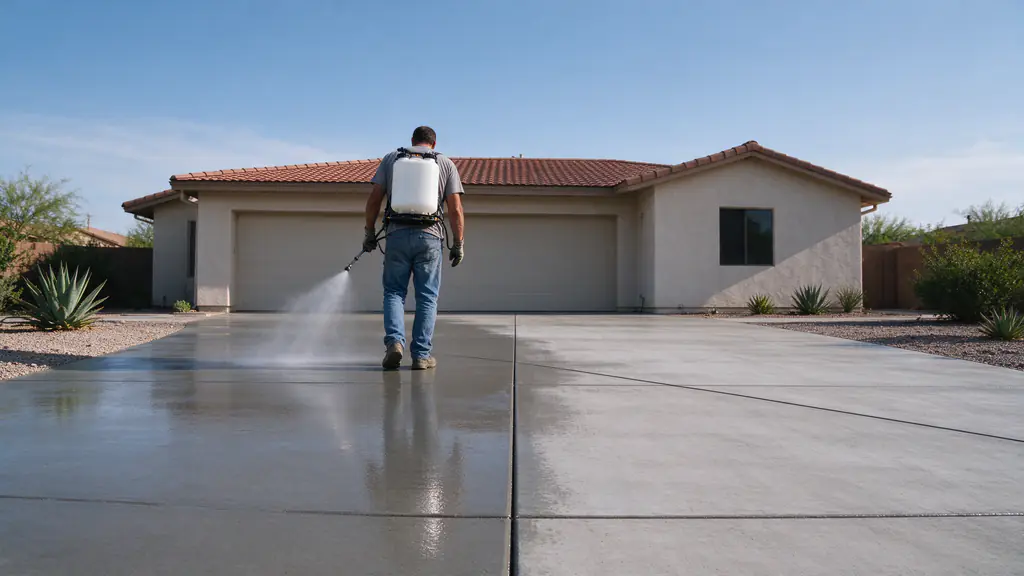
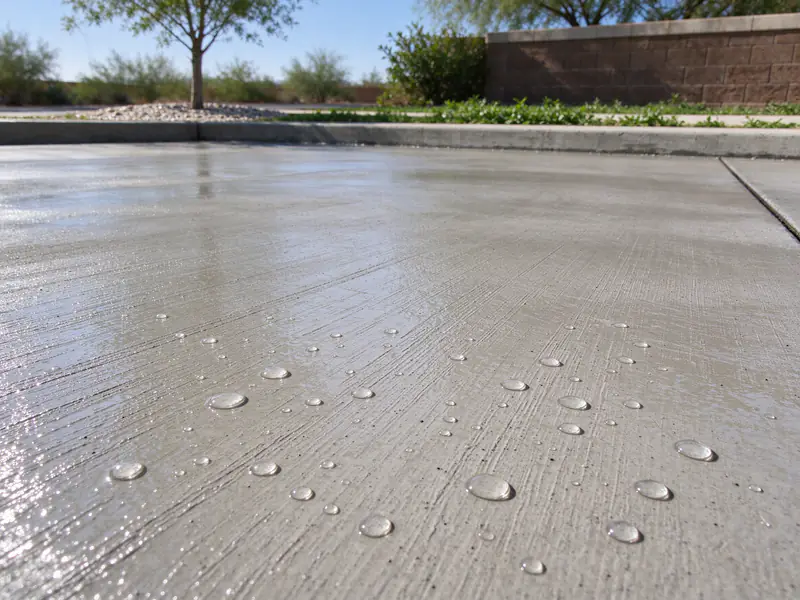
Water beading on a sealed concrete driveway surface in Tempe
Concrete or pavers looking tired? Get an Estimate.
Send photos of the drive, any stains and the joints if it is pavers. The estimate names the sealer, the area and anything to repair before sealing.
Does sealing a concrete driveway stop it from cracking?
No. Cracks come from shrinkage, soil movement and lost support under the slab, and a sealer works only on the surface. What it does is slow water, oil and dirt from soaking into the top of the concrete. Cracks are sealed separately with a flexible crack sealant, and a crack that keeps moving needs its cause fixed first.
Is concrete sealing the same as sealcoating?
No. Sealcoating is a black asphalt-based or coal-tar coating made for asphalt driveways, where it slows weathering of the binder. Concrete and paver sealers are clear or tinted acrylics and penetrating repellents made for cement and stone. Putting sealcoat on concrete stains it, and concrete sealers do nothing useful on asphalt.
Should a new concrete driveway be sealed right away?
Not with an ordinary sealer. Fresh concrete is still curing and giving off moisture, and a film sealer applied too soon can trap it and turn white. A curing compound, or a cure-and-seal product meeting ASTM C1315, can go on fresh concrete as part of the pour. A regular sealer waits until the slab has cured for the time its data sheet states.
Why do pavers turn white after sealing?
Two different things cause it. Sealer blush is moisture trapped under a film sealer that went on over damp pavers, too thick, or in high heat, and it is fixed by reactivating or stripping the sealer. Efflorescence is salt carried to the surface by moisture moving up through the pavers, and it shows as a white powder that is cleaned off before sealing, not sealed over.
Should pavers be re-sanded before they are sealed?
Where the joints have washed out, yes. Joint sand locks interlocking pavers together, and open joints let pavers shift and weeds grow. The joints are refilled, often with polymeric sand that firms up when wetted, and then the surface is sealed. Sealing over half-empty joints leaves the gaps open under a shiny surface.