111days a year reach 100°F or more at Sky HarborNOAA climate normals
0.6nights a year drop to freezing at Sky Harbor, so heat and water, not frost, drive most damageNOAA
June 15 to September 30 is monsoon seasonNational Weather Service
Phoenix treats up to 10.5 ft of concrete drive past a roll curb as on-site work, with no separate driveway permit
Concrete for a residential driveway in the Phoenix right-of-way is 6-inch Class A
Last Updated:
Driveway expansion joint repair replaces the failed filler in the gaps between concrete slabs with a flexible seal, so the slabs can still move and water, grit and weeds stay out. The joints are the part of a concrete driveway designed to give, and when their filler rots or packs with debris, the concrete around them starts taking damage instead. Sundial Driveway Repair is a service company offering and managing driveway expansion joint repair across Phoenix and the surrounding Valley, for homes and commercial properties, fulfilled by licensed and insured contractors.
Joint work is concrete-only. Asphalt has no designed joints, and the seam where an asphalt drive meets a concrete garage slab or apron is sealed as a crack; driveway crack repair covers that.
What happens on the first visit
The first visit looks at the whole drive: the surface, every joint, the edges, where water runs, and the transitions at the garage, sidewalk and street. Each joint is identified by type and checked for what is in it now: original wood or fiberboard, old sealant, sand, weeds or nothing. Joint edges are checked for chips and spalls, and the panels on each side are compared for height, since a step at a joint means a panel has moved and sealing alone won’t fix it. Cracks nearby are checked for width, offset and whether they cross panels.
The estimate names the work for each joint type, the total length and what the work excludes. If a joint turns out to hide a settled panel or soft base, that finding is explained before the joint work is priced, because sealing over a moving joint just tears the new sealant.
Control joints and expansion joints do different jobs
Control joints
A control joint is a groove saw-cut or tooled into the slab, usually a quarter of its depth, to make it crack in a straight line. Concrete shrinks as it dries and cures, and the shrinkage has to go somewhere; the groove weakens the slab at that line so the crack forms under it, out of sight, instead of wandering across the panel. A driveway’s panels are the spaces between its control joints. A crack running through a joint, below the groove, means the joint is working as designed. A crack crossing a panel away from the joints means the joints were too far apart, cut too late or too shallow, or the slab moved for some other reason. The guide to why driveways crack and sink traces those causes.
Expansion and isolation joints
An expansion joint, more precisely an isolation joint, is a full-depth gap between the driveway and something it shouldn’t be bonded to: the garage slab, the sidewalk, the curb, a wall or a column. It is formed when the concrete is placed, with a strip of compressible filler such as asphalt-impregnated fiberboard, felt or, on older drives, a wood board. Its job is to let each slab expand and settle on its own. Without it, a driveway expanding in the heat pushes against the garage slab or the sidewalk, and one of them cracks or lifts.
Why driveway joints fail in the Valley
Heat is the driving force. Concrete expands as it warms, roughly 1/16 inch over a 20-foot panel for a 50°F rise, and it does that every sunny day. At Phoenix Sky Harbor the normal July high is 106.5°F and 111 days a year reach 100°F or more (NOAA climate normals), so the joints open on cooler nights and close in the afternoon for much of the year. The guide to how heat affects driveways in Phoenix explains the mechanism further.
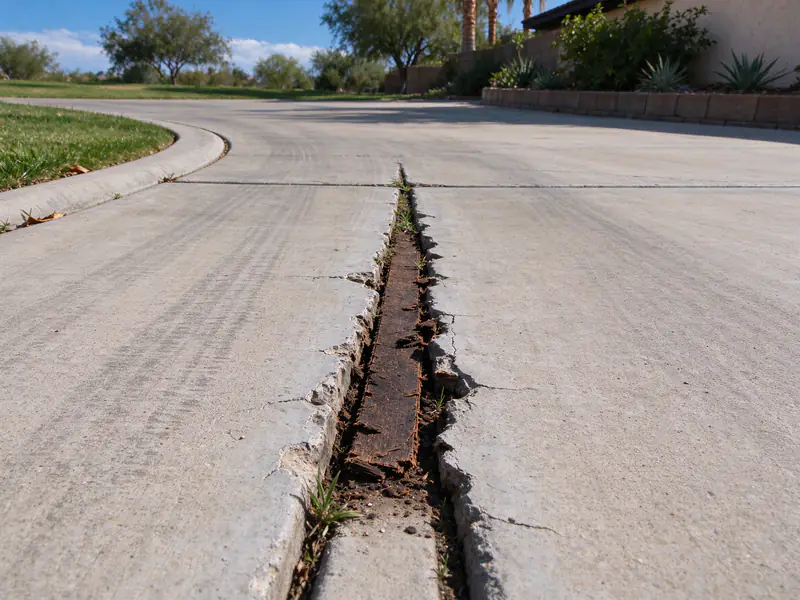
Original fillers don’t keep up. Wood boards rot where irrigation keeps them damp. Fiberboard and felt crumble, shrink back below the surface and leave an open slot. That slot fills with sand, grit and seed, and the trouble starts. When the slab expands against incompressible debris instead of soft filler, the force goes into the joint edges, which chip and spall. Water poured into an open joint by sprinklers or roof runoff reaches the base, and in clay soils that wets and dries the ground under the joint unevenly. In USDA soil survey samples, more than three of every four points in Gilbert and Chandler show moderate or higher shrink-swell clay, so a joint that passes water can become a joint with a step.
How a joint is repaired
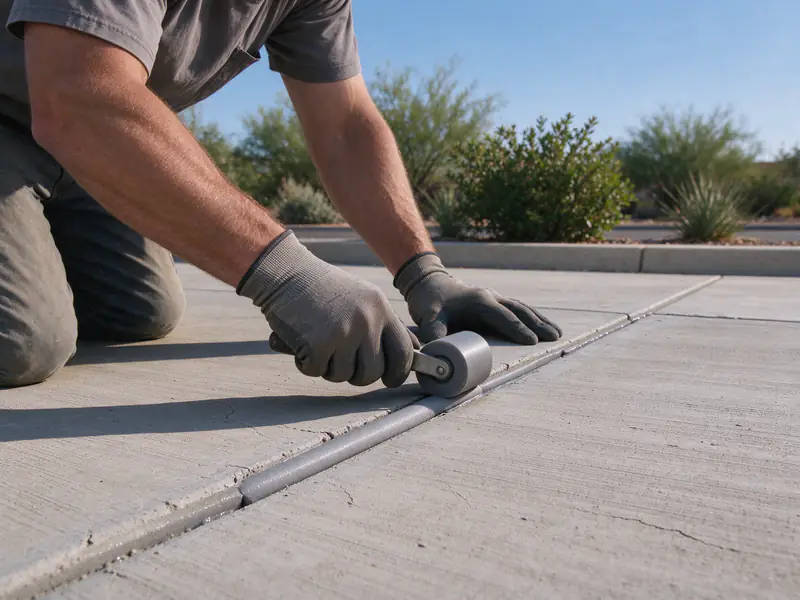
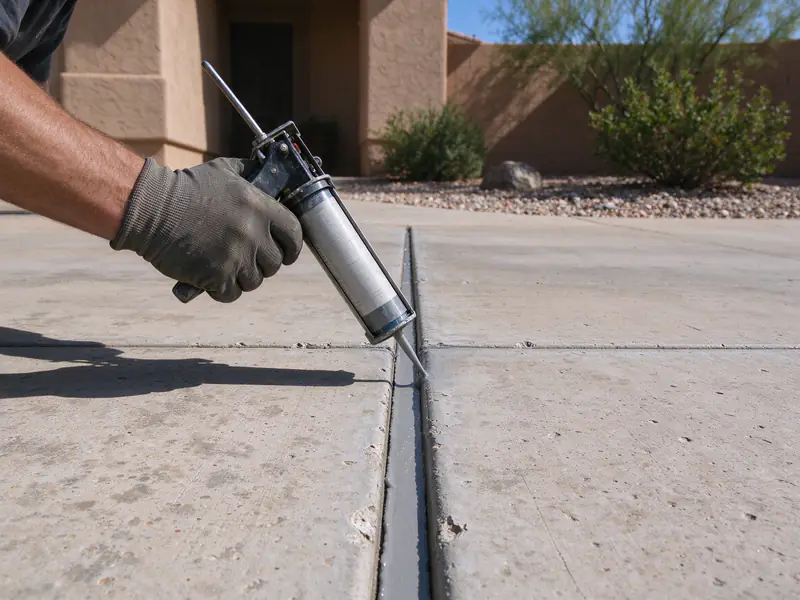
The old filler comes out first. Wood and fiberboard are cut and pulled, old sealant is cut free, and the joint is cleaned with a wire wheel or saw so the faces are sound, dry concrete. A closed-cell foam backer rod, slightly wider than the joint, is pressed in to set the depth. The rod does two things: it stops the sealant from bonding to the bottom, so it only grips the two faces and can stretch between them, and it keeps the sealant from being too deep to flex. An elastomeric sealant meeting ASTM C920, usually polyurethane or silicone, is then placed. Self-leveling grades are poured on flat joints; non-sag grades are tooled on sloped ones. The bead finishes just below the surface so tires and brooms don’t catch it, and tape keeps the concrete beside it clean.
Mortar, concrete and rigid patching compounds don’t belong in a movement joint. They bond the slabs together and remove the joint, and the next heat cycle cracks the concrete beside it. Chipped edges are repaired with a patching compound first, then the joint is re-formed and sealed. Sealant ages in the sun and will need renewing at some point, which is ordinary maintenance.
When joint repair isn’t the whole job
A step at a joint means a panel settled or heaved, and the support has to be dealt with first. A sound panel that dropped can be raised with driveway leveling; a small, stable lip can be removed by trip hazard grinding; a broken panel is replaced, as concrete driveway repair explains. Joint sealing comes last in each case.
The joint between the driveway and the sidewalk may sit in the street right-of-way. In Phoenix, City Code makes the owner of a lot abutting a sidewalk responsible for keeping it in repair, and the guide to who is responsible for the driveway apron covers that strip. Sealing a concrete driveway’s surface is a separate service; driveway sealing covers sealers and how they relate to joints.
Cost and payment notes
Joint repair is priced from the length of joint and what each one needs, so there is no single per-foot figure that fits every drive. Wide isolation joints use more backer rod and sealant than saw-cut control joints, removing old wood or fiberboard adds time, spalled edges add patching, and a short list of joints is usually set by a minimum charge. The driveway repair cost guide explains how small repairs are priced. Concrete joint work falls under Arizona’s R-9 and C-9 concrete classifications, and whether insurance pays for any repair depends on the policy and the cause. When you’re ready, ask for an estimate.
VIIVIVIVIIIIII
02
What's included
A look at every joint in the drive: control joints, and isolation joints at the garage, sidewalk and curb
Removal of rotted wood, fiberboard or felt filler, weeds and packed grit
Cleaning the joint faces back to sound concrete so the sealant can bond
Closed-cell backer rod sized to the joint width
Elastomeric sealant tooled or self-leveled just below the surface
A note in the estimate of any spalled joint edge that needs patching first
VIIVIVIVIIIIII
03
Driveway joint repairs compared
Driveway joint repairs compared: what each fixes, what it leaves, and how it is priced
Repair
Best for
Won't fix
How it's priced
Replace failed filler with backer rod and sealant
Isolation joints with rotted wood, crumbling fiberboard or missing filler
Panels that have dropped or tilted at the joint
By the linear foot of joint, after measuring width and depth
Seal open control joints
Saw-cut joints that collect grit and let water reach the base
Cracks running across panels away from the joints
By the linear foot, often grouped with other joints
Patch spalled joint edges, then seal
Joint edges chipped by debris or traffic
A slab still moving at the joint
Per job after measuring the damaged length
Lift or replace a panel, then seal
Joints with a step where a panel has settled
Nothing structural once the support is rebuilt
Lifting or section replacement rates, plus the joint work
04
Related resources
Guides that go deeper on expansion joint repair decisions in the Valley.
The physics of a slab that grows and shrinks every day, why heat does its worst damage to concrete in the first hours, how asphalt binder softens and ages under Valley sun, and what owners can do through a long summer.
Typical Phoenix-area and national budgeting ranges for each kind of driveway repair, what is inside the price, the City permit fees, and worked example budgets.
05
How the work runs
First call or estimate request
Describe the surface, what changed and roughly where the property is. Photos of the damage and the street edge help. The published ranges give you a budget to think about before any visit.
A look at the whole driveway
The visit looks at more than the damaged spot: the slab or asphalt, the joints and edges, where water runs, and the transitions at the garage, sidewalk and street. The damaged area is measured, and anything found that changes the scope, such as soft base or caliche, is explained in the estimate.
Work timed for the heat
Hot-weather practice from the American Concrete Institute caps concrete at 95°F at discharge for general work, so summer pours are planned for the cooler part of the day. Where the job crosses into the street right-of-way, the city's permit is part of the scope.
Cure and handover
How long the car stays off depends on the material and the temperature. That wait is set out before the work starts, so you can plan around it.
VIIVIVIVIIIIII
06
What this work looks like
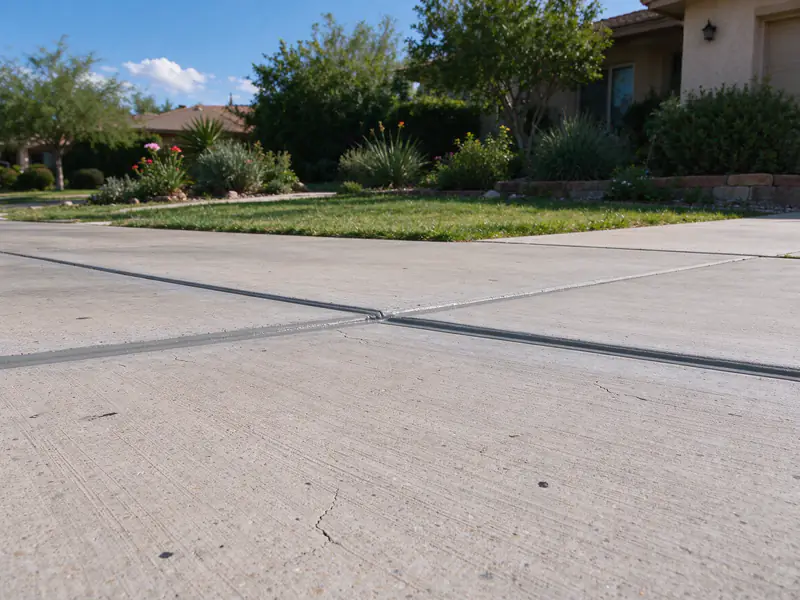
Deteriorated fiberboard expansion joint with weeds in a Chandler driveway
Foam backer rod being rolled into a driveway expansion joint in Chandler
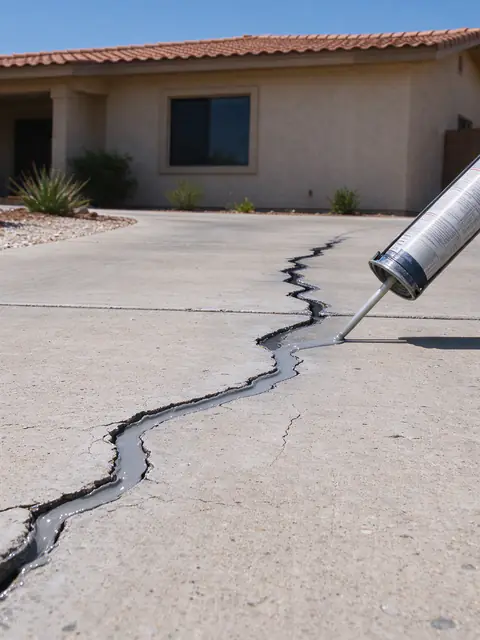
Self-leveling sealant being applied to a driveway expansion joint in Chandler
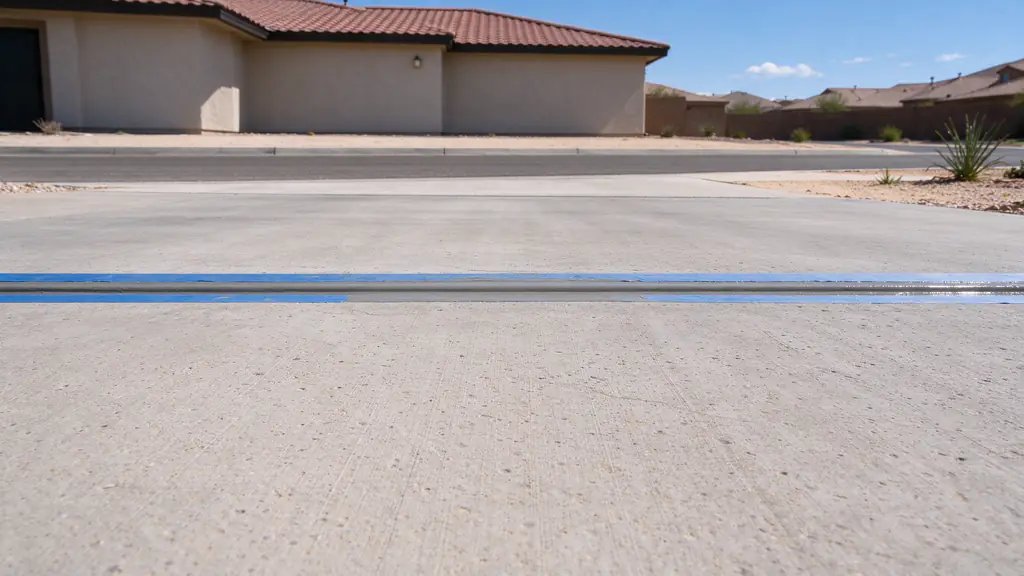
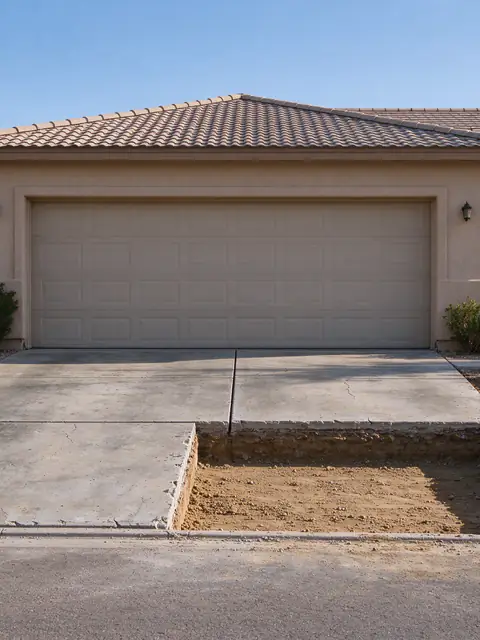
Finished gray sealant expansion joint between a Chandler driveway and sidewalk
Joints rotted or full of weeds? Get an Estimate.
Send photos of the joints at the garage, sidewalk and curb, and rough lengths. The estimate lists each joint, what it needs and any edge repair first.
What should replace a rotted wood expansion joint in a driveway?
The wood comes out completely, down to sound material or the base. The joint is cleaned, a closed-cell foam backer rod is pressed in to the right depth, and an elastomeric sealant is placed over it. That combination stays flexible, keeps water and weeds out, and can be cut out and renewed later without damaging the concrete.
How do you fill the gap between the garage floor and the driveway?
That gap is an isolation joint, and it is meant to stay flexible. The old filler is removed, the faces are cleaned, backer rod is set below the surface, and a self-leveling sealant is poured over it. Filling it with mortar or concrete locks the two slabs together, and the next hot spell can crack one of them.
Should the control joints in a driveway be sealed?
It depends on the joint and where water goes. An open saw-cut joint collects sand and grit, and where sprinklers or roof water cross the drive, it also lets water into the base. Sealing those joints keeps both out. A narrow tooled joint on a slab that sheds water well can be left open and kept clean.
Why are weeds growing in my driveway joints?
Because the filler has failed and soil and seeds have washed into the space. Weeds are a sign that the joint is also passing water down to the base. Pulling them treats the surface; removing the old filler, cleaning the joint and sealing it is what stops them returning.
How is driveway joint repair priced?
By the length of joint, adjusted for what each joint needs. Wide isolation joints take more backer rod and sealant than narrow saw cuts, removing old wood or fiberboard takes time, spalled edges need patching before sealing, and small jobs carry a minimum charge. The estimate lists each joint type, its length and the work it gets.