111days a year reach 100°F or more at Sky HarborNOAA climate normals
0.6nights a year drop to freezing at Sky Harbor, so heat and water, not frost, drive most damageNOAA
June 15 to September 30 is monsoon seasonNational Weather Service
Phoenix treats up to 10.5 ft of concrete drive past a roll curb as on-site work, with no separate driveway permit
Concrete for a residential driveway in the Phoenix right-of-way is 6-inch Class A
Last Updated:
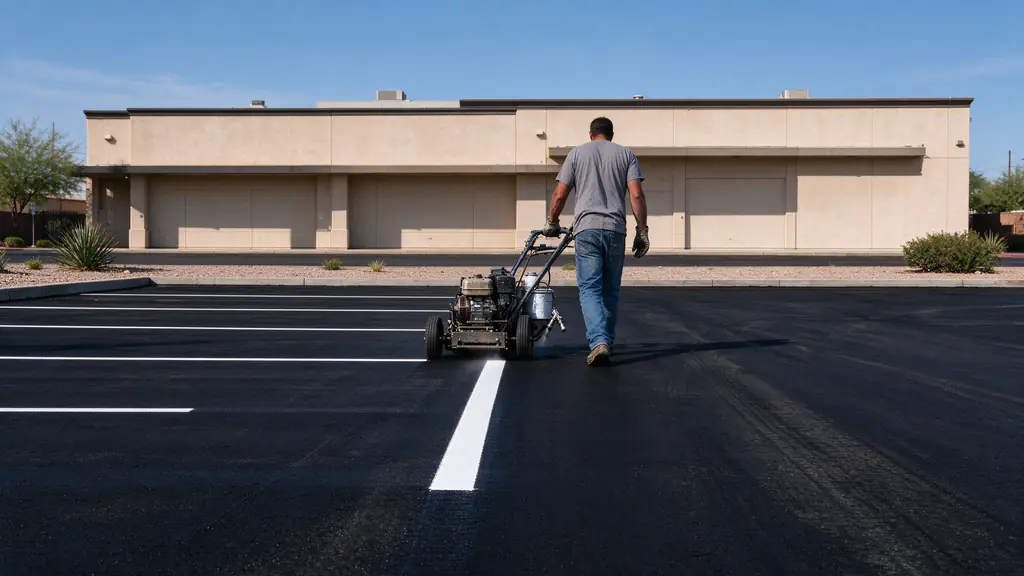
Parking lot striping in Phoenix, AZ, paints the lines and markings that organize a lot: stall lines, drive arrows, stop bars, crosswalks, fire lane markings and the lines and symbols for accessible spaces. Striping work comes in two kinds. Restriping puts an existing layout back on pavement where the lines have faded or been covered by sealcoat; a new layout re-measures the lot to a changed plan. Sundial Driveway Repair is a service company offering and managing parking lot striping across Phoenix and its suburbs, for retail, office, HOA and multifamily properties, and the work is fulfilled by licensed and insured contractors.
Striping is the last step of lot maintenance, not the first. Lines painted over potholes and alligator cracking break up with the pavement, so failing areas are repaired first, as the parking lot repair page explains, then the lot is sealed with sealcoating, then it is striped. Each step protects the one before it: the repairs give the coating a sound base, and the coating gives the paint a clean, even surface to grip.
What happens on the first visit
The first visit walks the lot rather than counting stalls from an aerial photo. It looks at the surface, the joints and edges, where water runs, and the transitions at entrances, curbs and sidewalks, because striping over cracked, ponding or raveling pavement wastes paint. It checks the existing lines against the property’s layout: worn arrows, ghost lines from an older layout, and accessible spaces whose markings have faded.
The estimate names the work, the area, any part in the street right-of-way and what it excludes. If the surface needs repair before it can be striped, that finding and its effect on the scope are explained first. When the lot is being sealcoated, the estimate also states the wait between the sealcoat and the paint.
Restriping and new layouts
Restriping an existing layout
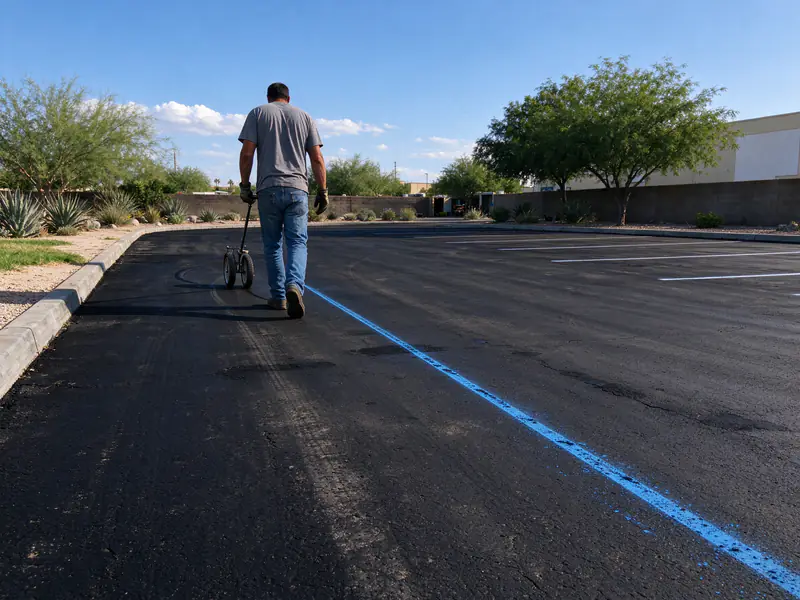
On a lot whose layout still works, restriping follows the old lines. Where the lines are still visible, they are retraced. After a sealcoat covers them, the layout is measured back out from fixed points such as curbs, light poles and islands, using a measuring wheel and chalk lines, so the new lines land where the old ones were. Stencils go down for arrows, stop bars and symbols.
Changing the layout
A new layout changes stall widths, angles, aisle directions or the number of spaces. That is more than paint. The City of Phoenix’s Parking Requirements Guideline requires parking areas to be striped and sizes accessible spaces under Zoning Ordinance Section 702.6, so changing stall counts or moving accessible spaces can touch the zoning parking requirements a site was approved under. Any layout change follows the property’s approved plan, or a revised plan the owner gets approved; striping itself doesn’t decide what the layout should be. Rules for other cities, including Mesa and Chandler, are confirmed per address.
Removing old lines
Lines a new layout no longer uses have to disappear, or drivers follow them. They are blacked out with a coating that matches the pavement, or they disappear under a full sealcoat. That is one reason to time a layout change with sealcoating, which the sealcoating guide covers.
Accessible parking as context
Accessible spaces are the most rule-bound part of any lot. Phoenix applies Zoning Ordinance Section 702.6, under which accessible spaces are 11 feet wide by 18 feet deep with a 5-foot access aisle and are signed with the international symbol of accessibility. The U.S. Department of Justice’s 2010 ADA Standards for Accessible Design set the number of accessible spaces (Section 208) and their dimensions and access aisles (Section 502). This is context, not a compliance service: whether a lot’s layout meets those rules is a design and code question for the owner, a design professional and the city. Restriping is a good time to check that the spaces, aisles, symbols and signs still match the plan, and that the route from them to the building hasn’t been broken by cracked or heaved pavement.
Paint, surface and weather
What the lines are made of
Waterborne traffic paint is used for stall lines; it goes on with a striping machine and dries quickly. Reflective glass beads can be dropped into wet paint where lines need to show at night. Preformed thermoplastic markings are heated and fused to the pavement and are much thicker than paint, which suits crosswalks, stop bars and symbols in heavy-wear spots. The choice is named in the estimate.
Why the surface matters
Paint holds only as well as what it is stuck to. On oxidized, gray asphalt, the surface itself is crumbling at a fine scale, and lines lose grip with it. Dust, oil and loose grit under the paint do the same. Fresh sealcoat gives an even black surface and the sharpest contrast, but it has to cure before paint goes on; how long depends on the product, coat thickness, temperature and humidity. Sealcoat is a protective coating, not resurfacing, and it doesn’t fix cracks. The sealcoating cost guide covers that side of the job.
Working around Phoenix weather
Sky Harbor averages 111.3 days a year at 100°F or hotter (NOAA climate normals). Heat and sun are what fade lines in the first place, and they also shorten the working window for paint and sealcoat on summer afternoons. Monsoon season, June 15 to September 30 under the National Weather Service definition, brings dust storms and sudden rain that can ruin wet paint, so striping is scheduled around the forecast. Closures can be planned in sections so the business keeps some parking open, and the commercial driveway repair page covers how entrances are handled at the same time.
Licensing, cost and payment notes
The Arizona Registrar of Contractors includes painted marking symbols in the A-15 seal coating class, and residential striping falls under R-13; A-14 commercial asphalt paving covers the A-15 scope too. The ROC lookup guide shows how to check a license before work starts.
No published price range fits parking lot striping, so it is quoted from the lot. What moves the number: total linear feet of line, the number of stalls, arrows, stencils and symbols, whether the layout is retraced or measured new, blacking out old lines, paint versus thermoplastic, the number of coats, surface cleaning, phasing the lot so it stays partly open, after-hours work, and a minimum charge on small lots. Striping bundled with sealcoat and repairs shares one mobilization. The Arizona Department of Revenue’s contracting rules decide how tax is built into the price; that is general information, not tax advice. To start with the pavement, see parking lot repair, or ask for an estimate.
VIIVIVIVIIIIII
02
What's included
A walk of the lot to check the surface, the existing lines and the site's layout
Cleaning loose dirt and debris from the line paths before painting
Layout by measuring wheel and chalk line, either retracing the existing lines or following the property's plan
Stall lines, drive arrows, stop bars, crosswalks and stenciled markings
Accessible-space lines and symbols placed where the property's layout shows them
Blacking out old lines that a new layout no longer uses
VIIVIVIVIIIIII
03
Parking lot striping jobs compared
Parking lot striping jobs compared: what each involves and what to check
Job
What it involves
Watch for
Price basis
Restripe over existing lines
Repainting the same layout on a lot whose lines have faded
Ghost lines and worn stencils that no longer match the plan
Drivers only; quoted by linear feet and markings
Restripe after sealcoat
Laying the layout back out on fresh black sealcoat
Sealcoat cure time before paint goes on
Drivers only; quoted with the sealcoat or separately
New or changed layout
Re-measuring stalls, aisles and markings to a new plan
Changes to stall counts and accessible spaces need the property's approved plan
Drivers only; layout time added
Markings only
Arrows, stop bars, fire lane or crosswalk markings without full restriping
Matching the existing line color and style
Drivers only; quoted per marking
04
Related resources
Guides that go deeper on lot striping decisions in the Valley.
What a sealcoat does to asphalt under Valley sun, the driveways it helps and the ones it can't, how to time it around heat and monsoon storms, and what to check before paying for it.
What sealcoating a residential asphalt driveway costs as a national budgeting example, what crack filling and patching add, what drives commercial lot pricing, and what sealcoat can and can't do for the money.
Which license classes fit each kind of driveway work, when the small-job exemption applies and when it doesn't, and what to check besides the license itself.
05
How the work runs
First call or estimate request
Describe the surface, what changed and roughly where the property is. Photos of the damage and the street edge help. The published ranges give you a budget to think about before any visit.
A look at the whole driveway
The visit looks at more than the damaged spot: the slab or asphalt, the joints and edges, where water runs, and the transitions at the garage, sidewalk and street. The damaged area is measured, and anything found that changes the scope, such as soft base or caliche, is explained in the estimate.
Work timed for the heat
Hot-weather practice from the American Concrete Institute caps concrete at 95°F at discharge for general work, so summer pours are planned for the cooler part of the day. Where the job crosses into the street right-of-way, the city's permit is part of the scope.
Cure and handover
How long the car stays off depends on the material and the temperature. That wait is set out before the work starts, so you can plan around it.
VIIVIVIVIIIIII
06
What this work looks like
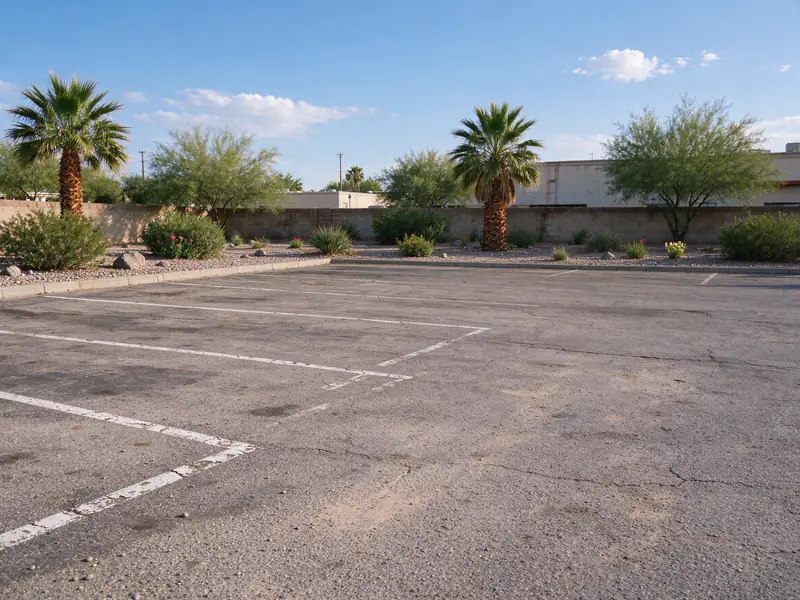
Faded white stall lines on an old asphalt parking lot in Mesa
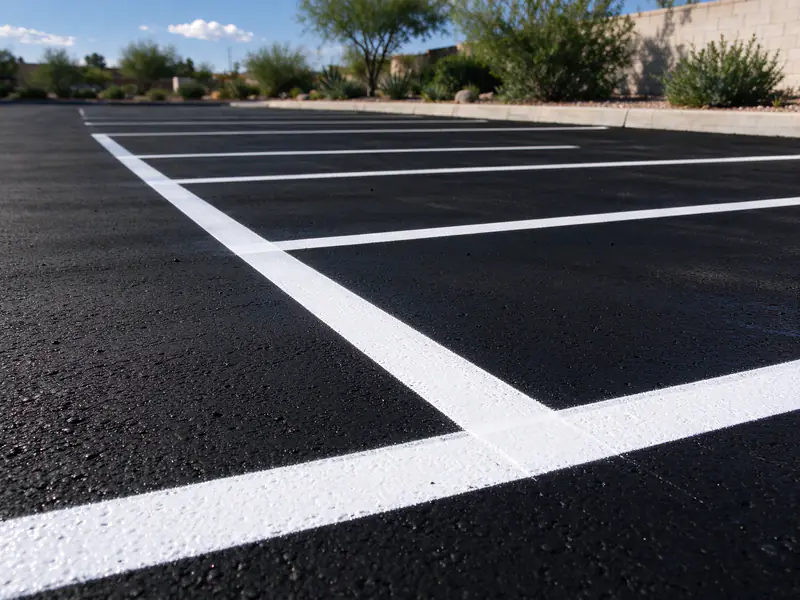
Crisp fresh white stall lines on new black sealcoat in Mesa
Measuring wheel and chalk line layout on a sealcoated Mesa parking lot
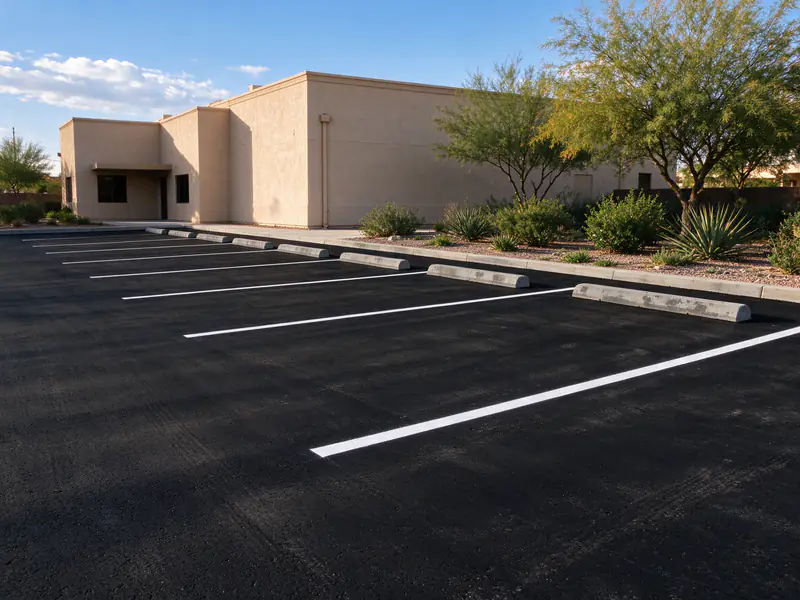
Finished sealcoated and striped parking lot with concrete wheel stops in Mesa
Faded lines or a new layout? Get an Estimate.
Send an aerial photo or site plan, the stall count and the hours the lot can close. The estimate names the layout, the markings, the paint and the wait after any sealcoat.
Can old parking lines be painted over for a new layout?
Not by simply painting new lines beside them. Old lines that stay visible confuse drivers, so they are blacked out with a coating that matches the pavement, or covered when the whole lot is sealcoated before restriping. On a lot that isn't being sealcoated, the blackout patches can show in some light, which is one reason to time a layout change with a sealcoat.
How soon after sealcoating can a parking lot be restriped?
Once the sealcoat has cured enough to take paint, which depends on the product, the coat thickness, the temperature and the humidity, so there is no single number. Painting too early can trap moisture and leave lines that peel. The estimate states the wait for the products being used, and it is planned into the closure time for the lot.
Does restriping make a parking lot ADA compliant?
No. Striping puts on the pavement the layout the property's plan shows; whether that layout meets the 2010 ADA Standards for Accessible Design and Phoenix's Zoning Ordinance Section 702.6 is a design and code question for the owner, a design professional and the city. Restriping is a chance to check that the accessible spaces, aisles and signs are still where the plan says.
What makes parking lot lines fade?
Sun breaks down the paint's binder, tires scrub the lines where cars turn into stalls, and dust and grit wear the surface. Lines painted on dirty or oxidized asphalt also lose grip sooner. Paint over a fresh sealcoat bonds to a clean, even surface, and high-wear markings such as crosswalks can use thermoplastic, which is applied thicker and lasts longer than paint.
What helps get an accurate parking lot striping estimate?
A site plan or aerial photo, the number of stalls, and photos of the current lines and markings. Note whether you want the same layout or a new one, whether the lot is being sealcoated first, and any markings to add, such as fire lanes or crosswalks. Include the hours the lot can close, since striping can be done in sections.