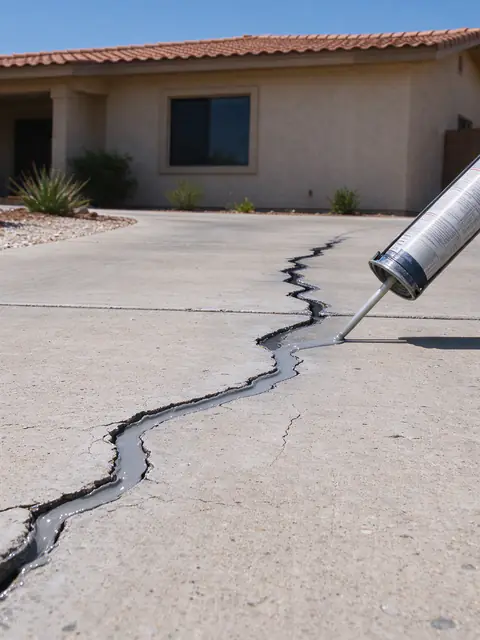
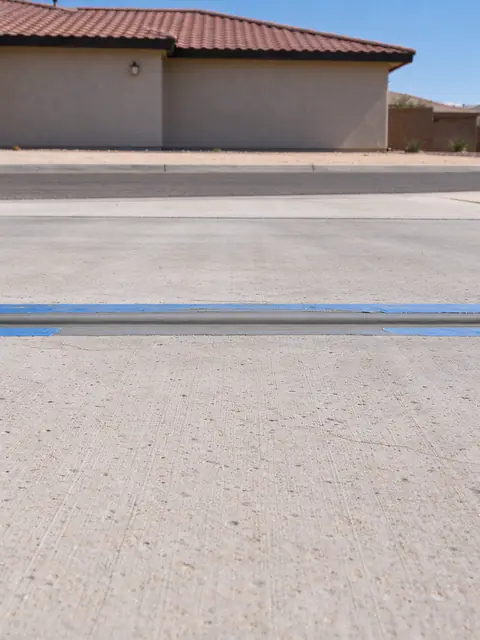
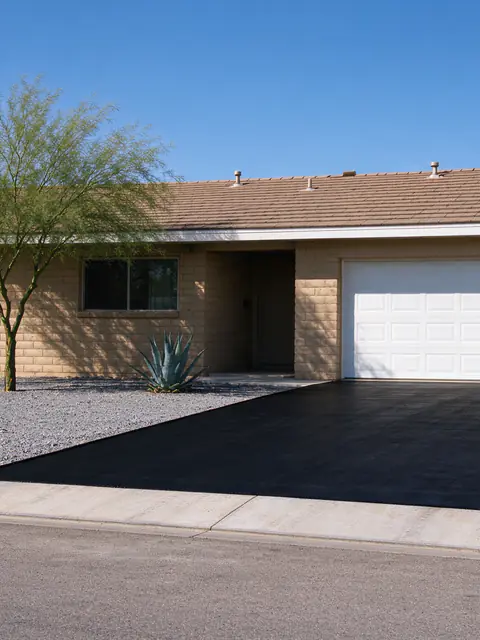
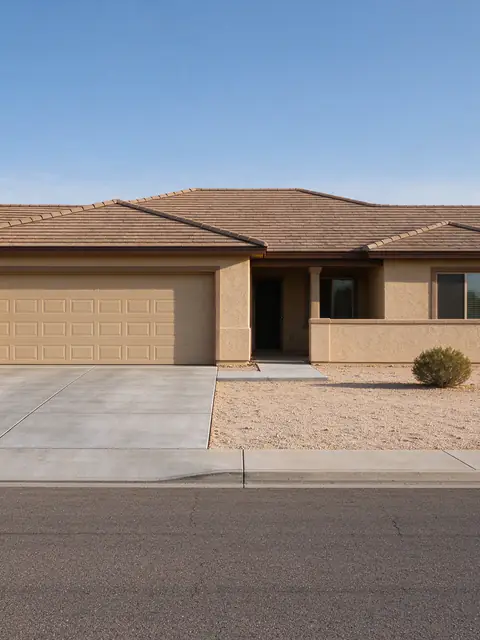
On an older slab, the joint material between panels dries out and falls away, and water then runs straight into the base along every joint. Cleaning the joints and refilling them with a flexible sealant is a small job that keeps a sound driveway from getting worse.
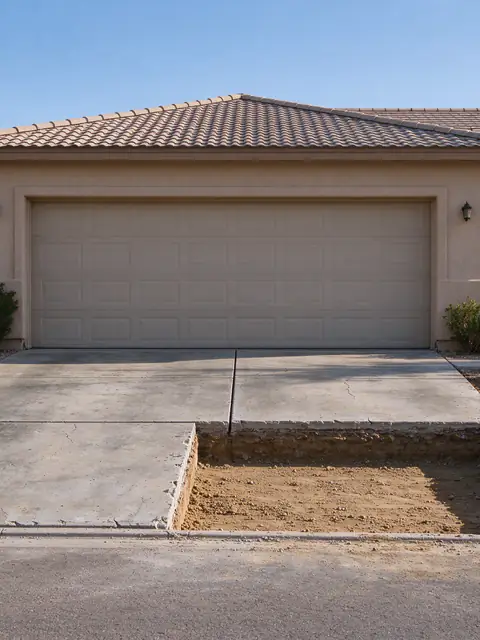
A panel that tipped toward the street
Clay loam expands as it takes on water and contracts as it dries, so a panel can settle or tip where water collects, such as beside the garage or at the apron. If the panel is whole, it can be lifted back to grade. If it has cracked through, it is saw-cut at the joints and repoured over a rebuilt base.
Cracks across most of the drive
When cracks cross most panels, edges are crumbling and the base is soft in several places, patching one area at a time stops making sense. A full replacement rebuilds the base and slab together, and the estimate compares it with repairing the worst sections first.
Cars parked on a dirt strip beside the drive
Phoenix doesn't allow vehicles to be parked or stored on a surface that isn't dust-free. On a single-family lot, a smooth layer of crushed rock or gravel at least 3 inches deep inside a permanent border qualifies, and so does concrete or asphalt. Widening onto that strip is a choice between the two, and rear yards are exempt.
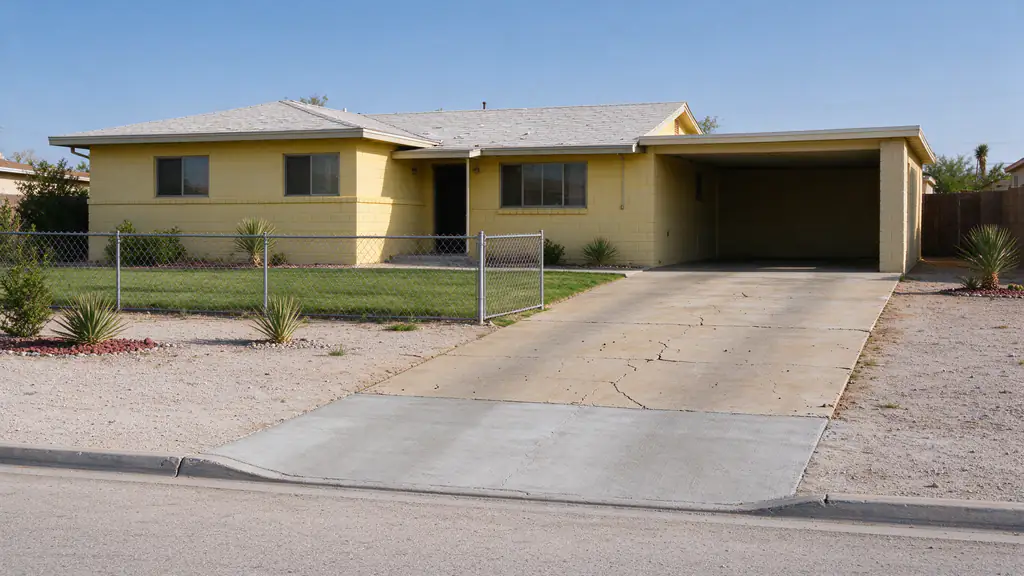
More than half of the homes in Maryvale were built before 1980, and two-thirds of this City of Phoenix village’s sampled soil points carry moderate or higher shrink-swell clay. Put together, driveway repair in Maryvale means working with slabs that have spent decades moving on clay. Sundial Driveway Repair is a service company offering and managing driveway repair in Maryvale and across the Phoenix area, for homes and commercial properties, and the work is fulfilled by licensed and insured contractors.
Old slabs on clay loam
By tract-level Census estimates, 52.1% of Maryvale’s 66,268 housing units date from before 1980 and 15.7% from before 1960, while only 19.0% are newer than 1999; 71.3% are single-family detached. Of the USDA NRCS sample points inside the village, 66.7% fall on soils with moderate or higher shrink-swell, chiefly Glenbar clay loam and Avondale clay loam, and none show a cemented layer. Clay takes on water and swells, then dries and shrinks, so an older slab here has moved through a great many cycles. Where a house keeps its original drive, that history shows as cracks that cross panels, joints that have opened and panels that tip.
None of that proves a defect in one driveway. It does explain why a Maryvale estimate checks support before surface. Narrow, stable cracks suit driveway crack repair, and opened joints suit expansion joint repair, which keeps water out of the base. The cracking and sinking guide explains the mechanisms in full.
What “flooding” means in a soil survey
The soil survey’s road ratings flag flooding at 37.3% of Maryvale points, low strength at 33.3% and shrink-swell at 29.4%. The flooding rating describes soils that formed where water spreads and stands, not a FEMA flood zone, and it says nothing about insurance. For a driveway, it means a base that drains slowly and loses strength when wet, so water from roofs and sprinklers has more effect than it would on sandier ground. A whole panel that dropped can be lifted through driveway leveling, and the leveling cost guide gives the ranges. A broken one is replaced as concrete driveway repair on new, compacted base.
Aprons and sidewalks under City of Phoenix code
Maryvale is part of the City of Phoenix, so the City’s single-family driveway policy applies. A short concrete run, 10.5 feet or less, can cross the right-of-way behind a rolled or ribbon curb as part of the on-lot job; anything longer, or any street without curb, takes a driveway permit. Under Section 31-54 of the City Code, the walk in front of the lot is the owner’s to keep in repair, and a Street Transportation notice can set the timing. Where cars park beside the drive, the City’s dust-free parking rule decides whether rock or concrete goes there, and gravel driveway replacement covers that conversion. The Phoenix driveway permit guide and the apron responsibility guide cover the details, and apron repair is the work itself.
Fix, lift or replace
On the visit, every panel gets a look, along with the joints, the edges, where roof and sprinkler water goes, and how the slab meets the garage, the sidewalk and the street. Each crack is measured for width and offset and traced to see whether it runs into the next panel, and tapping finds hollow spots under the slab. When repairs no longer hold, the repair or replace guide helps weigh driveway replacement. The Glendale and Central Phoenix pages cover nearby areas.
An older driveway in Maryvale? Get an Estimate.
Send a wide photo of the drive, close photos of the cracks and joints, and the curb edge. Note any spot where water stands after a storm.
The shaded disc marks the general service area around the area’s center, not an office or job site. Open Maryvale, AZ in Google Maps
VIIVIVIVIIIIII
05
Maryvale driveway questions
Why do older Maryvale driveways crack across several panels?
One likely reason is that the ground has moved under them for decades. USDA soil samples put two-thirds of Maryvale village points in moderate or higher shrink-swell soils, led by Glenbar and Avondale clay loams. Every wetting and drying lifts and drops the slab a little, and once joint filler fails, water reaches the base along every joint. Cracks that cross panels are a sign the support has changed, not just the surface.
Does the soil survey's flooding rating mean my Maryvale lot floods?
No. The USDA soil survey rates 37.3% of Maryvale points as limited by flooding for roads, which describes how those soils formed and how they behave when wet, not a mapped flood zone. FEMA's flood map decides flood-zone status, and you can look up your own address there. For a driveway, the soil rating points to slow drainage and soft base when wet.
What does it cost to lift or replace a driveway slab in Maryvale?
Lifting a settled panel by mudjacking typically runs about $4 to $10 per square foot in the Phoenix area, and jobs carry a minimum of several hundred dollars. Cutting out and repouring a broken section runs about $10 to $15 per square foot. Resealing open joints is priced by the foot after measuring, and a City right-of-way permit, where one is needed, starts at Phoenix's $195 residential minimum.
Will a new apron on a Maryvale house be built differently from the old one?
If the old one is original, it may be. A rebuilt apron in Phoenix's right-of-way is 6 inches of Class A concrete, and the City's parking guideline requires an accessible walkway across every driveway with a cross slope no steeper than 50:1, which an original apron may not meet. Whether the job also needs a separate driveway permit turns on the curb type and how far the concrete runs.
Is it worth replacing an original driveway on a Maryvale house?
Only if repairs no longer hold. A slab with scattered cracks, level panels and a firm base is a good candidate for sealing and patching, even if it is decades old. Replacement makes sense when cracking crosses most panels, several areas have sunk or heaved, or the base is soft throughout. The estimate prices both paths so you can compare them.
The signs that point to a repair, the ones that point to a new driveway, the middle option of replacing sections, and the Phoenix soil, water and right-of-way rules that tip the choice.
What mudjacking and polyurethane foam lifting cost per square foot, why small jobs price as a minimum, what drainage and joint work add, and where lifting stops being the cheaper choice.
How the City's Driveway Policy for Single Family Development and its right-of-way fee schedule decide whether your driveway job needs a permit, and what it costs when it does.
The apron usually sits on public land, yet the repair often falls to the homeowner. Here is how ownership, upkeep and permits split between you, the city and anyone who dug it up.