The apron usually sits on public land, yet the repair often falls to the homeowner. Here is how ownership, upkeep and permits split between you, the city and anyone who dug it up.
Last Updated:
Short answerThe apron, the curb beside it and often the sidewalk crossing usually sit in the city's right-of-way, but the abutting homeowner is often the one expected to keep them in repair. In Phoenix, City Code puts sidewalk upkeep on the abutting owner. Any repair there needs the city's right-of-way permit.
Who is responsible for driveway apron repair is a two-part question: who owns the ground, and who has to keep it in repair. The answers are often different. Sundial Driveway Repair is a service company that offers and manages driveway apron repair in Phoenix and across the Valley, with the work fulfilled by licensed and insured contractors, and sorting out this boundary is the first step of any apron job.
What counts as the apron?
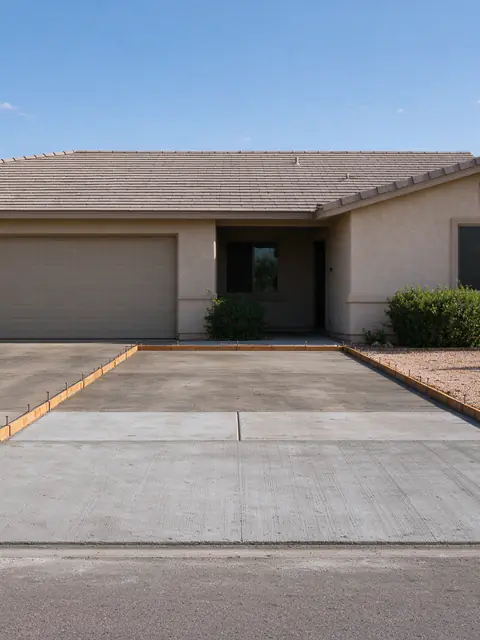
The apron is the stretch of driveway between the sidewalk, or the property line where there is no sidewalk, and the street. It ramps down to the gutter, meets the curb and carries every car that turns into the drive. Around it sit three other pieces that the same question touches:
The curb and gutter, which may be a vertical curb with a cut for the drive, a low roll curb, or a flat ribbon curb.
The sidewalk crossing, the section of public walk that runs across the drive, either attached to the curb or set back from it.
The right-of-way line, the edge of public land. The plat for your lot shows where it falls, and it often sits behind the sidewalk, so your lot may begin a few feet inside where the concrete changes.
Who owns the apron?
In a typical public-street subdivision, the city does: the apron, curb, gutter and sidewalk crossing sit inside the dedicated right-of-way. That is why the City of Phoenix’s Driveway Policy sets the concrete for residential drives in the right-of-way at 6 inches thick, Class A where the street has no curb, and why work there needs the City’s permit beyond the 10.5-foot allowance on roll and ribbon curb streets. The Phoenix driveway permit guide covers those rules.
The exception is a community with private streets. There, an HOA may own the street, and possibly the curb and apron with it. The CC&Rs and the plat say who holds that land, and the HOA driveway rules guide explains how associations handle it.
Who has to keep it in repair?
This is where ownership and responsibility split. Phoenix’s City Code makes the owner or lessee of any lot abutting a sidewalk responsible for keeping it in repair (Sec. 31-54), and liable for injury from a defect left unrepaired (Sec. 31-55). If the owner doesn’t act after the Street Transportation Director gives notice, the City can make the repair and charge it as a lien (Sec. 31-56), and costs unpaid after 45 days go to the Maricopa County Assessor and onto the tax roll (Sec. 31-57).
The code speaks of sidewalks. Whether the City treats the apron and curb at a given address the same way is confirmed with Phoenix’s Street Transportation Department before any work is priced as yours. In practice, the apron moves with the drive: when you replace or widen a driveway, the apron is part of that job and its permit.
Other cities set their own rules. Peoria’s code compliance rules require sidewalks, driveways and similar areas to be kept in a proper state of repair, and raised, sunken or cracked sidewalk slabs are reported to its Streets Division. For Scottsdale, Mesa, Tempe, Chandler, Gilbert and Glendale, who repairs the sidewalk and apron is confirmed per address with the city, and it is worth asking before you pay for anything.
What if someone else damaged it?
The cause changes who pays.
Cause
Who usually restores it
A utility or contractor cut the apron or sidewalk for a line
The party that did the work, under its own right-of-way permit
City street or sidewalk work broke the apron
The City’s project; report it to the city
Age, settlement or heavy vehicles on your drive
Usually the owner, as part of driveway upkeep
Roots from a tree in the right-of-way
Depends on whose tree it is; confirmed with the city
Permit conditions show how this works. The Town of Paradise Valley’s right-of-way permit conditions require a full removal and replacement of the panel or driveway whenever a utility pothole falls inside a sidewalk or driveway. Phoenix and other cities set their own restoration conditions. Photograph the damage before and after any outside work, and report it to the utility or the city’s right-of-way office. Where a street tree’s roots lifted the apron, the tree roots guide covers what can be done.
What does a repair in the right-of-way involve?
A permit, a contractor allowed to do the work, and a city standard to build to. Mesa issues right-of-way permits only to contractors licensed by the Arizona Registrar of Contractors with insurance on Mesa’s certificate form, and builds residential aprons to its M-1211 details. Chandler issues encroachment permits for construction in the right-of-way and lists the concrete driveway entrance as an inspection item. Phoenix charges a $195 minimum for residential single-lot right-of-way work plus a $195 as-built review on concrete permits.
When an apron is rebuilt, the walkway across the drive has to meet the city’s accessibility slope. Phoenix calls for a cross slope no steeper than 50:1, which can be the reason an old, steep apron can’t simply be patched back the way it was. A car that bottoms out at the curb is a related problem, and changing the apron’s profile or the curb cut is the fix, done to the city’s detail.
What should you do first?
Start with the boundary. Look at the plat or ask the city where the right-of-way line falls, then ask the city’s street or engineering office who maintains the apron and sidewalk at your address. If a trip edge has formed at the sidewalk, act on it soon; in Phoenix, the abutting owner carries the liability. A small lift can sometimes be ground flush with trip hazard grinding, while a broken or settled apron needs replacement under a permit.
The apron replacement cost guide shows a national budgeting range for the concrete plus the City fees. The cause underneath is worth knowing too: a sunken apron can be a water problem, which the guide to why driveways crack and sink explains. To find out what part of your apron is yours to fix, send a photo of the drive, the sidewalk and the curb, or call the number at the top of this page.
VIIVIVIVIIIIII
02
More questions on this
Can the city make me pay to fix the sidewalk at my driveway?
In Phoenix, yes. City Code makes the abutting owner responsible for sidewalk repair; after notice, if the owner doesn't act, the City can make the repair and charge the cost, and costs unpaid after 45 days are certified to the Maricopa County Assessor and added to the property tax roll. Other cities set their own rules.
Who fixes a driveway apron that a utility company dug up?
Generally the party that did the digging, under the right-of-way permit it worked under. Right-of-way permit conditions can require it to restore what it removed. Paradise Valley, for example, requires a full panel or driveway replacement when a utility pothole lands inside a driveway. Report it to the utility and the city's right-of-way office first.
Does replacing the apron also mean replacing the sidewalk?
Not always. Where the sidewalk runs across the drive, the apron and sidewalk are separate pieces, and only the damaged one needs replacing. When an apron is rebuilt, though, the walkway across the drive has to meet the city's slope rules, and in Phoenix that means a cross slope no steeper than 50:1.
VIIVIVIVIIIIII
03
Get an Estimate for apron repair
Tell us the surface, what changed and the nearest cross streets. Photos of the damage and the street edge make the estimate more useful.
How the City's Driveway Policy for Single Family Development and its right-of-way fee schedule decide whether your driveway job needs a permit, and what it costs when it does.
What replacing the concrete apron at the street costs, why it costs more per foot than the rest of the drive, the Phoenix and Chandler right-of-way fees, and how a new or widened curb cut is priced.
How association rules sit on top of city codes for driveway repairs, widening, pads and materials, and how to put together a request the board can approve.
Roots are one cause to check where a large tree grows near the drive, not one to assume. Here is how they do damage, how to confirm them, and which repairs fit.