111days a year reach 100°F or more at Sky HarborNOAA climate normals
0.6nights a year drop to freezing at Sky Harbor, so heat and water, not frost, drive most damageNOAA
June 15 to September 30 is monsoon seasonNational Weather Service
Phoenix treats up to 10.5 ft of concrete drive past a roll curb as on-site work, with no separate driveway permit
Concrete for a residential driveway in the Phoenix right-of-way is 6-inch Class A
Last Updated:
Driveway drainage solutions stop water from damaging the drive and reaching the garage, by dealing with three things in order: where the water comes from, the grade that moves it, and the outlet where it can legally leave. A puddle at the garage door is the visible part; the costly part is water soaking under the slab, where it softens the base and moves the soil. Sundial Driveway Repair is a service company offering and managing driveway drainage work across Phoenix and its suburbs, from regrading to channel drains, for homes and commercial properties, and the work is fulfilled by licensed and insured contractors.
This page covers drainage where it meets the driveway. Wider yard drainage, foundation waterproofing and structural foundation problems are separate trades and separate decisions, and they aren’t solved by a driveway drain.
What happens on the first visit
The first visit looks at the whole drive with the water in mind: the surface, the joints and edges, where water runs, and the garage, sidewalk and street transitions. Slope is checked along the drive and across it, and the garage threshold is compared with the slab in front of it. Every source is traced: downspouts, sprinklers and drip lines, water arriving from the street or a neighboring lot, and any low spot where the slab has sunk.
Signs of water under the slab get the same attention. Cracks are checked for offset, hollow spots are found by tapping, and soil washing out at an edge is noted. Then the outlet question is answered: is there a lower point the water can reach by gravity, and is it one the local rules allow? The estimate names the source, the fix, the outlet, any right-of-way work and what it won’t change.
How water damages a driveway
Ponding and water at the garage
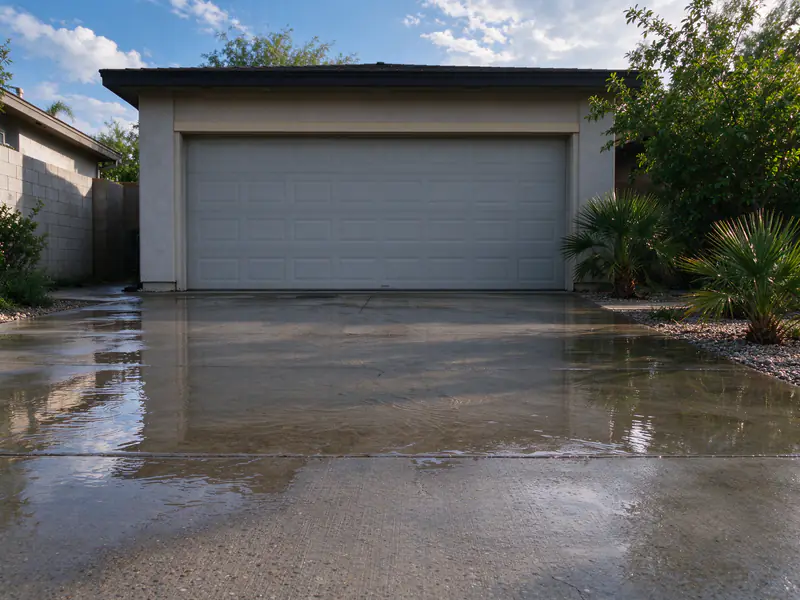
Water ponds where the surface is flat, slopes the wrong way or has sunk. Some drives were built with too little fall; others settled near the garage, where backfill beside the foundation can be deeper and harder to compact; and some garages sit lower than the street, so the drive slopes toward the door by design. The result is a puddle that sits after every storm or sprinkler cycle, stains and dirt lines on the slab, and in heavy storms, water under the garage door.
Water under the slab and soil stability
Water that gets under a driveway changes the ground holding it up. It enters through open joints, cracks and unsealed edges, and runs along the underside of the slab. On clay, it makes the soil swell; USDA soil survey samples show moderate or higher shrink-swell at 78.4% of points in Gilbert and 76.9% in Chandler, and that clay lifts the slab when wet and drops it as it dries. On sandier soils and base, moving water carries fine particles out from under the edges, leaving voids that let panels sink and crack. Caliche can make it worse by slowing water draining down through the soil, so it lingers just below the slab. That is why a drainage fix and a repair often go together: lifting a sunken driveway that keeps getting wet only resets the cycle. The guide to why driveways crack and sink in Phoenix traces the soil side in detail, and the caliche guide covers the cemented layer.
Subsurface drainage works on the same problem from below. A gravel trench with a perforated pipe along the edge of the drive, often called a French drain, intercepts water moving sideways through the soil, for example from an irrigated bed, before it reaches the base, so the soil under the slab stays at a steadier moisture and holds its support. It helps only when the pipe has continuous fall to an outlet, and where caliche sits near the surface the trench may have to be cut through it. Because the water that reaches a Phoenix driveway usually comes across the surface, from roofs, sprinklers and storm runoff, source fixes and grading come before any buried drain.
Matching the fix to the water
The order matters. A drain can’t make up for a source that keeps dumping water on the slab, and no fix works without an outlet.
Fix the source first
The simplest drainage work removes water before it reaches the drive. Downspouts that empty onto the slab can be extended or piped past the edge. Sprinkler heads that spray the drive can be moved or adjusted, and leaking lines repaired. Open joints and cracks can be cleaned and sealed so surface water stays out of the base; driveway expansion joint repair covers the joints against the garage and sidewalk.
Regrading and swales
Where the slope is the problem, the surface has to change. On a sound drive with one low area, the affected panels can sometimes be raised with driveway leveling so water runs off again. Where the whole drive falls toward the garage or the slab is failing anyway, the honest fix is rebuilding it to the right grade, as on the driveway replacement page. Water running along the side of a drive or across a yard can be carried by a shallow swale or a concrete or rock-lined channel to the street or a planned outlet. Where a public sidewalk crosses the drive, Phoenix requires an accessible walkway with a cross slope no steeper than 50:1, which limits how much the grade can change in that strip.
Channel drains across the drive
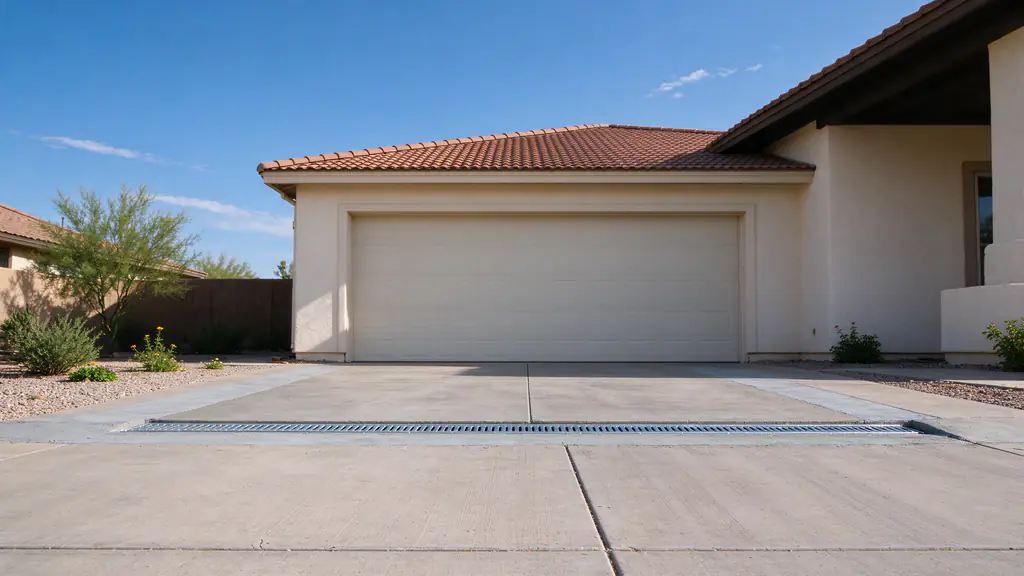
A channel drain, also called a trench drain, is a narrow inlet set across the drive with a grate on top. It catches water flowing down the slab before it reaches the garage. It suits drives that can’t be regraded, such as a garage set below the street. Doing it well depends on a few details:
Load rating. The grate and channel have to be rated for vehicle wheels, or they crack and shift.
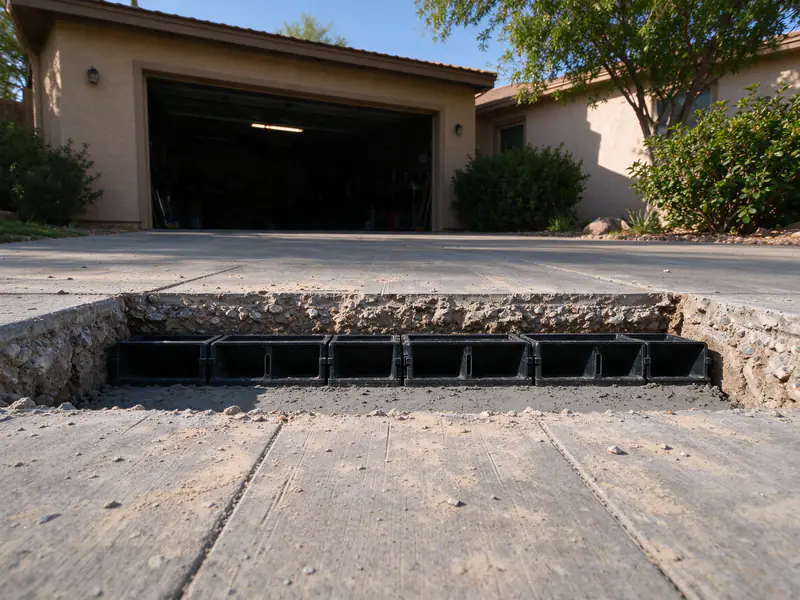
Support. The channel is set in a saw-cut trench and encased in concrete, flush with or just below the surface, so tires don’t break its edges.
Fall and outlet. The channel and its pipe need continuous fall to a lower outlet. A channel without one fills and overflows.
Maintenance. Grates and any catch basin collect sediment and leaves and need clearing, so access for cleanout is planned in.
Where the water goes
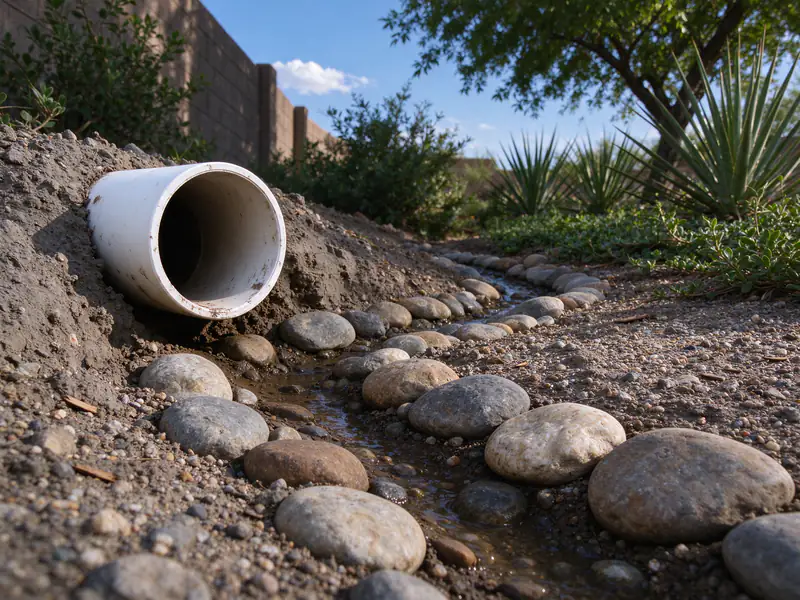
Every collection system is only as good as its outlet. Depending on the lot, the outlet may be the street through a curb outlet, a swale or landscape area on the same lot, a retention basin, or a dry well where the local rules permit one. Water can’t simply be sent onto a neighbor’s lot, and connections to the street or right-of-way usually need the city’s approval, so the workable outlet is confirmed per address before anything is cut.
Phoenix rain and local rules
Valley rain is rare but concentrated. Sky Harbor averages 7.22 inches a year in NOAA’s normals, yet it sees 4.1 days a year with half an inch or more and almost one day a year with an inch or more. The NWS monsoon season runs from June 15 to September 30, and those short, heavy storms are what overwhelm flat drives and undersized drains. In some parts of the city, FEMA flood maps add sheet flow to the picture: grid samples of Phoenix’s Desert View village put several points in Zone AO, shallow flooding that moves as a sheet across the ground. The pre-monsoon driveway checklist lists what to clear and check before the season.
Local rules shape where water can go. Scottsdale’s homeowner drainage guide says driveways must not block or divert drainage flow, should cross a roadside ditch with a dip or a properly sized culvert, and need a culvert at least 18 inches across inside the city right-of-way; grading or structural work in a drainage easement or right-of-way needs an encroachment permit. Scottsdale also requires on-lot retention of runoff from roofs, driveways and the lot where its ordinance applies. In Phoenix, work that reaches the street right-of-way falls under City permits, as the Phoenix driveway permit guide and the driveway apron repair page explain. Rules in other cities are confirmed per address.
What moves the price of drainage work
Drainage work is priced after the visit, because the cost follows the water. The main drivers are the length of any channel drain and the load rating of its grate; how much concrete has to be saw-cut, removed and restored; how far the pipe has to run to reach a workable outlet and what kind of outlet it is; how much regrading the drive or yard needs; caliche or rock that slows digging; and any right-of-way permit. When the fix is a new grade, the price is that of the driveway replacement or panel repair it rides on, and the driveway repair cost guide gives those ranges.
Licensing and payment notes
Arizona’s Registrar of Contractors licenses concrete work under R-9 and excavating and grading under R-2. A contractor generally needs a license when a job tops $1,000 in labor and materials or needs a permit; the license lookup guide shows how to check one. Whether insurance pays toward water damage depends on the policy and the cause, and that decision belongs to the insurer. On tax, the Arizona Department of Revenue treats this work as maintenance, repair, replacement or alteration contracting, so tax on materials is usually built into the price. The guide to driveway sinking after heavy rain explains what storms do to the base, and you can ask for an estimate with a short video of the water.
VIIVIVIVIIIIII
02
What's included
A look at where water comes from, where it runs on the drive and where it can leave the lot
Checking slope along and across the drive, the garage threshold and the street end
A named fix for the water source, the grade and the outlet in the estimate
Saw-cutting and removing concrete where a drain or regrade needs it
Setting a channel drain flush in a concrete surround, piped with fall to its outlet
Restoring the concrete, joints and edges around the new work
A water test of the finished drain or grade
The right-of-way permit when the work or outlet reaches the street
VIIVIVIVIIIIII
03
Driveway drainage fixes compared
Driveway drainage fixes compared: what each handles, its limits, and what moves the price
Fix
Best for
Won't fix
What moves the price
Redirect the source
Downspouts, sprinklers or a neighbor's runoff landing on the drive
A drive that slopes toward the garage
Length of extension or pipe, sprinkler changes, outlet distance
Seal joints and edges
Water getting into the base through open joints and cracks
Ponding from poor slope
Linear feet of joint, cleanout of old filler
Swale or edge channel
Runoff along the side of the drive or across a yard
Water that has no lower place to go
Length, rock or concrete lining, grading, caliche
Channel drain
Water reaching the garage on a drive that can't be regraded
A drain with no workable outlet
Drain length, grate load rating, saw-cutting, pipe run, outlet type
Regrade or replace
A drive whose slope sends water the wrong way
Water arriving from off the lot
Area replaced, thickness, base repair, removal and haul-off
04
Related resources
Guides that go deeper on driveway drainage decisions in the Valley.
What a monsoon storm does to the layers under a driveway, how to tell a washed-out base from a slab that is only cracked, and which repairs hold once the water is dealt with.
How caliche forms, where soil surveys flag it around Phoenix, why a compacted subgrade matters more than the caliche itself, and how a cemented layer changes drainage, excavation and the price of a repair.
05
How the work runs
First call or estimate request
Describe the surface, what changed and roughly where the property is. Photos of the damage and the street edge help. The published ranges give you a budget to think about before any visit.
A look at the whole driveway
The visit looks at more than the damaged spot: the slab or asphalt, the joints and edges, where water runs, and the transitions at the garage, sidewalk and street. The damaged area is measured, and anything found that changes the scope, such as soft base or caliche, is explained in the estimate.
Work timed for the heat
Hot-weather practice from the American Concrete Institute caps concrete at 95°F at discharge for general work, so summer pours are planned for the cooler part of the day. Where the job crosses into the street right-of-way, the city's permit is part of the scope.
Cure and handover
How long the car stays off depends on the material and the temperature. That wait is set out before the work starts, so you can plan around it.
VIIVIVIVIIIIII
06
What this work looks like
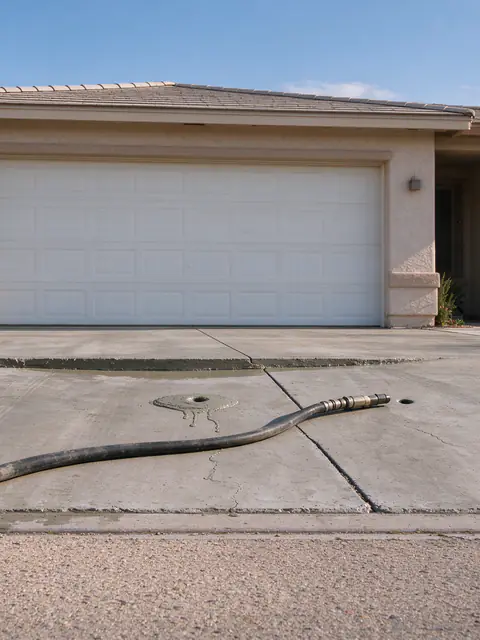
Water ponding against a garage door at the low end of a concrete driveway in Gilbert
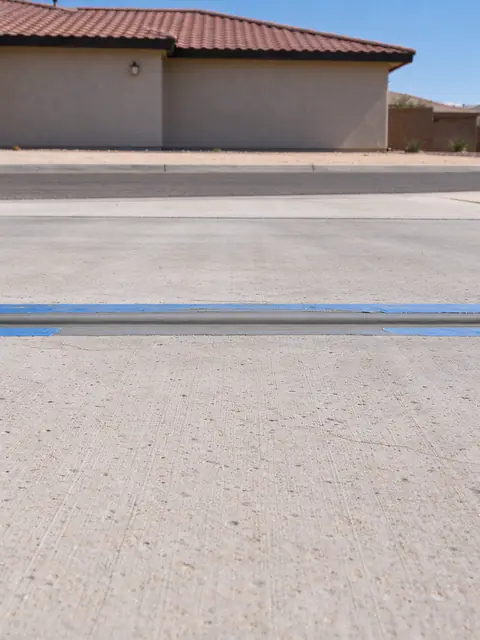
Channel drain sections set in a saw-cut trench across a Gilbert driveway
Driveway drain pipe outlet into a rock-lined channel in a Gilbert side yard
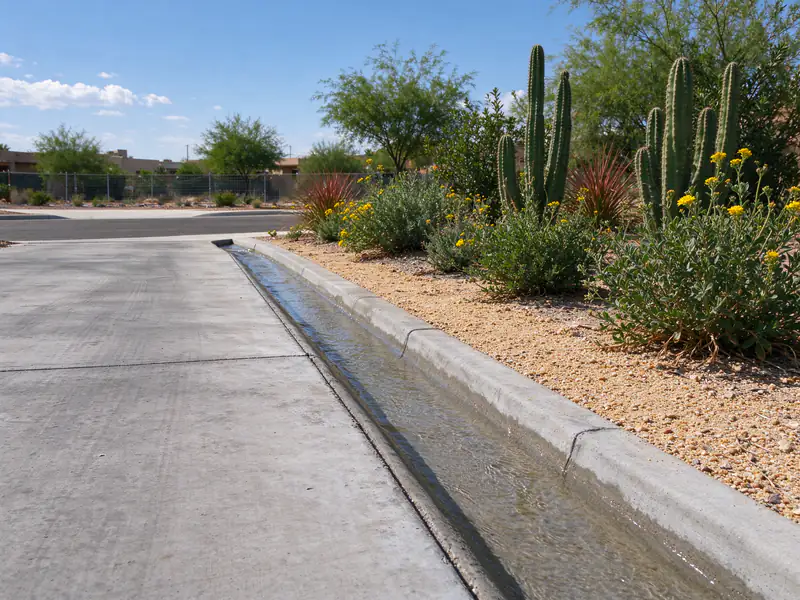
Concrete swale along the edge of a Gilbert driveway carrying water to the street
Water at the garage or under the slab? Get an Estimate.
Send photos or a short video of where the water goes. The estimate names the source, the fix, the outlet and what it won't change.
Is it a problem if my downspout empties onto the driveway?
It can be. A downspout concentrates a whole roof section onto one spot, and that water finds the nearest joint, crack or edge and soaks into the base. Over time that can soften the base, wash out fine soil or swell clay underneath. An extension, a splash path or a short pipe that carries the water past the drive's edge is a simple first fix.
Can a channel drain keep water from reaching my garage?
Yes, when it has somewhere to send the water. A drain across the drive in front of the garage catches runoff before the door, but only if its pipe can fall to a lower outlet and the grate is rated for cars. Without an outlet, the drain fills and overflows. Where the drive can be regraded instead, that can solve the problem with less to maintain.
Where can water from a driveway drain be sent?
To a point lower than the drain that the local rules allow, such as the street through a curb outlet, a landscape area or swale on the same lot, or a retention area. Sending it onto a neighbor's lot isn't acceptable, and street or right-of-way connections usually need the city's approval. The workable outlet is confirmed per address before anything is installed.
Can driveway drainage be fixed without replacing the driveway?
Yes, when the slab itself is sound. Redirecting downspouts and sprinklers, sealing open joints, adding a swale along the edge or cutting in a channel drain all work on an existing drive. Replacement makes sense when the slab itself slopes toward the garage, has sunk into a low spot, or is failing anyway; then the new drive is graded to shed water correctly.
What should I record about the water before a driveway drainage visit?
If you can, take a short video during a storm or while the sprinklers run, showing where water comes from, where it runs and where it stops. Note whether it reaches the garage, how long puddles last, where downspouts empty, and whether water arrives from the street or a neighbor's lot. Photos of stains, sediment lines and sunken areas help too.