What is caliche soil in Arizona, and how does it affect a driveway?
How caliche forms, where soil surveys flag it around Phoenix, why a compacted subgrade matters more than the caliche itself, and how a cemented layer changes drainage, excavation and the price of a repair.
Last Updated:
Short answerCaliche is a layer of desert soil cemented by calcium carbonate, ranging from soft nodules to rock-hard beds. It rarely cracks a driveway by itself. It matters because it slows water draining down, so water can sit in the base above it, and because it makes digging out a failed base or regrading for drainage slower and costlier.
Caliche soil in Arizona is a layer of desert soil cemented together by calcium carbonate, the same mineral as limestone. It ranges from scattered white nodules to a continuous bed hard enough to need a breaker. For a driveway, caliche is rarely the cause of a crack, but it changes how water drains under the slab and how hard it is to dig out and rebuild the base. Sundial Driveway Repair is a service company offering and managing driveway replacement and driveway drainage work across Phoenix and its suburbs, fulfilled by licensed and insured contractors, and this guide explains what caliche means for a driveway project.
How does caliche form?
Caliche forms slowly in dry climates. Rain dissolves calcium carbonate from the soil and from wind-blown dust and carries it downward. In a desert, that water rarely travels far: it evaporates or is drawn up by plants a short distance below the surface, and the carbonate it carried is left behind, coating and binding the soil grains. Over very long periods, the carbonate builds up from coatings to nodules to a solid cemented layer. Soil scientists call the hardest form a petrocalcic horizon.
The result is uneven. Caliche can sit at the surface on eroded desert slopes, a few feet down in one part of a lot and absent in another, and anywhere from crumbly to rock-hard.
Where is caliche found around Phoenix?
USDA soil surveys flag cemented layers mostly along the Valley’s foothill and desert edges. The Peoria and Paradise Valley service-area pages cover two of those areas. In sampled survey points, a cemented layer within about five feet of the surface shows up at 29.2% of points in Phoenix’s Rio Vista village, 20.5% in Peoria, 18.2% in the town of Paradise Valley, 17.6% in Phoenix’s Paradise Valley village, 13.7% in North Gateway and 13.3% in Camelback East. Mesa’s samples show 7.7% and Scottsdale’s 5.1%. The samples from Tempe, Chandler, Gilbert, Glendale, Maryvale, Central City and Alhambra show none.
Those figures describe areas, not properties. A lot in a low-caliche area can still have it, for example in fill brought in during construction, and a lot in a high-caliche area may not have it under the driveway. Nothing short of digging confirms it.
Why does a compacted subgrade matter so much?
The subgrade is the native soil under the driveway, graded and compacted before any base or pavement goes on. It is the bottom layer of the system, and the concrete or asphalt above it is only as stable as it is. A well-built subgrade is compacted in thin layers at the right moisture, so it is dense and uniform from one side of the drive to the other. That uniformity is the point: a slab rests evenly, and the aggregate base on top spreads loads into ground that responds the same way everywhere.
A subgrade fails a driveway in two ways. It can be soft throughout, because it was placed loose, compacted too dry or too wet, or is a weak soil that loses strength when wet. Or it can be uneven, firm in one place and soft in another, so the slab is supported in some spots and bridging in others. Uneven support is what cracks concrete across a panel, which concrete driveway repair has to work around, and what makes asphalt dip.
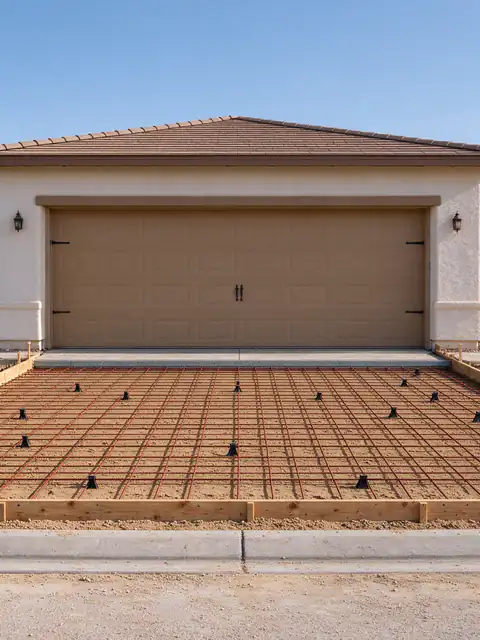
Caliche feeds the second problem. A hard caliche ledge under one side of a drive, with loose fill or soft soil beside it, gives exactly the hard-spot, soft-spot support that cracks slabs along the line where the ground changes. Broken caliche chunks mixed into fill also don’t compact evenly with the soil around them. On a rebuild, the fix is to bring the subgrade to an even, compacted condition: removing loose material, cutting high caliche down where it pokes up, and building the base to a uniform depth over it. The guide to why driveways crack and sink explains how the layers work together.
How does caliche affect drainage under a driveway?
A dense caliche layer is far less permeable than the soil above it. Water that gets under a driveway, from monsoon runoff along an edge, a downspout, a sprinkler or flood irrigation, soaks down until it reaches the caliche and then sits on top of it or moves sideways along it. That keeps the base and subgrade above the layer wet for longer than open soil would.
Wet base loses strength, and on clay soils it swells. Both are routes to cracking and to the settlement that sunken driveway repair deals with. The National Weather Service defines monsoon season as June 15 to September 30, and about 4.1 days a year at Sky Harbor bring half an inch of rain or more (NOAA climate normals), so a few heavy storms can put a lot of water under a slab quickly. Where caliche is shallow, getting that water to the street or into a properly built drainage feature matters even more. Retention and drainage rules are set by Maricopa County and each city; the County requires lots to be graded so drainage doesn’t harm neighboring property. The guide to driveway sinking after heavy rain covers the signs of water undermining a slab.
How does caliche change a repair or replacement?
It changes the digging more than the design. Breaking out an old slab is the same; what changes is what happens next. Removing a failed base, cutting the subgrade to grade, trenching for a drain line or a curb cut, or setting forms deeper all go slower in caliche, and a hard layer may need a hydraulic breaker or rock bit instead of a bucket. A typical Phoenix-area range for removing an existing concrete driveway slab is about $1.20 to $1.90 per square foot, and small sections, thick or reinforced slabs and caliche cost more per square foot. The driveway replacement cost guide covers the rest of the price.
It also changes what is reasonable. A full regrade to fix a drive that slopes toward the garage may mean cutting caliche, which costs more and is worth knowing before choosing between a repair and a replacement. Where the work reaches the street, the right-of-way rules still apply: in Phoenix, residential driveway concrete there is 6-inch Class A, and a city permit may be needed.
Because caliche is often found only once digging starts, the estimate should handle it openly. The first visit looks at the whole drive, including where water runs and the transitions at the garage, sidewalk and street, and a section is sometimes cut out to see the base. Findings that change the scope, such as soft base or caliche, are explained, along with how they affect the price.
Is caliche the same as an earth fissure?
No. Caliche is a cemented soil layer. Earth fissures are open ground cracks caused by land subsidence, mapped by the Arizona Geological Survey in parts of the Valley, including the Chandler Heights and Queen Creek area. A fissure can crack a driveway in a way no repair can stop, and it has nothing to do with caliche. If a large crack runs through your drive, yard and street in a line, check the AZGS earth fissure maps before planning a repair.
If you are planning work where caliche is likely, such as a foothill lot or a property in Peoria or Paradise Valley, call the number at the top of this page or ask for an estimate that states how a cemented layer would be handled.
VIIVIVIVIIIIII
02
More questions on this
How can I tell whether there is caliche under my driveway?
You usually can't from the surface. Soil survey maps show whether an area tends to have cemented layers, which raises or lowers the odds, but they describe an area, not a lot. Hard, pale, chalky material in a planting hole or trench nearby is a strong hint. For certain, someone has to dig, which is why it often shows up only when the old slab and base come out.
Is caliche good or bad support for a driveway?
It depends on how even it is. A continuous, intact caliche layer under the whole drive is firm, but a ledge under one side with loose fill or soft soil beside it gives the slab uneven support, and the slab tends to crack along the line where the ground changes. That is why a rebuild aims for an evenly compacted subgrade, cutting high spots of caliche down rather than building around them.
Can caliche trap water under a driveway slab?
It can slow water draining down. Where a dense layer sits close under the base, water from storms, downspouts or sprinklers that gets under the slab can sit above it instead of soaking away, keeping the base and subgrade wet. Wet base loses strength, and on clay soil it also swells. Moving water away from the driveway edges is the first defense.
VIIVIVIVIIIIII
03
Get an Estimate for driveway replacement
Tell us the surface, what changed and the nearest cross streets. Photos of the damage and the street edge make the estimate more useful.
The two numbers behind a concrete driveway replacement, tear-out and new pour, plus what base repair, grade correction, the apron and permits add, with illustrative budgets.
What a monsoon storm does to the layers under a driveway, how to tell a washed-out base from a slab that is only cracked, and which repairs hold once the water is dealt with.
The signs that point to a repair, the ones that point to a new driveway, the middle option of replacing sections, and the Phoenix soil, water and right-of-way rules that tip the choice.
The physics of a slab that grows and shrinks every day, why heat does its worst damage to concrete in the first hours, how asphalt binder softens and ages under Valley sun, and what owners can do through a long summer.