111days a year reach 100°F or more at Sky HarborNOAA climate normals
0.6nights a year drop to freezing at Sky Harbor, so heat and water, not frost, drive most damageNOAA
June 15 to September 30 is monsoon seasonNational Weather Service
Phoenix treats up to 10.5 ft of concrete drive past a roll curb as on-site work, with no separate driveway permit
Concrete for a residential driveway in the Phoenix right-of-way is 6-inch Class A
Last Updated:
Paver driveway repair fixes the areas where pavers have sunk, shifted, cracked or spread apart, usually by lifting them, rebuilding what failed underneath, and setting the same pavers back in place. Because pavers are separate pieces on a bed of sand, a failed section can be taken apart and rebuilt without breaking anything out, which is the main advantage of a paver drive. Sundial Driveway Repair is a service company offering and managing paver driveway repair across Phoenix and its suburbs, for concrete pavers and stone such as travertine, and the work is fulfilled by licensed and insured contractors.
A sunken band, a rut or a gap is a sign of something happening in the layers below the pavers or at the edge beside them, so the repair starts with finding out which one.
What happens on the first visit
The first visit looks at the whole drive before any section is lifted: the surface, the joints, the edges, where water runs, and where the pavers meet the garage, the sidewalk and the street. Low spots are mapped, and a straightedge shows how far they have dropped. Joints are checked for missing sand, weeds and ant mounds, and edges are checked for gaps that mean the restraint has failed and the pavers are spreading.
Water sources get particular attention, since water that reaches the bedding sand can wash it out: downspouts that empty onto the drive, sprinklers that spray it, and leaking irrigation lines underneath. The estimate names the cause found, the area to reset, the base work, and what it won’t change, such as an exact color match for any new pavers. If you’d like to sort the signs first, the driveway condition assessment asks the same questions.
How a paver driveway is built
A paver drive is a layered system. At the bottom is the compacted soil. On it sits a compacted aggregate base, the layer that actually carries the cars. On the base goes a thin layer of bedding sand, screeded flat so each paver sits evenly. The pavers are laid in a pattern, compacted into the sand, and the joints between them are filled with sand. Around the edges, a restraint, such as a concrete curb, a buried edge strip or a soldier course set in concrete, stops the field from spreading outward.
The pavers lock together through their joint sand and the restraint at the edges. Take away either one and the pieces start to move independently. That interlock is also why the pattern matters: herringbone patterns resist the push of turning tires better than straight rows.
What goes wrong with paver drives in the Valley
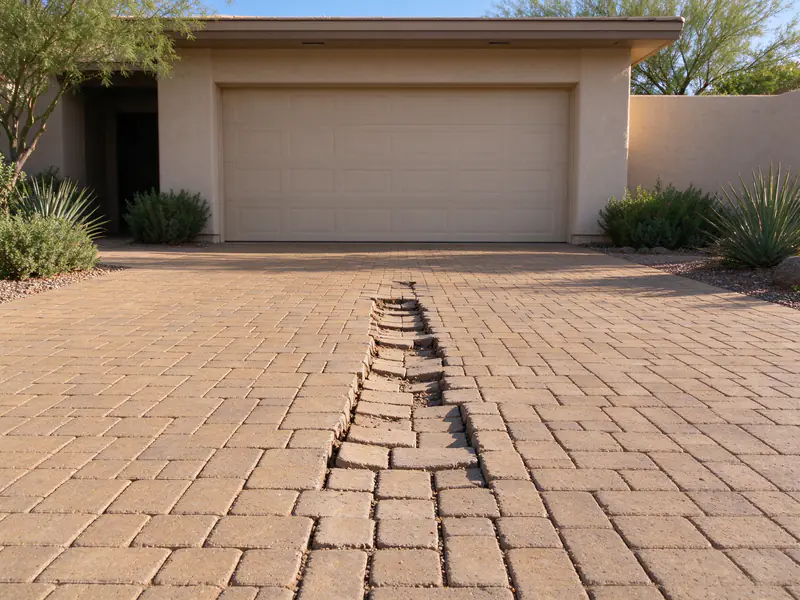
Sinking and ruts
A dip or rut in the wheel path means the support under it has given way. The base may have been too thin or poorly compacted for vehicle loads, or water may have washed out the bedding sand and fine material from the base. In Phoenix, that water tends to arrive in bursts: the NWS monsoon season runs June 15 to September 30, and a downspout or sheet of runoff can wash sand out of the joints and the bed in a single storm. The guide on driveway sinking after heavy rain explains that mechanism. Clay soils add another cause. USDA soil survey samples show moderate or higher shrink-swell at 78.4% of points in Gilbert and 56.4% in Scottsdale, and clay that swells when irrigated and shrinks as it dries can lift and drop a section unevenly.
Shifting, gaps and spreading edges
Pavers that creep apart or open gaps along one side point to the edge restraint. Edge strips held with too few spikes, restraints that were never installed, or a soldier course that lost its concrete backing let the field move outward under turning tires. Gaps then lose their sand, and the problem speeds up. Resetting those pavers without fixing the edge only buys a short break.
Joint sand loss, weeds and ants
Joint sand washes out under rain and runoff, and pressure washing or leaf blowers pull it out too. Empty joints let pavers rock and chip, invite weeds, and give ants an easy place to dig, which brings up more sand. Re-sanding and compacting the joints restores the interlock, as long as the pavers are still level and the base is sound.
Cracked and chipped pavers
A paver cracks when it is loaded without full support, such as over a soft spot, or under a heavy point load like a trailer jack. Single cracked pavers can be replaced. A cluster of them in the same place is a base problem showing up at the surface. White haze on pavers is efflorescence, salts carried up by moisture; it is a cleaning matter, not a sign of structural failure.
How a paver section is repaired
The repair is mostly a rebuild of the layers under the surface, using the same pavers:
Lift and keep order. The pavers in the failed area are lifted and stacked in sequence so the pattern goes back the way it came, with a margin past the damage so the repair ties into firm ground.
Rebuild the base. Old bedding sand comes out. Soft or washed-out base is dug out, replaced with aggregate base, and compacted in lifts until it is firm.
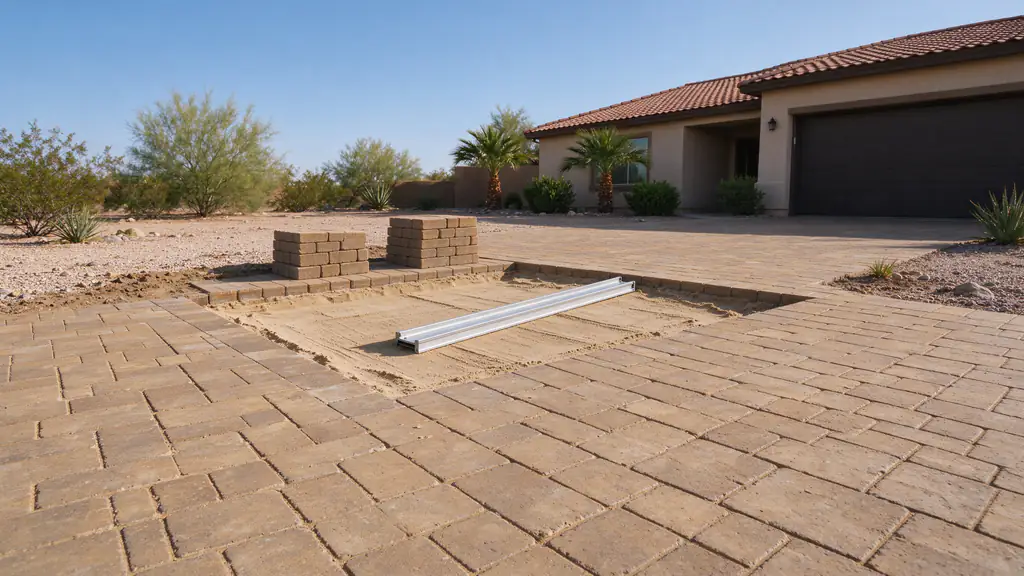
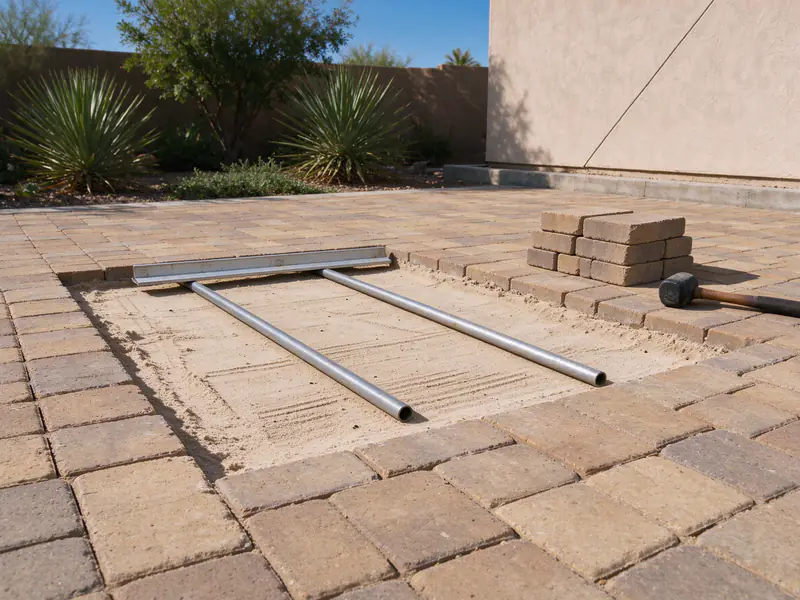
Screed new bedding sand. A thin, even layer is screeded to the grade of the drive around it, allowing for the small drop the pavers take when compacted.
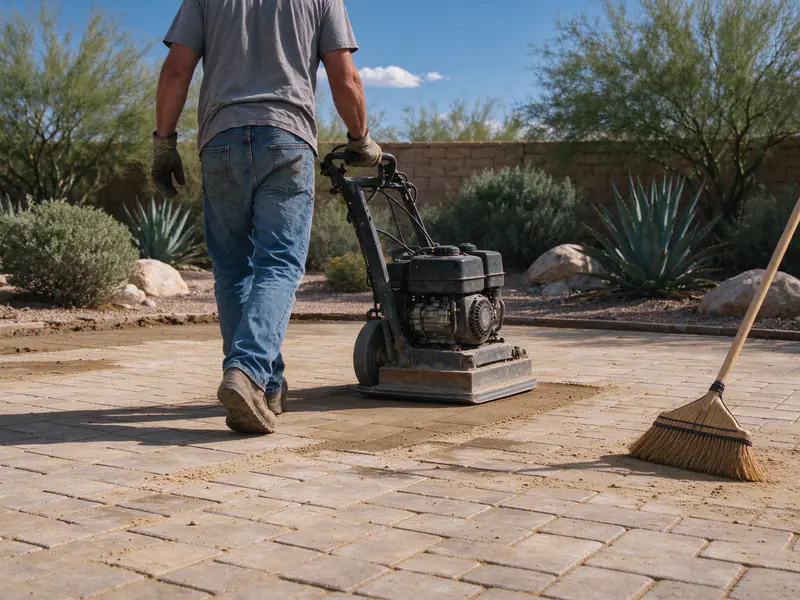
Re-lay and compact. The pavers go back in their pattern, cut pieces are fitted at edges, cracked units are swapped where spares exist, and a plate compactor with a protective pad sets them.
Joints and edges. Joint sand is swept in and compacted, polymeric sand where it suits, and the edge restraint is reset or replaced.
Whatever washed the base out has to be dealt with too, or the same section drops again. That may mean extending a downspout, moving a sprinkler head or fixing a leaking line, or larger driveway drainage work.
Color, spares and appearance
Re-laid pavers match because they are the original pavers. New pavers rarely match exactly: color varies between production runs, styles are discontinued, and old pavers have faded in the sun. Spares saved from the original job are the best source for replacements, and pulling matching pavers from a less visible area, such as under a side-yard gate, and putting new ones there is another option. Cleaning and sealing can even out the overall look. A typical Phoenix-area range for cleaning and sealing pavers is about $1 to $3.50 per square foot, and the concrete and paver sealing page covers what sealing does and doesn’t do.
The street edge, HOAs and who does the work
Pavers in the street right-of-way follow City rules. Under the City of Phoenix Driveway Policy, materials other than concrete beyond the first 10.5 feet of right-of-way need a maintenance agreement with Street Transportation, which matters if a paver drive runs to the curb. The Phoenix driveway permit guide and the driveway apron repair page cover that strip. An HOA may set rules on paver color and pattern too; the HOA driveway rules guide covers what to check before changing anything visible.
Arizona’s Registrar of Contractors licenses paver and stone driveways under the hardscaping classes R-21, C-21 and CR-21, which explicitly exclude concrete driveways. A contractor generally needs a license when a job tops $1,000 in labor and materials or needs a permit; the license lookup guide shows how to check one. If the drive is concrete with a stamped pattern rather than pavers, stamped concrete repair is the right page.
Insurance and payment notes
Whether insurance pays for paver damage depends on the policy and on what caused it, and that decision belongs to the insurer. On tax, the Arizona Department of Revenue treats repair work as maintenance, repair, replacement or alteration contracting, so tax on materials is usually built into the price rather than added as a line. As national budgeting examples, swapping out a few damaged pavers often runs about $200 to $500, while resetting a sunken section over a rebuilt base runs about $1,000 to $2,500. The paver repair cost guide explains what moves those numbers, the cost estimator gives a budget, and you can ask for an estimate with photos of each problem area.
VIIVIVIVIIIIII
02
What's included
A look at the whole drive, its edges and where water runs before a method is chosen
A measured repair area and the cause of the failure named in the estimate
Lifting the pavers in the failed area and keeping them in order for re-laying
Removing old bedding sand and soft base, then rebuilding and compacting the base
New bedding sand screeded to the grade of the surrounding drive
Re-laying the pavers in their pattern, with cracked units swapped where spares exist
Compacting the pavers, filling joints with sand and restoring the edge restraint
VIIVIVIVIIIIII
03
Paver driveway repairs compared
Paver driveway repairs compared: what each fixes, what it leaves, and a budgeting range
Repair
Best for
Won't fix
Budgeting range
Swap a few pavers
Cracked or chipped pavers on a level, firm area
A low spot or soft base under them
$200 to $500 per job (national budgeting example)
Lift and reset a section
Sunken or rutted areas, rebuilt on new base
Water that keeps washing out the base nearby
$1,000 to $2,500 per job (national budgeting example)
Re-sand the joints
Washed-out joints, loose pavers, weeds in the gaps
Settlement or a failed edge
Priced after measuring
Reset the edge
Pavers spreading and gaps opening along a side
Sinking in the middle of the drive
Priced after measuring
Clean and seal
Stains, faded color, joint sand held in place
Any movement or settlement
$1 to $3.50 per sq ft (typical Phoenix area)
04
Related resources
Guides that go deeper on paver repair decisions in the Valley.
What swapping damaged pavers, resetting a sunken section and cleaning and sealing a paver driveway cost, why the base under the pavers sets the price, and what to look for on a quote.
What a monsoon storm does to the layers under a driveway, how to tell a washed-out base from a slab that is only cracked, and which repairs hold once the water is dealt with.
How association rules sit on top of city codes for driveway repairs, widening, pads and materials, and how to put together a request the board can approve.
05
How the work runs
First call or estimate request
Describe the surface, what changed and roughly where the property is. Photos of the damage and the street edge help. The published ranges give you a budget to think about before any visit.
A look at the whole driveway
The visit looks at more than the damaged spot: the slab or asphalt, the joints and edges, where water runs, and the transitions at the garage, sidewalk and street. The damaged area is measured, and anything found that changes the scope, such as soft base or caliche, is explained in the estimate.
Work timed for the heat
Hot-weather practice from the American Concrete Institute caps concrete at 95°F at discharge for general work, so summer pours are planned for the cooler part of the day. Where the job crosses into the street right-of-way, the city's permit is part of the scope.
Cure and handover
How long the car stays off depends on the material and the temperature. That wait is set out before the work starts, so you can plan around it.
VIIVIVIVIIIIII
06
What this work looks like
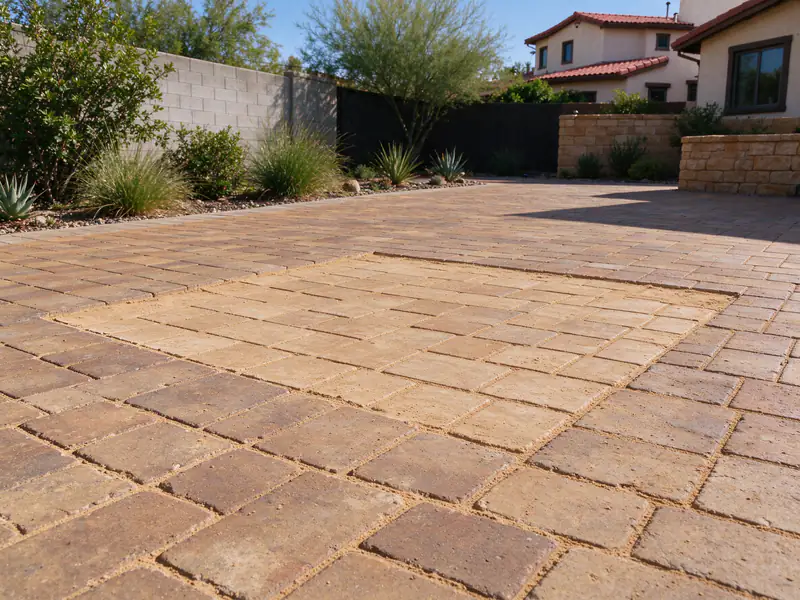
Sunken band of displaced pavers in the wheel path of a Scottsdale paver driveway
Bedding sand being screeded between two pipes for a paver repair in Scottsdale
Plate compactor settling reset pavers with joint sand in a Scottsdale driveway
Reset section of a Scottsdale paver driveway sitting level with the rest, joints filled with sand
Sunken, shifted or cracked pavers? Get an Estimate.
Send photos of each problem area and the whole drive. The estimate names the cause, the area to reset, the base work and what it won't change.
Why do pavers sink in the tire tracks of a driveway?
Because the support under the wheel paths gave way. The base may have been too thin or poorly compacted for cars, or water from a downspout, sprinkler or storm washed out the bedding sand and fine base. The fix lifts those pavers, rebuilds and compacts the base, screeds fresh bedding sand and re-lays the same pavers, after the water source is dealt with.
Can a single cracked paver be replaced?
Yes. A cracked paver is broken out, the pavers around it are loosened, and a new one is set in its place, then the joints are re-sanded. It works best with spare pavers from the original job. If several pavers in the same spot keep cracking, the base under them is likely the cause, and swapping pavers alone won't stop it.
Should paver joints be filled with polymeric sand?
It can be. Polymeric sand hardens once it is wetted, which resists washout, weeds and ants better than plain sand. It needs clean, dry joints of the right depth and careful wetting, or it can leave a haze on the pavers. On very narrow joints or where the base still moves, plain joint sand topped up from time to time can be the better fit.
Where do matching pavers come from for a driveway repair?
The best source is spares left over from the original job, since they share the same production run. Another is borrowing pavers from a hidden spot, such as under a side-yard gate, and putting new ones there. New pavers bought today can differ in color from older ones that have faded in the sun, so an exact match isn't something any repair can promise.
What should I note before asking for a paver driveway repair estimate?
Wide photos of the drive and close photos of each low spot, crack or gap, plus rough dimensions. Note whether you have spare pavers from the original job, the paver brand or style if you know it, where downspouts and sprinklers discharge, and whether the damage reaches the sidewalk or street. HOA rules on pavers are worth checking too.