111days a year reach 100°F or more at Sky HarborNOAA climate normals
0.6nights a year drop to freezing at Sky Harbor, so heat and water, not frost, drive most damageNOAA
June 15 to September 30 is monsoon seasonNational Weather Service
Phoenix treats up to 10.5 ft of concrete drive past a roll curb as on-site work, with no separate driveway permit
Concrete for a residential driveway in the Phoenix right-of-way is 6-inch Class A
Last Updated:
Concrete trip hazard grinding takes a raised slab edge down to a gradual bevel, so a lip at a driveway joint or sidewalk crossing stops catching toes, strollers and mower wheels. It suits small, stable offsets where the slabs are otherwise sound and in plane. Sundial Driveway Repair is a service company offering and managing concrete trip hazard grinding across Phoenix and its suburbs, for homes and commercial properties, fulfilled by licensed and insured contractors. Grinding is one of three ways to remove a step, and the visit decides which one fits.
The others are lifting the low panel, covered on the driveway leveling page, and replacing the panel that moved. Grinding is quickest and least disruptive, but it only shaves the high side. It can’t raise anything, fill a void or stop the slab from moving again.
What happens on the first visit
The first visit looks at the whole drive: surface, joints, edges, where water runs, and the garage, sidewalk and street transitions. Each raised edge is measured, and the two panels are compared to see which one moved. Panels are tapped for hollow spots, and cracks are checked for width, offset and whether they cross panels. The visit also notes whether the slab is part of the driveway or sits in the street right-of-way, such as the public sidewalk or apron, since that changes who is responsible and what rules apply.
The estimate names the method for each location, the area, any right-of-way portion and what it excludes, such as matching the broom finish. Findings that change the scope, such as an edge too high to grind or a panel that rocks over a void, are explained so you can weigh grinding against lifting or replacement. The driveway condition assessment asks the same questions if you want to sort the edges yourself first.
When grinding is the right fix
A small, stable lip
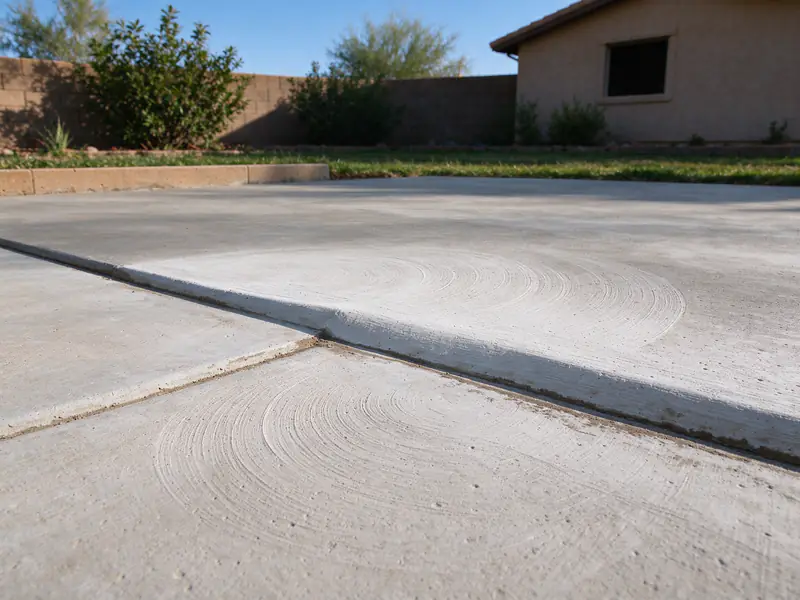
Grinding works on a lip roughly up to an inch where both panels are firm and the step doesn’t hold water. The high edge is cut back to a long, gentle bevel, so a foot or wheel rolls over it instead of striking it. As a reference point, the 2010 ADA Standards for public walking surfaces allow a vertical change of up to 1/4 inch and require changes between 1/4 and 1/2 inch to be beveled no steeper than 1 in 2. Those rules govern public facilities, not a private driveway, but they show why a vertical edge of even half an inch is treated as a hazard.
Movement that has stopped
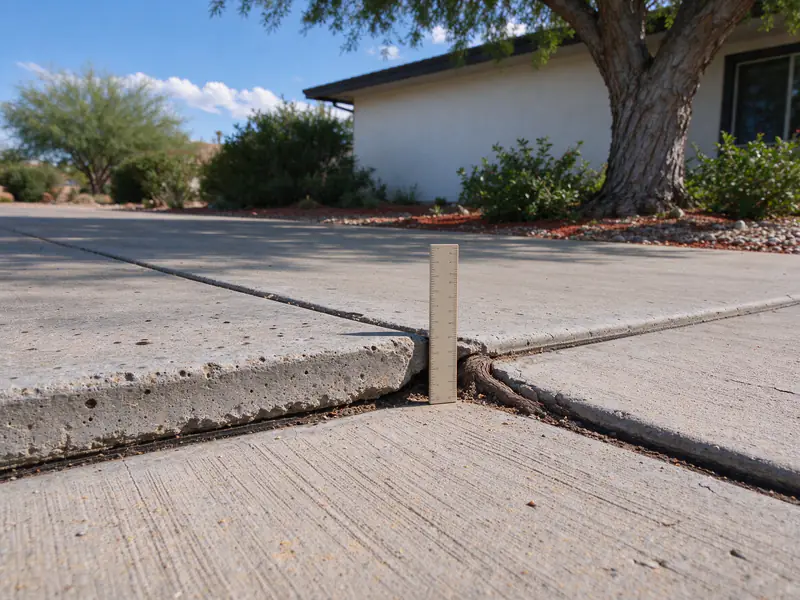
Grinding is only a lasting fix when the slab has stopped moving. A panel left high by settling fill beside it, or raised by clay that has since dried and stabilized, can be ground once and left. A panel still rising over a growing root or a wet, swelling patch of clay will form a new lip. Where a large tree grows close to the slab, a raised edge next to the trunk is the sign to look for, and the guide to driveways damaged by tree roots covers what the choices are. In USDA soil survey samples, more than three of every four points in Gilbert and Chandler show moderate or higher shrink-swell clay, so watering patterns next to the slab are part of judging whether it will stay put. The guide to why driveways crack and sink explains how that soil moves.
When grinding is the wrong fix
Grinding is a poor choice when the low panel sank and now holds water against the garage or the house, because shaving the high side doesn’t restore the drainage; lifting the low panel does. It is a poor choice on a panel that rocks, sounds hollow or has broken, because there is no stable surface to grind to. And it is a poor choice past about an inch of offset: the bevel has to run so far back into the high slab that it removes much of the top surface, can thin the edge and can reach reinforcement. Each of those calls for lifting or replacing the panel instead.
A wedge of patching mortar on the low side is sometimes offered as a cheap ramp. On concrete it rarely lasts: the feather edge is too thin to bond and breaks off, and it does nothing about the movement.
How the grinding is done
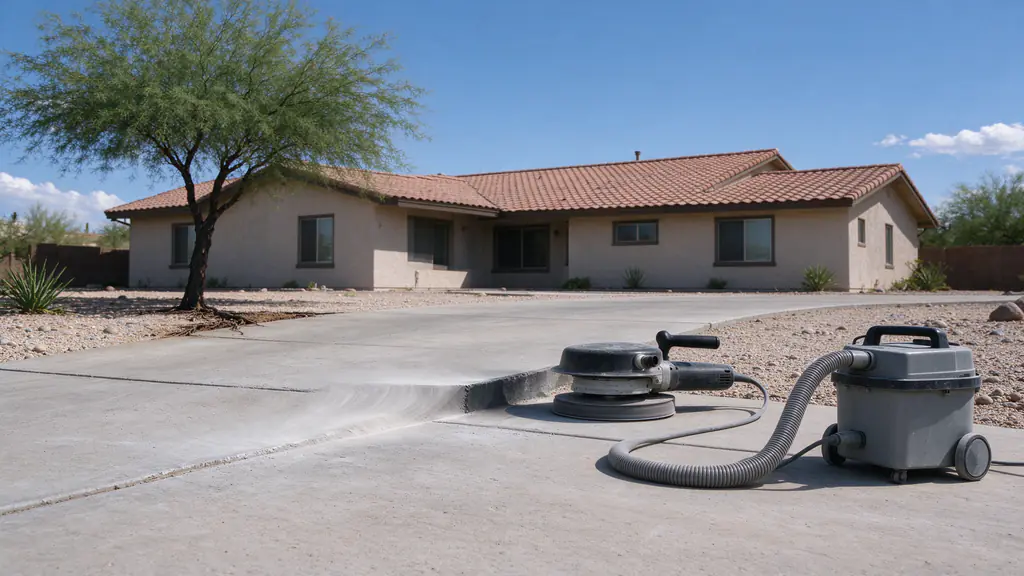
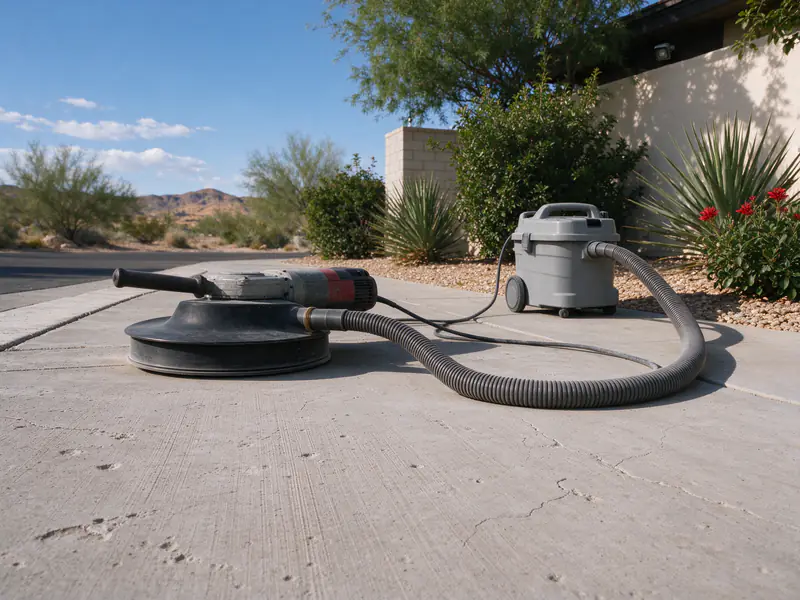
A hand-held grinder with a diamond cup wheel cuts the high edge back in passes, starting at the lip and feathering back into the panel until the bevel is gradual and even across the full width of the joint. On longer edges a walk-behind grinder can be used. The bevel is shaped so water still runs off the joint rather than collecting at it. Where a sidewalk crosses the driveway, the City of Phoenix requires an accessible walkway with a cross slope no steeper than 50:1, so grinding there has to leave the walkway’s cross slope within that limit.
Dust is the main by-product. Concrete contains crystalline silica, and OSHA’s silica standard for construction names a shrouded grinder connected to a dust-collecting vacuum as the control method for handheld grinding. Even with that, slurry and fine dust settle nearby, so cars are moved and the area is washed down at the end. The ground band is smoother and lighter than the broom finish around it, and some sand and stone show through; it weathers toward the slab color but doesn’t disappear. If the joint beside the bevel has lost its filler, expansion joint repair reseals it so water stops reaching the base.
The sidewalk and apron belong to a different set of rules
Raised slabs at the street are often public sidewalk or apron rather than driveway. Phoenix City Code makes the owner of a lot abutting a sidewalk responsible for keeping it in repair (Sec. 31-54) and liable for injuries from a defect left unrepaired (Sec. 31-55). If the owner doesn’t act after notice, the Street Transportation Director can have the City repair it and charge the cost as a lien (Sec. 31-56), with unpaid costs added to the property tax roll after 45 days (Sec. 31-57). Other cities set their own rules, and responsibility there is confirmed per address. The guide to who is responsible for the driveway apron and the driveway apron repair page cover that strip. When work in the right-of-way needs a city permit, the permit is part of the scope.
Cost and payment notes
Grinding is priced per location or per job rather than per square foot. The height and length of each lip, the number of locations, how hard the concrete and its stone are, access for the grinder and vacuum, and cleanup all move the price, and a single small lip is usually set by a minimum charge. If a location turns out to need lifting, the mudjacking vs polyjacking guide compares the lifting methods. Concrete grinding is concrete repair under Arizona’s R-9 and C-9 classes, and whether insurance pays depends on the policy and the cause. When you’re ready, ask for an estimate.
VIIVIVIVIIIIII
02
What's included
Measuring each raised edge and checking whether the slab is stable or still moving
Checking whether the slab sits on the driveway or in the street right-of-way
Grinding the high edge to a gradual bevel with a diamond cup wheel
Dust control with a shrouded grinder and vacuum
Feathering the bevel so water still drains off the joint
Cleanup of slurry and dust from the drive, walk and landscaping
A note in the estimate of any edge too high to grind, with the lifting or replacement it needs
VIIVIVIVIIIIII
03
Ways to remove a concrete trip hazard compared
Ways to remove a concrete trip hazard compared: what each fixes, what it leaves, and how it is priced
Option
Best for
Won't fix
How it's priced
Grind the raised edge
A stable lip up to roughly an inch where the panels are otherwise in plane
A slab that is still rising or sinking, or one that tilts and holds water
Per location or per job after measuring the edge
Lift the low panel
A sound panel that settled and left its neighbor high
A panel that heaved, or broken concrete
Mudjacking $4 to $10 per sq ft (typical Phoenix area); foam $8 to $25 per sq ft (national)
Replace the panel
A heaved, broken or badly tilted panel, or a root under the slab
Color match with the older concrete beside it
$10 to $15 per sq ft (typical Phoenix area)
Patch a ramp onto the low side
Rarely the right choice on concrete
Any movement; thin patches break off at the feather edge
Not recommended as a lasting repair
04
Related resources
Guides that go deeper on trip hazard grinding decisions in the Valley.
Roots are one cause to check where a large tree grows near the drive, not one to assume. Here is how they do damage, how to confirm them, and which repairs fit.
How each lifting method works, where they really differ, how Phoenix clay and storm water affect the choice, and the cases where lifting isn't the answer at all.
The apron usually sits on public land, yet the repair often falls to the homeowner. Here is how ownership, upkeep and permits split between you, the city and anyone who dug it up.
05
How the work runs
First call or estimate request
Describe the surface, what changed and roughly where the property is. Photos of the damage and the street edge help. The published ranges give you a budget to think about before any visit.
A look at the whole driveway
The visit looks at more than the damaged spot: the slab or asphalt, the joints and edges, where water runs, and the transitions at the garage, sidewalk and street. The damaged area is measured, and anything found that changes the scope, such as soft base or caliche, is explained in the estimate.
Work timed for the heat
Hot-weather practice from the American Concrete Institute caps concrete at 95°F at discharge for general work, so summer pours are planned for the cooler part of the day. Where the job crosses into the street right-of-way, the city's permit is part of the scope.
Cure and handover
How long the car stays off depends on the material and the temperature. That wait is set out before the work starts, so you can plan around it.
VIIVIVIVIIIIII
06
What this work looks like
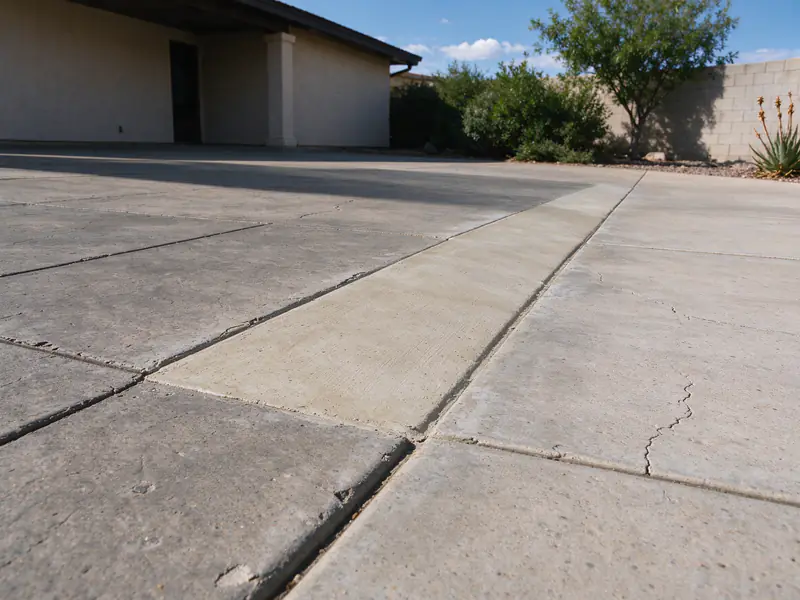
Concrete slab edge raised about an inch by a tree root at a Phoenix driveway
Close view of a smooth ground bevel joining two concrete slabs in Phoenix
Shrouded grinder and shop vacuum beside a partly ground slab edge in Phoenix
Finished ground transition between a Phoenix driveway and sidewalk with no step
Raised edge on your drive or walk? Get an Estimate.
Send a photo of each lip with a tape measure standing on the low side. The estimate says whether it can be ground, lifted or needs replacing.
As a practical rule, offsets up to about an inch grind well. Past that, the bevel has to run so far back into the high panel to stay gradual that it removes a lot of the slab's top surface, and it can thin the edge or reach the reinforcement. Higher offsets usually point to lifting the low panel or replacing the high one.
Will grinding stop a slab from rising again?
No. Grinding removes the lip that is there now; it does nothing to the root, swelling clay or settlement that made it. If the slab is still moving, a new lip forms over time. That is why the visit checks whether the movement has stopped before grinding is recommended.
Does a ground trip hazard look different from the rest of the concrete?
Yes. Grinding cuts through the broom finish and the cement paste on top, so the bevel shows a smooth, lighter band with sand and some stone exposed. It weathers toward the color of the slab over time but stays smoother. On colored or stamped concrete the difference is more obvious.
Is grinding or lifting better for a raised driveway edge?
It depends on which panel moved. If the low panel sank and is whole, lifting it closes the step and fixes the drainage at the same time. If the high panel rose and the lip is small and stable, grinding is quicker and leaves both panels where they are. A step that holds water usually needs lifting or replacement, not grinding.
Is concrete grinding dusty?
Dry grinding throws fine silica dust, so the work is done with a grinder whose shroud is connected to a vacuum, the dust-control method OSHA's silica standard names for handheld grinders. Some slurry and dust still lands nearby, so cars are moved, windows closed and the area cleaned when the work is done.