111days a year reach 100°F or more at Sky HarborNOAA climate normals
0.6nights a year drop to freezing at Sky Harbor, so heat and water, not frost, drive most damageNOAA
June 15 to September 30 is monsoon seasonNational Weather Service
Phoenix treats up to 10.5 ft of concrete drive past a roll curb as on-site work, with no separate driveway permit
Concrete for a residential driveway in the Phoenix right-of-way is 6-inch Class A
Last Updated:
Parking lot repair restores the asphalt that customers, employees and residents park on: the stalls, the drive aisles, the entrances and the drainage points between them. The right repair depends on where and why the pavement failed, because a lot that cracks only along its main drive aisle needs different work from one that is wearing out evenly everywhere. Sundial Driveway Repair is a service company offering and managing parking lot repair across Phoenix and its suburbs, for retail, office, HOA and multifamily properties, and the work is fulfilled by licensed and insured contractors.
Parking lots fail in patterns. The drive aisles carry the moving traffic, the dumpster approach takes the heaviest trucks, and the low spots collect the water. Reading those patterns is how a repair budget gets spent where it does the most good. For entrances and drive lanes that connect to the street, see commercial driveway repair.
What happens on the first visit
The first visit walks the whole lot rather than going straight to the worst pothole. It looks at the surface, the joints and edges, where water runs and stands, and the transitions at entrances, curbs and sidewalks. Each distress is mapped by type and location: individual cracks, interconnected alligator cracking, potholes, ruts, raveling, and ponding. Cracks are checked for width and offset, and sometimes a patch area is cut open to see the base.
The estimate names the method, the area for each repair, any part in the street right-of-way and what it excludes. Findings that change the scope, such as soft base under a drive aisle or caliche, are explained before work goes further. The result is a plan that says what is being fixed now and what is being left to watch.
How lot pavement fails in the Phoenix heat
Sun and oxidation
Asphalt is aggregate held together by a bitumen binder. Sunlight and heat oxidize the binder over time, so it stiffens and turns from black to gray. Stiff, brittle asphalt cracks instead of flexing and starts to lose fine aggregate from the surface, which is called raveling. Sky Harbor averages 111.3 days a year at 100°F or hotter (NOAA climate normals), so the surface spends a long season under that stress. Sealcoat slows the process on pavement that is still sound; it doesn’t restore asphalt that has already cracked through.
Soft asphalt and turning wheels
The same heat softens the binder during the day. Where cars turn their wheels while parked, or trucks brake and stand, softened mix scuffs and shoves. In the drive aisles, repeated loads press wheel ruts into a thin section. Neither is a surface flaw that sealcoat or crack filler can correct; the deformed mix is cut out and replaced.
Fatigue and failed base
Alligator cracking is the sign of fatigue: the pavement has been bending under loads more than it can take, usually because the base beneath it has weakened. It shows up first where traffic is heaviest, such as the main aisle and the route refuse trucks take. Crack sealing doesn’t help here, because the problem is the support, not the cracks. The alligator cracking guide explains how to recognize it and why it spreads.
Water at the low points
Lots are graded to send water to catch basins, retention areas or the street. Where a low spot holds water, or the asphalt around a catch basin settles and breaks, water soaks into the base and weakens it, and potholes follow. Monsoon season runs June 15 to September 30 under the National Weather Service definition, and the storms that come with it test every low point at once. The City of Phoenix’s Parking Requirements Guideline has site plans show the stormwater path, catch basins and retention, so drainage repairs follow the approved grades rather than inventing new ones.
How each repair is matched to the damage
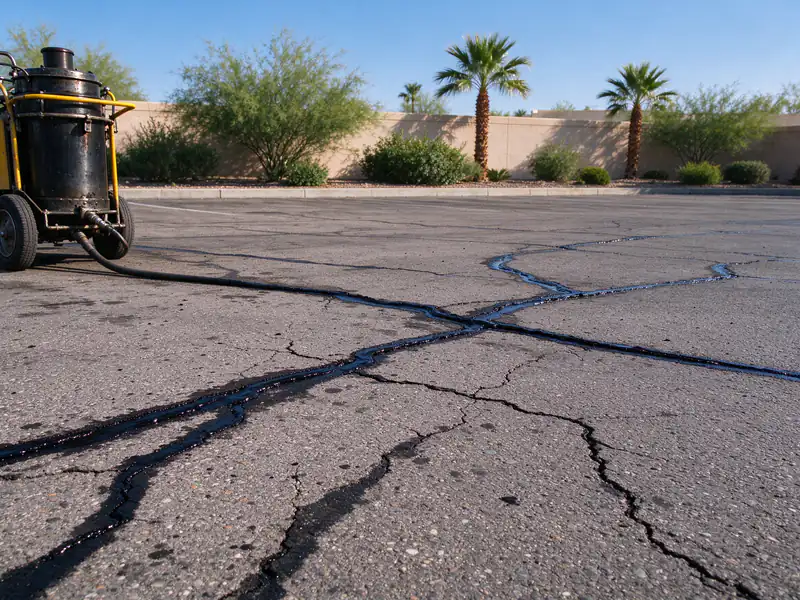
Crack sealing. Individual cracks in sound pavement are cleaned and sealed with a hot rubberized sealant to keep water out of the base. It is maintenance, and it is the wrong tool for alligator cracking.
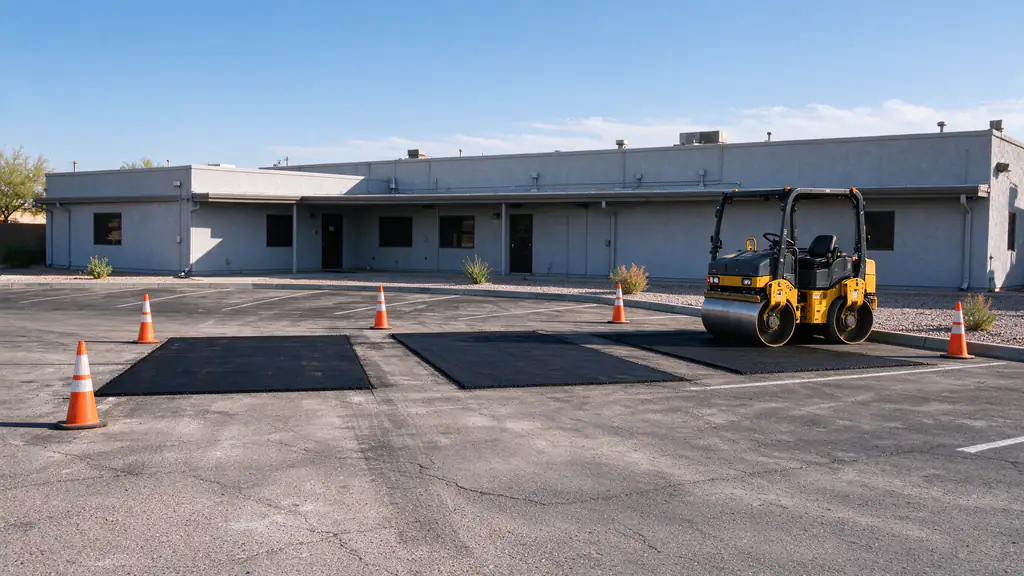
Saw-cut full-depth patching. Potholes and fatigue areas are cut out in clean rectangles beyond the visible damage, the failed asphalt and soft base are removed, new base is compacted, and hot mix is placed and rolled. A surface patch over a failed base breaks up again.
Mill and overlay. When the base is sound but the surface is worn, oxidized or raveling, the top layer is milled off and new asphalt laid. An overlay over widespread base failure reflects the old cracks.
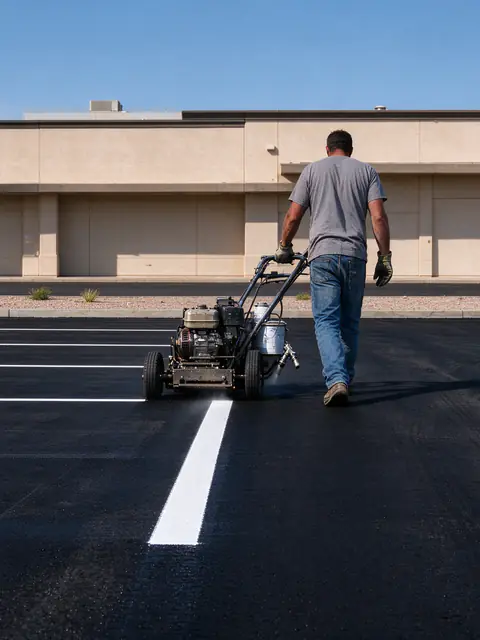
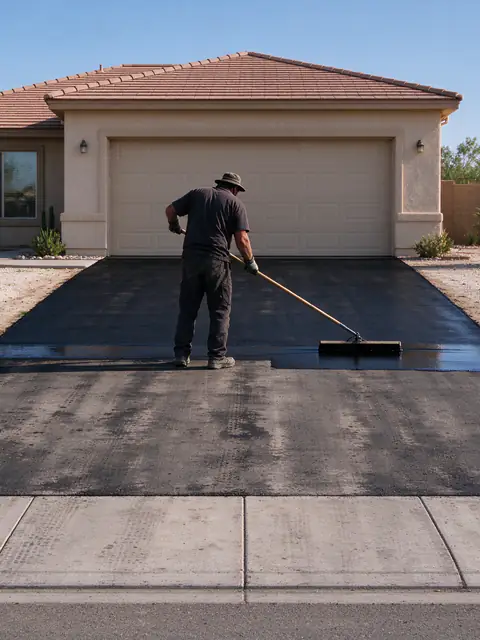
Sealcoat and restriping. After repairs, a sealcoat protects the surface and the lines are laid out again on the parking lot striping page. Sealcoat is a coating, not resurfacing, and the sealcoating guide covers when it pays.
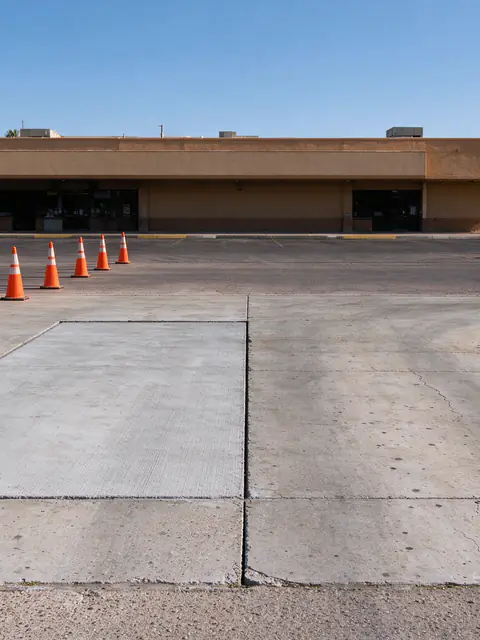
Concrete items in a lot, such as curbs, wheel stops, sidewalks and a pad in front of the dumpster enclosure, are repaired as concrete; concrete driveway repair explains those methods.
Rules that apply to parking lots
In Phoenix, every parking area needs a dust-free surface under Zoning Ordinance Section 702, which typically means asphalt or concrete, along with striping and 6-inch safety curbing around parking and maneuvering areas. Accessible spaces follow Section 702.6, which the City applies alongside the 2010 ADA Standards for Accessible Design; repairs that disturb those spaces have to put them back, and the striping page explains that layout as context.
Unpaved lots fall under Maricopa County Rule 310.01. At non-residential sites used more than 35 days a year, the lot must be paved, treated with a non-water dust suppressant plus a trackout control device, or covered with gravel that is spread and maintained evenly. Visible dust can’t cross the property line, and trackout of 25 cumulative linear feet or more onto curbs, gutters or sidewalks has to be cleaned up. A gravel lot that keeps failing those limits is one reason to look at paving.
Placement temperature matters too. ADOT’s specification for state work places asphaltic concrete when the surface is at least 85°F and the air at least 70°F and rising, and stops at 75°F and falling. Sky Harbor’s normal December and January highs sit below 70°F, so winter mornings and cool days can push paving later in the day. The Glendale and Mesa pages cover those cities’ permit offices.
Licensing, cost and payment notes
The Arizona Registrar of Contractors licenses commercial asphalt paving under A-14, which also covers seal coating, and seal coating with surface crack repair and painted markings under A-15; concrete curbs and pads fall under C-9. The ROC lookup guide shows how to check a license.
No published price range fits commercial lot work, so repairs are quoted from measured quantities. What moves the number: the total area of saw-cut patching and its depth, how much base has to be rebuilt, linear feet of crack sealing, overlay area and thickness, haul-off, drainage corrections, traffic control and phasing so the lot stays partly open, off-hours work, and sealcoat and restriping afterward. The sealcoating cost guide covers the coating side. The Arizona Department of Revenue’s contracting rules decide how tax is built into the price; that is general information, not tax advice. When you have the site plan ready, ask for an estimate.
VIIVIVIVIIIIII
02
What's included
A walk of the whole lot: drive aisles, stalls, entrances, curbs and drainage
A distress map that sorts cracks, potholes, fatigue areas and ponding by location
A measured area and a named method for each repair
Saw-cutting, removal and haul-off of failed asphalt
Base repair and compaction under full-depth patches
New hot mix placed and compacted in each patch
Crack sealing on pavement that is still sound
VIIVIVIVIIIIII
03
Parking lot repairs compared
Parking lot repairs compared: what each fixes and what it leaves
Repair
Best for
Won't fix
Price basis
Crack sealing
Individual cracks in pavement that is otherwise sound
Alligator cracking or failed base
Drivers only; quoted by measured linear feet
Saw-cut full-depth patch
Potholes and alligator-cracked areas over failed base
Wear across the whole lot
Drivers only; quoted by measured area and depth
Mill and overlay
A worn, oxidized or raveling surface on a sound base
Base failure, which reflects through
Drivers only; quoted by area and thickness
Sealcoat
Protecting sound asphalt from sun and water after repairs
Any structural crack or base problem
Drivers only; see the sealcoating cost guide
Drainage repair
Ponding at low spots and broken catch basin edges
Grades the approved site plan doesn't allow
Drivers only; quoted per job
04
Related resources
Guides that go deeper on parking lots decisions in the Valley.
How to recognize fatigue cracking, the base and water problems behind it, how it differs from other asphalt cracks, and why the repair has to go below the surface.
What a sealcoat does to asphalt under Valley sun, the driveways it helps and the ones it can't, how to time it around heat and monsoon storms, and what to check before paying for it.
What sealcoating a residential asphalt driveway costs as a national budgeting example, what crack filling and patching add, what drives commercial lot pricing, and what sealcoat can and can't do for the money.
05
How the work runs
First call or estimate request
Describe the surface, what changed and roughly where the property is. Photos of the damage and the street edge help. The published ranges give you a budget to think about before any visit.
A look at the whole driveway
The visit looks at more than the damaged spot: the slab or asphalt, the joints and edges, where water runs, and the transitions at the garage, sidewalk and street. The damaged area is measured, and anything found that changes the scope, such as soft base or caliche, is explained in the estimate.
Work timed for the heat
Hot-weather practice from the American Concrete Institute caps concrete at 95°F at discharge for general work, so summer pours are planned for the cooler part of the day. Where the job crosses into the street right-of-way, the city's permit is part of the scope.
Cure and handover
How long the car stays off depends on the material and the temperature. That wait is set out before the work starts, so you can plan around it.
VIIVIVIVIIIIII
06
What this work looks like
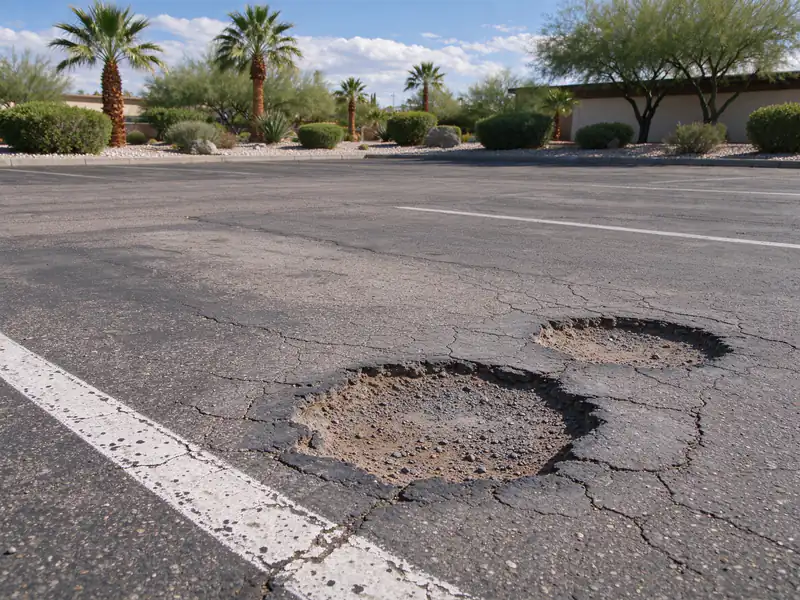
Potholes and alligator cracking in an older Glendale parking lot drive aisle
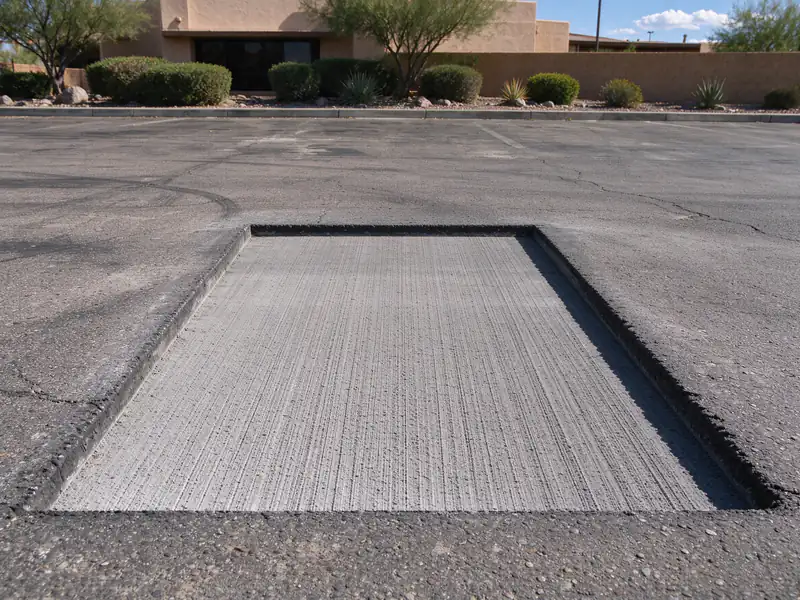
Milled rectangular area in an asphalt parking lot in Glendale ready for new asphalt
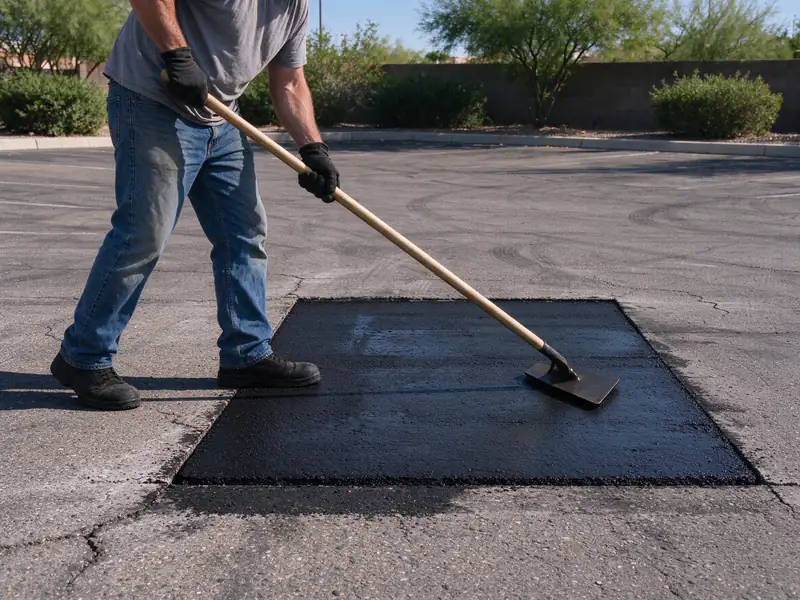
Fresh asphalt being spread with a lute inside a saw-cut parking lot patch in Glendale
Cracks sealed with black rubberized sealant across a Glendale parking lot
Potholes or cracking across your lot? Get an Estimate.
Send an aerial photo or site plan with the damage marked, plus the hours the lot can close. The estimate maps each repair, its area and method, and what it leaves for later.
Is it better to patch potholes or overlay the whole parking lot?
It depends on how much of the lot has failed underneath. If the potholes and alligator cracking sit in a few areas, such as the main drive aisle or the dumpster approach, saw-cut patches over rebuilt base fix them and the rest can be sealed. If failure is spread across the lot, an overlay laid over it will crack where the old pavement does.
Why does a parking lot crack around the dumpster enclosure?
Refuse trucks are among the heaviest vehicles a lot sees, and they stop, lift and turn in the same spot. The truck's front wheels and the steel feet of a loaded bin put concentrated loads on the pavement, and asphalt softened by heat deforms and fatigues under them. A concrete pad in front of the enclosure is one way to take that load off the asphalt.
Can a business park customers on a gravel or dirt lot in Maricopa County?
Only with dust controls. Maricopa County Rule 310.01 limits dust from unpaved lots, and at non-residential sites used more than 35 days a year the lot has to be paved, treated with a dust suppressant and trackout control, or covered with maintained gravel. In Phoenix, parking areas must also have a dust-free surface, which typically means asphalt or concrete.
Does parking lot repair need a city permit?
Work inside the lot often doesn't, but it depends on the city and the scope. Work that reaches the street right-of-way does: Phoenix charges $48 per 100 square yards for a paving right-of-way permit, plus $240 in City lab tests on paving permits over $500. Chandler lists inspection fees for parking-area paving and overlays. The permit question is confirmed per address before work starts.
What should I gather before requesting a parking lot repair estimate?
An aerial photo or site plan with the problem areas marked, close photos of each, and a note of where water stands after rain. Add the hours the lot can close, how many entrances it has, where refuse and delivery trucks run, and when it was last sealcoated or striped. Past repair records help sort old patches from new failures.