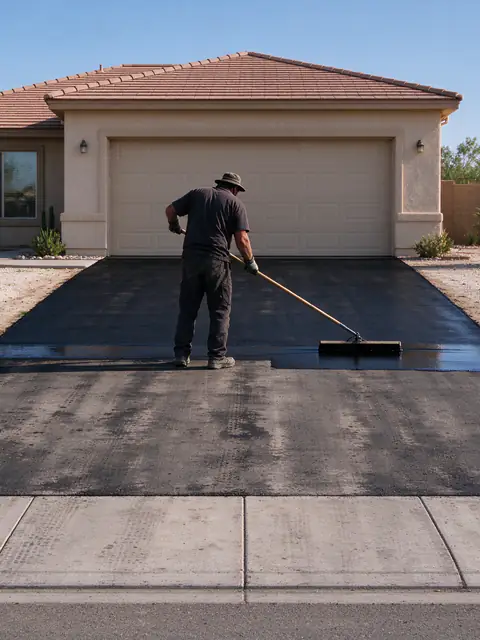
What sealcoating a residential asphalt driveway costs as a national budgeting example, what crack filling and patching add, what drives commercial lot pricing, and what sealcoat can and can't do for the money.
Last Updated:
Short answerAs a national budgeting example, sealcoating a typical residential asphalt driveway runs roughly $280 to $870, depending on size, prep and crack repair. Filling cracks first adds a national budgeting range of about $0.50 to $3 per linear foot, and potholes are patched separately, at a typical Phoenix-area $100 to $415 each.
Sealcoating driveway cost, as a national budgeting example, runs roughly $280 to $870 for a typical residential asphalt driveway, with size, cleaning and crack repair setting where a job falls. Sundial Driveway Repair is a service company offering and managing driveway sealcoating across Phoenix and the surrounding Valley, fulfilled by licensed and insured contractors. This guide covers what the price includes, what is priced alongside it, and what sealcoat does and doesn’t do for an asphalt driveway.
Each figure is labeled as a national budgeting figure or a typical Phoenix-area range, and none is a quote. The driveway sealcoating page explains the work, and is sealcoating worth it covers whether to do it at all.
What does sealcoating cost, and what is priced with it?
The sealcoat itself is priced per driveway here. The repairs that should come first are priced separately.
Work
Range
Unit
What it covers
Range type
Residential asphalt sealcoating
$280 to $870
per driveway
Cleaning and sealcoating a typical residential driveway, depending on size, prep and crack repair
Cleaning and sealing a paver driveway (not sealcoat)
Typical Phoenix area
The residential figure is a national budgeting example, not a Phoenix rate. Per-square-foot sealcoating rates from different sources, including an older Phoenix figure, disagree by three times or more, so no per-square-foot rate is published on this site.
What does sealcoat actually do for the money?
Sealcoat is a thin coating spread over asphalt to slow the weathering of the surface. Sun and oxygen dry out the asphalt binder over time, which turns the surface gray and lets fine aggregate loosen, the start of raveling. A fresh coat fills surface pores, can help the surface shed oil and gasoline drips, and restores a dark, even color. Those are real benefits on a driveway that is structurally sound.
It does nothing structural. Alligator cracking, the interconnected pattern that looks like reptile skin, means the pavement or its base has failed under load; the alligator cracking guide explains why crack filler and sealcoat can’t fix it. Potholes, ruts and soft spots need patching or base repair first. Sealcoating is also not resurfacing: an overlay adds a new layer of asphalt, and the resurfacing cost guide covers that price.
Why does prep move the price so much?
A sealcoat bonds only to a clean, dry surface. Prep starts with removing dirt, sand and debris, often with blowers, brooms or power washing, then treating oil and gasoline spots, which can stop sealcoat from sticking. Cracks are cleaned and filled with a flexible crack sealant. Edges along the garage, walkways and landscape are cut in by hand so sealer doesn’t get onto concrete or rock. Then the coat is applied by squeegee, brush or spray, sometimes in two coats, and the driveway is closed until it dries.
A driveway with few cracks and little staining sits low in the range. One with long runs of cracks, heavy oil spots, raveled edges and a few potholes costs more, and some of that work is priced as separate lines.
What moves the price of sealcoating?
Factor
Why it moves the price
What to check
Driveway area
Material and labor scale with area; small driveways carry a minimum charge
Measured area
Number of cracks
Crack filling is labor-heavy and is sometimes a separate line
Total crack length
Patches and potholes
Failed spots must be repaired before sealing
Number and size of potholes or soft areas
Extent of failed base
Widespread base failure makes sealcoat money poorly spent
Alligator cracking, ruts, sinking
Surface condition
Oil spots, raveling and loose aggregate need extra prep
Stains, loose stones at the edges
Edge complexity
Hand work along garage slabs, walks, borders and pavers
How much edge the driveway has
Coats and product
Two coats or additives use more material
What the quote specifies
Weather and season
Sealers have application temperature and drying limits on their labels; monsoon rain can wash out a fresh coat
Timing, especially June 15 to September 30
Access and traffic
Commercial lots are sealed in phases around business hours
Parking, deliveries, closures
What’s inside a Phoenix sealcoating price?
Part of the price
What sets it
Local figure and source
Sealcoat and paving labor
Cleaning, crack filling, application, edge work
Paving, surfacing and tamping equipment operators (SOC 47-2071): mean $29.10 an hour in the Phoenix-Mesa-Chandler metro vs $28.37 nationally; median $26.77 vs $25.64 (BLS wage data)
Helper labor
Prep, blowing, hand edging, cleanup
Construction laborers (SOC 47-2061): mean $23.40 an hour in the metro vs $25.02 nationally (BLS national data)
Sealcoat material
Product type, coats and coverage
No public local price figure; quotes should name the product
Right-of-way permit
Seal coat on paving in the street right-of-way
Phoenix paving permit, which covers seal coat: $48 per 100 sq yd or fraction, $195 residential minimum, $195 as-built review (City of Phoenix fee schedule)
Built into materials rather than added as an invoice line on maintenance and repair work (Arizona Department of Revenue)
Overspray and cleanup
Protecting concrete, rock and walls
No public figure; scope to check on the quote
A wage is not a billing rate. The rate built into a quote also carries insurance, licensing, trucks, equipment and overhead. Paving equipment operators in the Phoenix-Mesa-Chandler metro earn a mean $29.10 an hour, about 3% above the $28.37 national mean, a gap too small to explain a high sealcoating quote on its own. Prep and repair scope explain far more.
Does sealcoating need a permit?
Sealcoating a driveway on your own lot generally needs no City permit. Phoenix’s paving permit lists seal coat among the work it covers in the street right-of-way, so sealing pavement beyond the property line can need one: $48 per 100 square yards, a $195 residential minimum, a $195 as-built review and $240 in City lab tests on paving permits over $500. Other cities run their own right-of-way rules; the Phoenix driveway permit guide covers when the City’s rules apply.
Are there rebates for sealcoating?
No. No City of Phoenix, utility, county or federal program found pays toward sealcoating a driveway or parking lot. The City’s cool-pavement coating program applies to City streets as part of its street maintenance, not to private driveways.
What could a sealcoating budget look like?
These are illustrative arithmetic from the ranges above, with assumed quantities. They are not quotes.
Example (illustrative)
Assumed scope
Arithmetic
Illustrative budget
Sealcoat only
A typical residential asphalt driveway in fair shape
National budgeting example
$280 to $870
Sealcoat plus crack filling
Same driveway with 80 linear ft of cracks
$280 to $870, plus 80 × $0.50 to $3 = $40 to $240 (both national budgeting examples)
$320 to $1,110
Sealcoat, cracks and potholes
Same driveway, 80 linear ft of cracks and two potholes over sound base
$320 to $1,110, plus 2 × $100 to $415 = $200 to $830
$520 to $1,940
When the third row starts to grow, with more potholes, soft spots and alligator cracking, sealcoat stops being the right spend. That is the point to look at patching by area, an overlay or replacement; the driveway repair cost guide and the replacement cost guide cover those.
What do commercial lot sealcoating prices depend on?
Commercial and HOA lots have no published range on this site; they are priced from the site. Area is the starting point, but crack filling quantity, patching, the number of phases needed to keep the lot open, traffic control, and restriping all add lines. Striping is often bundled because fresh sealcoat covers the old lines; the parking lot striping and parking lot repair pages cover that work, and the commercial driveway repair page covers the rest.
How do you compare sealcoating quotes?
Check that each one names the sealcoat product, the number of coats, how the surface is cleaned, how oil spots are treated, whether cracks are filled and how they are priced, which potholes or soft spots are repaired first, how edges are protected, and how long to keep vehicles off. A price given without measuring or looking at the cracks isn’t a quote. Arizona generally requires a Registrar of Contractors license once a job tops $1,000 in labor and materials or needs a permit; the license lookup guide shows how to check for R-13.
For a budget on repairs alongside sealing, the cost estimator uses the same published ranges, and you can ask for an estimate with photos of the driveway and its cracks.
VIIVIVIVIIIIII
02
More questions on this
Is sealcoating priced per square foot or per driveway?
Contractors use both, but published per-square-foot sealcoating rates disagree by three times or more, so this site gives a per-driveway figure instead: a national budgeting example of roughly $280 to $870 for a typical residential asphalt driveway. Size, the amount of crack filling and patching, and how much cleaning the surface needs move a job within that range.
Does a sealcoating price include filling the cracks?
Not always. Some quotes include light crack filling; others price it per linear foot or leave it out. A national budgeting range for asphalt crack filling is about $0.50 to $3 per linear foot, usually with a minimum charge. Sealing over open cracks without filling them leaves the water path in place, so check which approach the quote takes.
Should potholes be patched before a driveway is sealcoated?
Yes. Sealcoat is a thin surface coat and can't fill a pothole or hold up over a soft spot, so potholes and failed areas are repaired first. Patching a single pothole over sound base runs a typical Phoenix-area $100 to $415; where the base has failed, the repair is saw-cut and rebuilt and priced by area. A sealcoating quote that skips the potholes is pricing a coat that won't last over them.
VIIVIVIVIIIIII
03
Get an Estimate for sealcoating
Tell us the surface, what changed and the nearest cross streets. Photos of the damage and the street edge make the estimate more useful.
Typical Phoenix-area and national budgeting ranges for each kind of driveway repair, what is inside the price, the City permit fees, and worked example budgets.
What a bonded concrete overlay and an asphalt overlay cost, what prep is priced on top, how the numbers compare with replacement, and the conditions that make resurfacing money poorly spent.
What swapping damaged pavers, resetting a sunken section and cleaning and sealing a paver driveway cost, why the base under the pavers sets the price, and what to look for on a quote.
The two numbers behind a concrete driveway replacement, tear-out and new pour, plus what base repair, grade correction, the apron and permits add, with illustrative budgets.
There is no single published price for a gravel-to-concrete conversion. This guide builds the budget from its parts: the new pour, the site work under it, the street end and the permits.