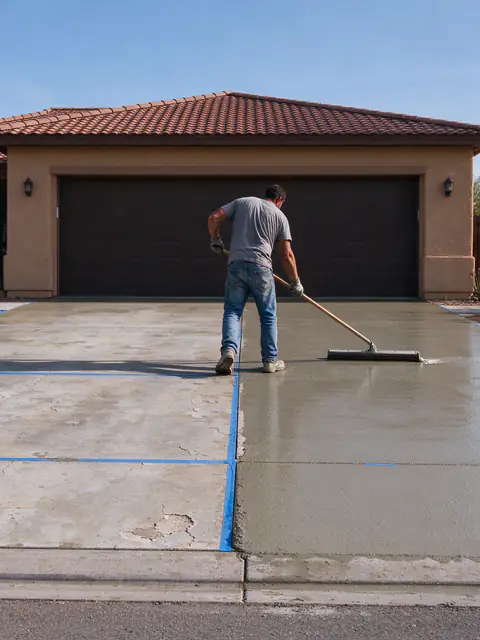
What a bonded concrete overlay and an asphalt overlay cost, what prep is priced on top, how the numbers compare with replacement, and the conditions that make resurfacing money poorly spent.
Last Updated:
Short answerA typical Phoenix-area range for resurfacing a sound concrete driveway is about $5 to $10 per square foot, with decorative overlays costing more. For asphalt, a national budgeting example for an overlay on a sound base is roughly $1 to $4 per square foot. Crack, spall and base repairs are priced on top.
Driveway resurfacing cost in the Phoenix area sits at about $5 to $10 per square foot for a bonded overlay on sound concrete, and the price only makes sense when the slab underneath is solid. Sundial Driveway Repair is a service company offering and managing driveway resurfacing across Phoenix and its suburbs, fulfilled by licensed and insured contractors. This guide covers what resurfacing costs, what prep is priced on top, and how to tell whether the money is better spent elsewhere.
Each figure is labeled as a typical Phoenix-area range or a national budgeting figure. None is a quote. The driveway resurfacing page explains the work itself, and the resurfacing vs replacement guide covers the decision in depth.
What does resurfacing cost by surface type?
The answer depends on whether the driveway is concrete or asphalt, because the two are resurfaced with different materials and methods.
Work
Range
Unit
What it covers
Range type
Concrete resurfacing (bonded overlay)
$5 to $10
per sq ft
Cleaning, preparing and applying a cement-based overlay to a level, solid slab
Filling cracks in sound asphalt, usually with a minimum service charge
National budgeting range
Asphalt pothole patch before an overlay
$100 to $415
per pothole
One pothole over sound base; failed base is cut out and priced by area
Typical Phoenix area
The asphalt overlay figure is a national budgeting example, not a Phoenix rate. Sources disagree on it, and older or more damaged surfaces sit above it. On concrete, the Phoenix-area range runs higher than some national figures for basic overlays, which is one more reason to read the scope line by line.
Why does resurfacing cost what it does?
A concrete overlay is only as good as its bond. The slab is cleaned and profiled, often by grinding or pressure washing, so the new material can grip it. Cracks are cleaned and filled, spalled or scaled patches are repaired, and expansion and control joints are kept open through the overlay so the slab can still move at those lines. The overlay is then placed, finished and cured, in summer during cooler hours. Most of that work is prep, which is why a heavily worn slab costs more to resurface than one with light surface wear.
Asphalt overlays work differently. Failed areas are cut out and patched first, the surface is cleaned and tack-coated, edges and transitions at the garage and street are adjusted so the added height doesn’t create a lip, and a new layer of hot-mix is placed and rolled. An overlay over failed base reflects the old cracks back through, so the patching is not optional.
Neither of these is sealcoating. Sealcoat is a thin maintenance coat on asphalt, priced per driveway; the sealcoating cost guide covers it.
When is resurfacing not worth the money?
Resurfacing is wasted on a slab that is still moving. If panels have sunk or lifted at the joints, sound hollow when tapped, or have cracks that are offset or growing, the overlay bonds to a moving surface and cracks again along the same lines. The fix there is leveling, section replacement or full replacement, depending on how much of the drive is affected. The leveling cost guide and the driveway replacement cost guide cover those prices.
Surface damage is different. Scaling, pitting, worn paste and fine shrinkage cracks on a slab that sits firm are what an overlay is for. The spalling guide explains where surface flaking comes from, and the heat and driveways guide covers what Phoenix temperatures do to a slab.
What moves the price of driveway resurfacing?
Factor
Why it moves the price
What to check
Driveway area
Per-square-foot rates apply above the minimum job size
Measured area of the surface being resurfaced
Pavement type
Concrete overlays and asphalt overlays use different crews and materials
Concrete or asphalt
Resurfacing thickness
Thicker overlays use more material and may need edge transitions
Planned thickness at the garage and street edges
Crack and spall count
Each crack and damaged patch adds prep before the overlay
Total crack length; number and size of spalled areas
Extent of failed base
Areas with soft base must be cut out and rebuilt first, or the overlay will fail there
Hollow spots, panels stepping at joints
Finish
Tinted, stained or stamped overlays cost more than a plain finish
The finish you want and any HOA approval
Transitions
Overlay height must tie into the garage slab, sidewalk and street without a trip edge
Overlays are placed in cooler hours in summer and kept from drying too fast
Timing for June through September work
What’s inside a Phoenix driveway resurfacing price?
Part of the price
What sets it
Local figure and source
Concrete overlay labor
Surface prep, mixing, placing and finishing the overlay
Cement masons and concrete finishers (SOC 47-2051): mean $29.25 an hour in the Phoenix-Mesa-Chandler metro vs $28.87 nationally; median $28.49 vs $27.41 (BLS wage data)
Asphalt overlay operation
Paving and rolling the new asphalt layer
Paving, surfacing and tamping equipment operators (SOC 47-2071): mean $29.10 an hour in the metro vs $28.37 nationally (BLS national data)
Prep and cleanup labor
Grinding, washing, patch removal, haul-off
Construction laborers (SOC 47-2061): mean $23.40 an hour in the metro vs $25.02 nationally (BLS)
Asphalt placement conditions
When hot-mix can be placed
Hot-mix needs a warm surface and rising air temperature to compact; Sky Harbor’s normal daily high stays below 70°F in December and January (NOAA climate normals), so cool winter mornings can limit when an overlay goes down
Right-of-way permit
Overlay or paving that extends into the street right-of-way
Phoenix paving permit: $48 per 100 sq yd or fraction, $195 residential minimum, $195 as-built review (City of Phoenix fee schedule)
HOA approval
Review of color and finish for decorative overlays
Resetting rock, edging or irrigation along raised edges
No public figure; scope to check on the quote
A wage is not a billing rate. The rate inside a quote also covers insurance, licensing, vehicles, equipment and overhead. Concrete finishers in the Phoenix-Mesa-Chandler metro earn a mean $29.25 an hour, about 1% above the $28.87 national mean, so local wages don’t explain a high resurfacing quote. Prep and the condition of the slab do.
Do you need a permit to resurface a driveway?
Resurfacing a driveway on your own lot generally needs no City permit. Work that reaches into the street right-of-way can. In Phoenix, the paving permit covers asphalt and seal coat in the right-of-way at $48 per 100 square yards, with a $195 residential minimum and a $195 as-built review, plus $240 in City lab tests on paving permits over $500. Other cities run their own right-of-way permits, and the Phoenix driveway permit guide covers when the City’s rules apply.
Are there rebates for driveway resurfacing?
None. No City of Phoenix, utility, county or federal program found pays toward resurfacing a driveway, and Phoenix has no sidewalk repair cost-share. The City’s grass removal incentive pays for removing living lawn and says nothing about hardscape, so it does not apply to resurfacing an existing drive.
What could a resurfacing budget look like?
These are illustrative arithmetic from the ranges above, with assumed sizes. They are not quotes.
Example (illustrative)
Assumed scope
Arithmetic
Illustrative budget
Plain concrete overlay
500 sq ft of level, solid concrete with light wear
500 × $5 to $10
$2,500 to $5,000, plus crack and spall prep
Same slab, compared with replacement
500 sq ft new pour plus removal
500 × $6 to $11 pour; 500 × $1.20 to $1.90 removal
$3,000 to $5,500 pour, plus $600 to $950 removal
Crack prep before the overlay
60 linear ft of cracks
60 × $0.50 to $5
$30 to $300, so a minimum charge may set it
Asphalt overlay
600 sq ft of asphalt on a sound base
600 × $1 to $4 (national budgeting example)
$600 to $2,400, plus any patching
The second row is the one to look at. When a slab needs heavy prep, a resurface can land close to the cost of a new pour, without the new base or the fresh start. That is when a contractor’s advice to replace deserves a hearing, and when a second opinion that checks the same signs is worth having.
How do you compare resurfacing quotes?
Check that each one states the area, the overlay product type and thickness, the surface prep method, how cracks and spalled areas are repaired, how joints are carried through, how edges tie into the garage and street, the cure time before driving and what is excluded. A quote that says nothing about the condition of the slab underneath hasn’t answered the main question. Arizona generally requires a Registrar of Contractors license when a job tops $1,000 in labor and materials or needs a permit; R-9 covers residential concrete and R-13 residential asphalt. The license lookup guide shows how to check.
How can I tell if a contractor is right that my driveway can't be resurfaced?
Ask what they found and how. A slab that rocks, sounds hollow when tapped, has panels stepping at the joints, or has cracks that keep widening is moving, and an overlay bonded to it will crack in the same places. A slab with surface wear, scaling or fine cracks but solid support is a reasonable candidate. A second opinion that checks the same things is fair to ask for before paying for replacement.
Does resurfacing cost less than replacing a concrete driveway?
Per square foot it can be close. A typical Phoenix-area range is about $5 to $10 per square foot to resurface and about $6 to $11 per square foot for a new standard pour, plus $1.20 to $1.90 per square foot to remove the old slab. Resurfacing saves the removal and base work, but only on a slab that is still sound; on a failing slab it is money spent twice.
Can a resurfaced driveway be colored or stamped?
Yes. Decorative overlays can be tinted, stained or stamped, and they cost more than a plain bonded overlay because of the extra material, layers and finishing time. Color on a new overlay will not exactly match untreated concrete elsewhere on the property, and the overlay still depends on the slab underneath staying put.
VIIVIVIVIIIIII
03
Get an Estimate for resurfacing
Tell us the surface, what changed and the nearest cross streets. Photos of the damage and the street edge make the estimate more useful.
The two numbers behind a concrete driveway replacement, tear-out and new pour, plus what base repair, grade correction, the apron and permits add, with illustrative budgets.
Typical Phoenix-area and national budgeting ranges for each kind of driveway repair, what is inside the price, the City permit fees, and worked example budgets.
What sealcoating a residential asphalt driveway costs as a national budgeting example, what crack filling and patching add, what drives commercial lot pricing, and what sealcoat can and can't do for the money.
What mudjacking and polyurethane foam lifting cost per square foot, why small jobs price as a minimum, what drainage and joint work add, and where lifting stops being the cheaper choice.
What swapping damaged pavers, resetting a sunken section and cleaning and sealing a paver driveway cost, why the base under the pavers sets the price, and what to look for on a quote.