Driveway resurfacing vs replacement: which does your driveway need?
What resurfacing actually is on concrete and on asphalt, the condition it needs underneath, how it compares on price with a rebuild, and the height and drainage questions an overlay raises.
Last Updated:
Short answerResurface when the slab or pavement is level, solid and only worn on top: flaking, stains, fine crazing or a graying asphalt surface. Replace when it has sunk, broken, cracked across panels or failed at the base, because an overlay follows the surface beneath it and those cracks and dips come back through.
Driveway resurfacing vs replacement is a question about what lies under the surface. Resurfacing puts a new wearing layer on pavement that is still structurally sound. Replacement removes the old pavement, corrects the base and drainage, and builds a new one. Sundial Driveway Repair is a service company offering and managing driveway resurfacing and driveway replacement across Phoenix and its suburbs, fulfilled by licensed and insured contractors, and this guide explains how to tell which one a driveway needs.
The two get confused because a tired surface and a failed driveway can look alike from the street. The difference is support. If the slab or pavement is level and firm and only the top is worn, resurfacing is good value. If it has moved, it isn’t.
What does resurfacing actually do?
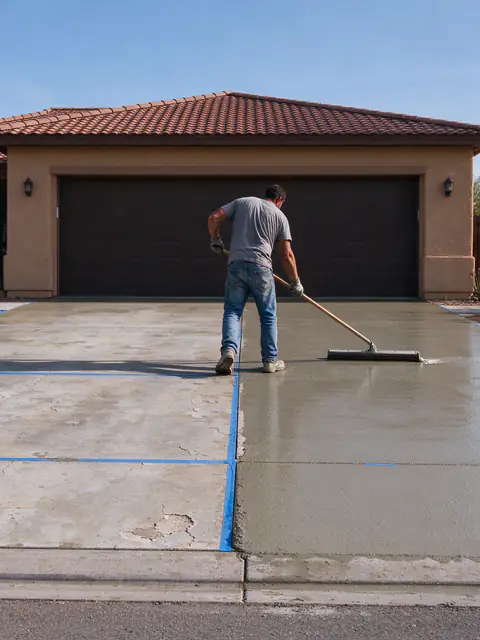
On concrete, resurfacing means a thin bonded overlay. The old surface is cleaned and profiled, usually by pressure washing and grinding or shot-blasting, so the new material can grip it. Loose and flaking concrete is removed, cracks and spalls are repaired, and a cement-based or polymer-modified resurfacer is spread across the slab and finished, sometimes with a broom texture, color or a stamped pattern. Joints are carried through the overlay so the slab can still move where it was designed to. The result is a new top on the old slab, bonded to it and moving with it.
On asphalt, resurfacing means an overlay: a new layer of hot-mix asphalt placed over the old pavement. Failed areas are saw-cut and patched first, cracks are cleaned and filled, a tack coat is sprayed so the layers bond, and the new asphalt is placed and rolled. Where the surface would rise too high at the garage or street, the old asphalt is milled down at the edges first, which is the mill-and-overlay approach.
Neither is sealcoating. Sealcoat is a thin liquid coat that protects a sound asphalt surface from sun and water; it adds no wearing layer and no thickness worth measuring. The sealcoating guide covers when it pays off.
When is resurfacing the right call?
Resurfacing fits when the driveway’s structure is fine and only the surface has aged. Typical cases on concrete are a flaking or scaled top from finishing or fast drying in the heat, popouts, light spalling, stains that won’t clean, or an old finish the owner simply wants to change. On asphalt, it fits pavement that has oxidized to gray and opened fine cracks but still has a firm base, with no ruts or alligator patterns over large areas.
Before agreeing to it, check three things. The surface should be level, without panels stepped at the joints. It should sound solid when tapped, with no hollow areas over voids. And the cracks should be dormant: marked and photographed, they haven’t grown over a season. If all three hold, resurfacing is cheaper than replacement and a good deal less disruptive. The spalling guide explains the surface defects that resurfacing treats well.
When is replacement the honest answer?
Replacement is the honest answer when the problem is below the surface. An overlay follows what is under it, so it can’t fix any of these:
Settlement. A panel that has dropped stays dropped under a new top. If it is whole, lifting can raise it first; if it is broken, it needs replacing.
Working cracks. A crack that is still opening reflects through the overlay, often within a season, as a matching line in the new surface.
A failed or washed-out base. Soft, wet or eroded base keeps moving whatever sits on top. In the Valley that often traces to monsoon runoff along an edge or irrigation keeping clay wet, which the guide to why driveways crack and sink explains.
Widespread alligator cracking on asphalt. That pattern is fatigue from a weak base, and an overlay over it cracks the same way. The alligator cracking guide covers it.
Wrong slope. A drive that sheds water toward the garage needs regrading, and a thin overlay can’t change the slope enough.
Between the two sits section work: replacing the failed panels or cutting out the failed asphalt, then deciding whether the rest needs resurfacing at all. The repair vs replacement guide covers that middle ground.
Should asphalt be patched or overlaid?
Patch when the failure is local; overlay when the base is sound but the whole surface is worn. A patch is a full repair of one area: the failed asphalt is saw-cut out, the base under it is dug out and rebuilt where it is soft, and new hot-mix is placed in compacted lifts. It deals with the cause in that spot and leaves the rest of the drive as it was. An overlay renews the whole surface, but only works if the pavement under it is firm everywhere.
In practice, the two go together. An overlay on a driveway with a few failed areas starts with patching those areas, because a soft spot left under an overlay pushes through it. If patches would cover a large share of the drive, the overlay is sitting on a pavement that is mostly patch, and a full rebuild is worth pricing. The asphalt driveway repair page covers patching in detail.
How do the costs compare?
On concrete, resurfacing and replacement are closer in price than people expect. A typical Phoenix-area range for resurfacing a sound concrete driveway is about $5 to $10 per square foot, with decorative overlays costing more. A standard broom-finish concrete driveway runs about $6 to $11 per square foot for the new pour, and removing and hauling off the old slab adds roughly $1.20 to $1.90 per square foot. So resurfacing saves the most on a slab that needs nothing else, and loses its edge quickly if it also needs crack repair, panel lifting or section replacement first. The driveway resurfacing cost guide and the driveway replacement cost guide break both down.
On asphalt, as a national budgeting example, an overlay on a sound base runs roughly $1 to $4 per square foot, with base repairs extra. Full asphalt replacement is priced per job after measuring, because it depends on how much base has to be rebuilt.
What about the garage, sidewalk and street edges?
An overlay raises the surface, and every edge has to be planned. At the garage, the drive should stay below the garage floor and slope away so water doesn’t run inside. At the sidewalk and street, the overlay has to meet existing concrete without leaving a lip. Where there is no room to add height, the edges are ground or milled down first, which adds work.
The street end has rules of its own. In Phoenix, the driveway concrete in the right-of-way is 6-inch Class A, and beyond 10.5 feet in the right-of-way, materials other than concrete and finishes other than broom need a maintenance agreement with Street Transportation, which matters if you want a colored or stamped overlay to run out to the curb. Other cities set their own terms, confirmed per address. The driveway apron repair page covers that strip.
How is the choice made on site?
The first visit looks at the whole drive: surface, joints, edges, where water runs, and the garage, sidewalk and street transitions. Cracks are checked for width, offset and whether they cross panels, and hollow spots are found by tapping. The estimate names the method, the area and what it excludes, and if the visit turns up soft base, it says so and explains how that changes the scope.
If you aren’t sure where your driveway sits, the condition assessment sorts the signs, or call the number at the top of this page and describe what you see.
VIIVIVIVIIIIII
02
More questions on this
Can a settled or cracked slab be fixed first and then resurfaced?
Yes, if the panels are whole and the cause has stopped. A settled panel can be lifted, dormant cracks repaired and spalls patched, and then the overlay goes on with the joints carried through. The catch is cost: once lifting and crack work are added, the total can approach a new pour, and any crack that is still moving will show through the new surface.
Why do cracks in an overlay line up with the old cracks underneath?
Because the old pavement keeps moving under the new layer. Where a crack in the old slab or asphalt opens and closes with temperature or with soil movement, it pulls the thin layer above it apart along the same line. This is called reflective cracking. Repairing or sealing the old cracks first slows it, but a crack over failing base reflects whatever the overlay is made of.
Does an asphalt overlay need milling first?
Not always. Milling grinds off the top of the old asphalt, and it is needed where added height would leave the drive too high at the garage floor, sidewalk or street, or would change how water drains. On a long drive with room to spare, the overlay can go straight on after patching and tack coat, with milling only at the edges where it meets other surfaces.
VIIVIVIVIIIIII
03
Get an Estimate for resurfacing
Tell us the surface, what changed and the nearest cross streets. Photos of the damage and the street edge make the estimate more useful.
What a bonded concrete overlay and an asphalt overlay cost, what prep is priced on top, how the numbers compare with replacement, and the conditions that make resurfacing money poorly spent.
The signs that point to a repair, the ones that point to a new driveway, the middle option of replacing sections, and the Phoenix soil, water and right-of-way rules that tip the choice.
Why the freeze-thaw explanation found in typical driveway advice rarely fits the Valley, the finishing, curing, steel and joint problems that do, and how the depth of the damage sets the repair.
How to recognize fatigue cracking, the base and water problems behind it, how it differs from other asphalt cracks, and why the repair has to go below the surface.
The two numbers behind a concrete driveway replacement, tear-out and new pour, plus what base repair, grade correction, the apron and permits add, with illustrative budgets.