111days a year reach 100°F or more at Sky HarborNOAA climate normals
0.6nights a year drop to freezing at Sky Harbor, so heat and water, not frost, drive most damageNOAA
June 15 to September 30 is monsoon seasonNational Weather Service
Phoenix treats up to 10.5 ft of concrete drive past a roll curb as on-site work, with no separate driveway permit
Concrete for a residential driveway in the Phoenix right-of-way is 6-inch Class A
Last Updated:
Commercial driveway repair covers the drives that serve businesses and shared property: retail and office entrances, loading drives, HOA common drives and multifamily entrances. The failures look like residential ones, cracked panels, potholes and sunken edges, but heavier loads, more traffic and city rules for commercial entrances change both the method and the planning. Sundial Driveway Repair is a service company offering and managing commercial driveway repair across Phoenix and its suburbs, in concrete and asphalt, and the work is fulfilled by licensed and insured contractors.
This page covers the entrance and drive lanes. Repairs across the parking field itself are covered on the parking lot repair page, and line work on the parking lot striping page.
What happens on the first visit
The first visit looks at the whole entrance, not only the worst spot. That covers the surface, the joints and edges, where water runs, and the transitions to the street, the sidewalk and the parking lot. Cracks are checked for width, offset and whether they cross panels, hollow concrete is found by tapping, and sometimes a section is cut out to see the base. The damaged areas are measured, and the estimate names the method for each, the area, any right-of-way portion and what it excludes, such as color match with older panels.
Commercial work also has to answer questions a driveway at a house doesn’t. When can the entrance close, and for how long? Is there a second way in for customers, deliveries and fire access? Who needs to approve the work: an owner, a property manager, an HOA board? Those answers shape how the work is phased, and they go into the estimate along with any findings, such as soft base or caliche, that change the scope.
Why commercial drives fail
Heavy, repeated loads
A commercial entrance carries refuse trucks, delivery vans and semis as well as cars. Pavement damage rises steeply with axle load, so a handful of heavy trucks can do more harm than a far larger number of cars. Concrete fails at the corners and joints first, where a slab has support on fewer sides, and a panel that has lost load transfer to its neighbor rocks and breaks under each crossing. In asphalt, repeated heavy loads on a weak base cause fatigue, which shows as alligator cracking, the interconnected pattern the alligator cracking guide describes.
Heat and the asphalt binder
Asphalt is aggregate held in a bitumen binder that softens as it warms. Sky Harbor averages 111.3 days a year at 100°F or hotter (NOAA climate normals), and pavement in the sun runs hotter than the air. Where loaded trucks brake, turn or stand at an entrance, softened mix shoves into ripples and ruts. Concrete doesn’t soften this way, which is one reason concrete is chosen for entrances that take heavy turning traffic, even when the lot is asphalt. The asphalt vs concrete guide compares the two in Valley conditions.
Water at the low points
An entrance is usually where the lot drains toward the street, and monsoon storms send concentrated runoff across it. Water that gets in through open joints and cracks softens the base and carries fines out, so panels settle and asphalt edges crumble. The City of Phoenix’s Parking Requirements Guideline requires site plans to show the stormwater path, catch basins and retention, and a grading and drainage plan may be required for sites over half an acre, so drainage changes during a repair can touch the approved plan.
How the repair is matched to the damage
The method depends on the pavement and on what the base is doing:
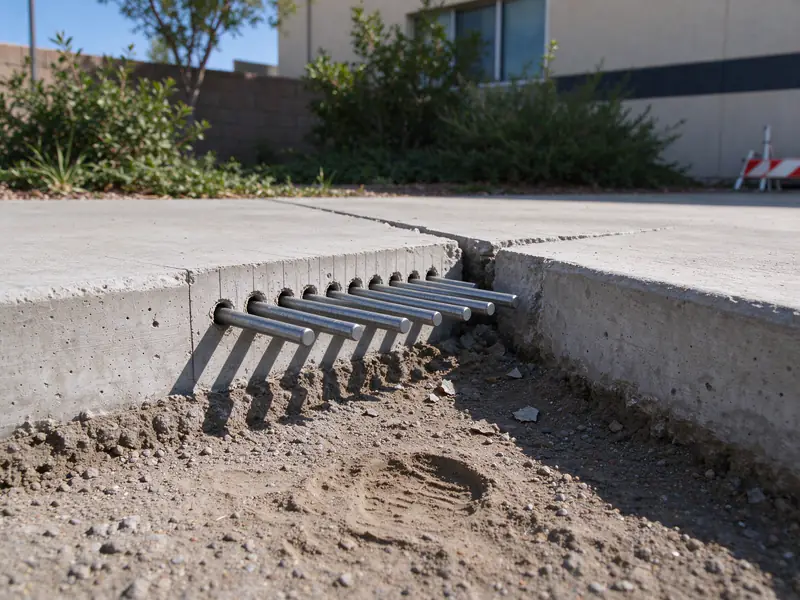
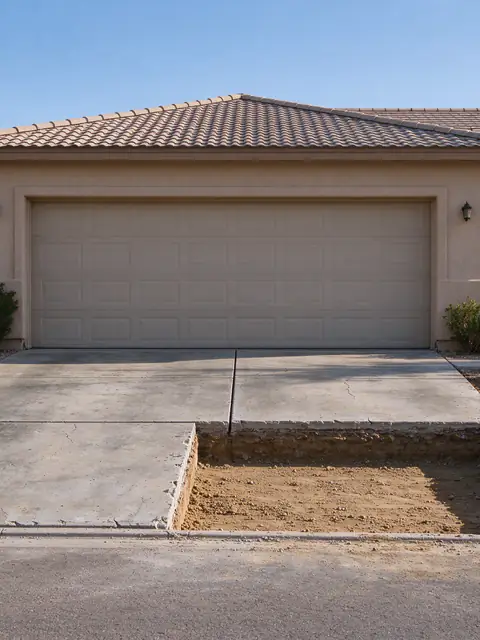
Concrete panel replacement. Broken panels are saw-cut at the joints, removed, and the base is repaired and compacted. Where the design calls for them, steel dowel bars are drilled into the edges of the neighboring slabs so the new panel carries loads across the joint instead of rocking. The new concrete is cured before traffic returns.
Partial-depth concrete repair. Spalled joints and broken edges in otherwise sound slabs are cut back to sound concrete and patched, and the joints are resealed.
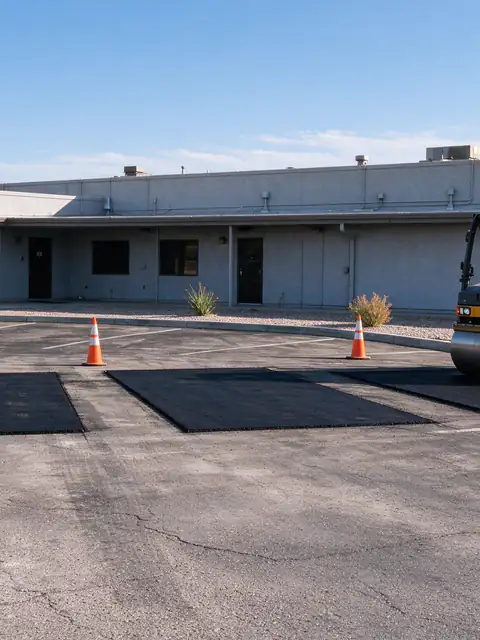
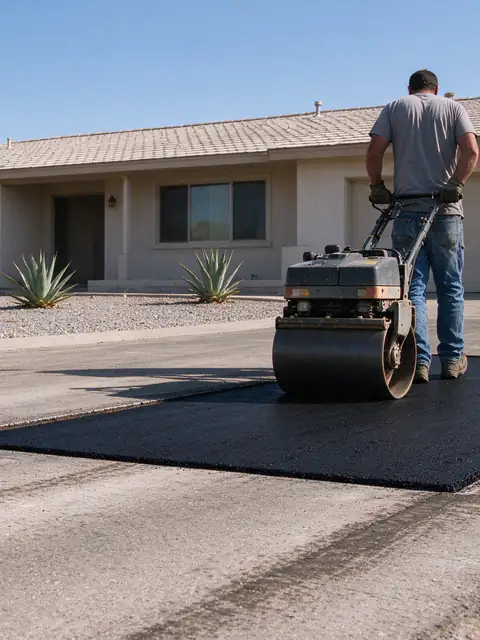
Saw-cut asphalt patching. Potholes, alligator-cracked areas and shoved mix are cut out to full depth, the base is rebuilt, and new hot mix is placed and compacted. Surface patches over failed base don’t last under truck traffic.
Mill and overlay. A worn but structurally sound asphalt surface is milled and repaved. It won’t cure base failure, which reflects through new asphalt.
Crack sealing and sealcoat. These are maintenance for pavement that is still sound. Sealcoat protects the surface from sun and water; it is not resurfacing and doesn’t fix structural cracks.
The part of the entrance between the property line and the street is public right-of-way, and the rules there are stricter than on a house lot. Mesa builds commercial driveways to Standard Detail M-1212 in Class A concrete, with a 30-foot minimum width for a one-in, one-out drive. The City of Phoenix’s minimum right-of-way permit for construction other than a residential single lot is $390, and concrete and paving permits add a $195 as-built review. Avondale charges a commercial return-type driveway at $0.10 per square foot plus a $50 base, and Chandler lists inspection fees for concrete driveway entrances and parking areas. The Phoenix permit guide explains the City’s process.
Traffic control is part of right-of-way work in several cities. Buckeye requires an approved traffic control plan for all work in its right-of-way, Fountain Hills requires one with every encroachment permit, and Mesa issues temporary traffic control permits. Inside the property, Phoenix requires parking and maneuvering areas to have a dust-free surface and 6-inch safety curbing. Where the drive meets an accessible route, the 2010 ADA Standards for Accessible Design and Phoenix’s Zoning Ordinance Section 702.6 set the requirements for accessible parking; they are context for the plan, and compliance is confirmed by the property’s own design professional or the city, not by this page. See the Tempe and Glendale pages for those cities’ permit offices.
Licensing, insurance and payment notes
Commercial concrete work falls under the Arizona Registrar of Contractors’ C-9 class (or the dual CR-9), commercial asphalt paving under A-14, and seal coating under A-15. The handyman exemption doesn’t apply to work over $1,000 or to any job that needs a permit. The ROC license lookup guide shows how to check a license before signing.
No published price range fits commercial driveway work, so it is quoted from measured quantities. What moves the number: the area and depth of each repair, concrete versus asphalt, base rebuilding, dowels and joint work, haul-off, phasing and off-hours work, traffic control, the right-of-way permit, and restoring curbs, landscaping and markings around the repair. If sealcoating is on the table for the rest of the pavement, the sealcoating guide explains when it is worth doing.
Damage from a vehicle strike or a utility cut may be someone else’s to pay for; that is between the property owner, the insurer and the responsible party, and nothing in an estimate settles it. On tax, the Arizona Department of Revenue’s contracting rules decide whether a job is taxed as maintenance, repair, replacement or alteration work, with tax built into materials, or as prime contracting; that is general information, not tax advice. When the site details are ready, ask for an estimate.
VIIVIVIVIIIIII
02
What's included
A look at the whole entrance: surface, joints, edges, drainage and the street and lot transitions
A measured repair area and a named method for each part of the drive
Saw-cutting, breakout and haul-off of failed concrete or asphalt
Base repair and compaction under every replaced section
Concrete panel replacement or asphalt patching matched to the existing pavement
Joint and crack sealing next to the repairs where needed
The city right-of-way permit when the work reaches the street
VIIVIVIVIIIIII
03
Commercial driveway repairs compared
Commercial driveway repairs compared: what each fixes and what it leaves
Repair
Best for
Won't fix
Price basis
Seal cracks and joints
Dormant cracks and open joints in sound concrete or asphalt
Fatigue cracking or a failed base
Priced per job; commercial work is quoted from measured quantities
Replace concrete panels
Broken or sunken panels at an entrance or loading drive
Color match with older panels
Priced per job after measuring
Saw-cut asphalt patch
Potholes, alligator cracking or shoving in one area
Widespread base failure across the lot
Priced per job after measuring
Mill and overlay
A worn asphalt surface on a sound base
Base failure, which reflects through
Priced per job after measuring
Rebuild the entrance
Failure across the whole drive, or a drive that misses the city detail
Problems in the lot beyond the entrance
Priced per job; permit and traffic control extra
04
Related resources
Guides that go deeper on commercial drives decisions in the Valley.
How a rigid slab and a flexible pavement each respond to Valley heat, storms and soils, what each needs to stay sound, how they are repaired, and the City rules that apply at the street.
Which license classes fit each kind of driveway work, when the small-job exemption applies and when it doesn't, and what to check besides the license itself.
What a sealcoat does to asphalt under Valley sun, the driveways it helps and the ones it can't, how to time it around heat and monsoon storms, and what to check before paying for it.
05
How the work runs
First call or estimate request
Describe the surface, what changed and roughly where the property is. Photos of the damage and the street edge help. The published ranges give you a budget to think about before any visit.
A look at the whole driveway
The visit looks at more than the damaged spot: the slab or asphalt, the joints and edges, where water runs, and the transitions at the garage, sidewalk and street. The damaged area is measured, and anything found that changes the scope, such as soft base or caliche, is explained in the estimate.
Work timed for the heat
Hot-weather practice from the American Concrete Institute caps concrete at 95°F at discharge for general work, so summer pours are planned for the cooler part of the day. Where the job crosses into the street right-of-way, the city's permit is part of the scope.
Cure and handover
How long the car stays off depends on the material and the temperature. That wait is set out before the work starts, so you can plan around it.
VIIVIVIVIIIIII
06
What this work looks like
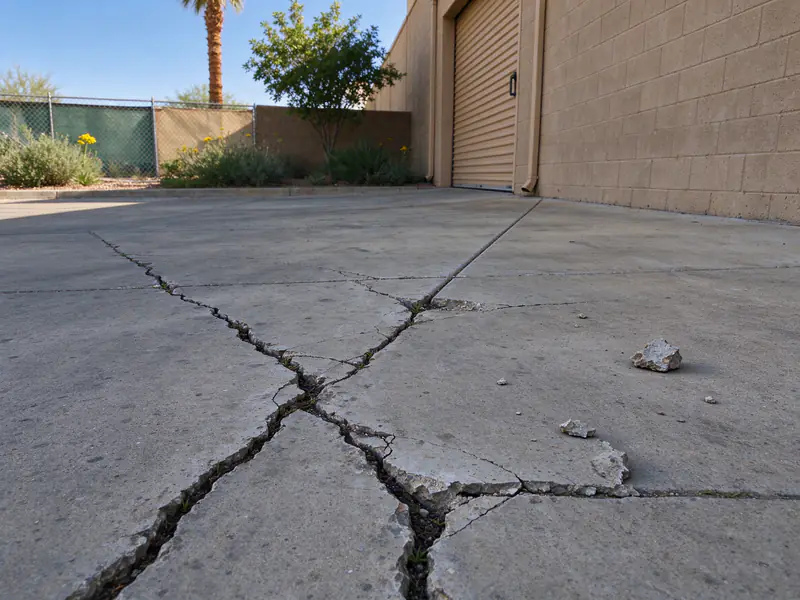
Cracked, broken concrete at a commercial loading driveway in Tempe
Steel dowel bars set in the edge of a commercial concrete slab before a repair pour in Tempe
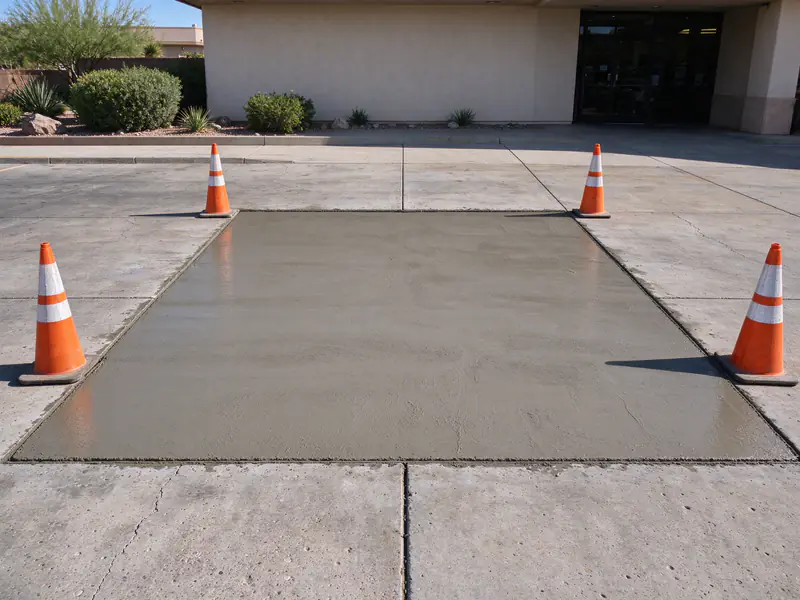
Fresh concrete in a coned-off commercial driveway repair in Tempe
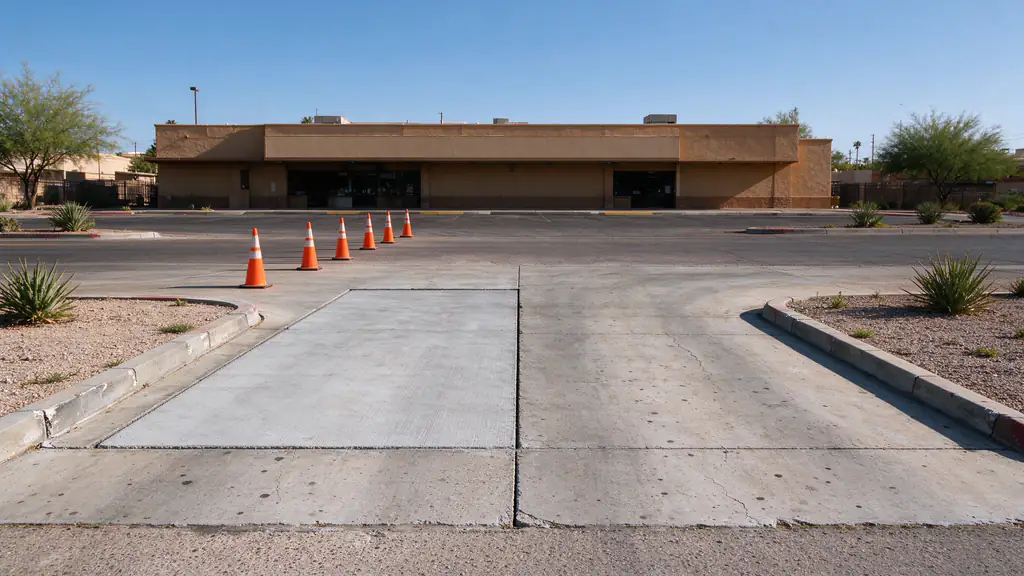
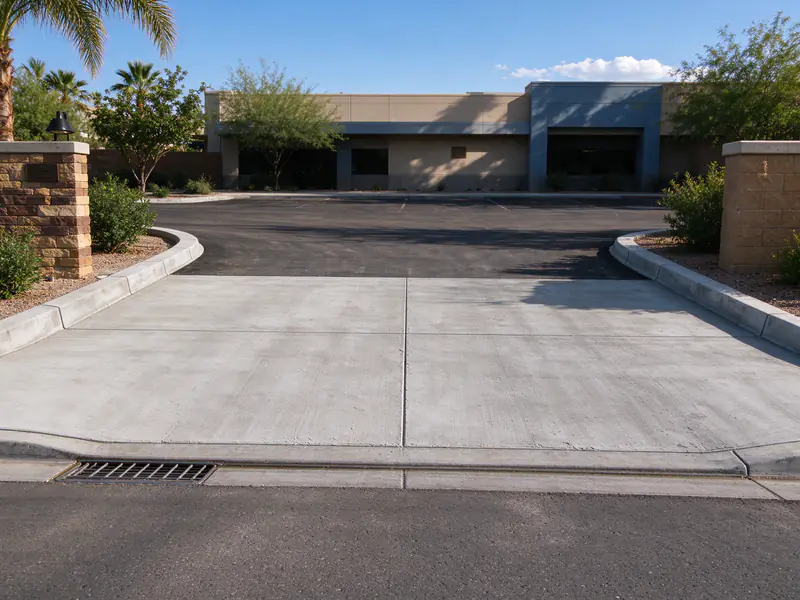
Finished concrete commercial driveway entrance into an asphalt lot in Tempe
Commercial entrance breaking up? Get an Estimate.
Send a site plan or aerial photo with the damaged areas marked, plus the property's hours. The estimate names each repair, the area, the permit and how access is handled.
Can a commercial entrance be repaired while the business stays open?
Sometimes, if the entrance is wide enough or there is a second way in. A wide drive can be repaired one lane at a time, leaving the other open, while a single narrow entrance may need off-hours work or a temporary route. Concrete also needs time to cure before trucks cross it. How the work is phased is settled in the estimate, with the property's hours and deliveries in mind.
Should a commercial driveway entrance be concrete or asphalt?
Concrete holds up better where heavy trucks turn and brake, because it doesn't soften in heat the way asphalt binder does, and some cities require it in the right-of-way: Mesa's commercial detail calls for Class A concrete. Asphalt costs less up front and is quicker to patch. Pairing a concrete entrance with an asphalt lot gets some of each.
Which ROC license classes cover commercial concrete and asphalt work?
The Arizona Registrar of Contractors licenses commercial concrete under C-9 (or the dual CR-9), commercial asphalt paving under A-14, which includes seal coating, and seal coating alone under A-15. A dual CR-69 covers asphalt paving for both commercial and residential work. You can look up any contractor's license on the ROC site before work starts.
Why does asphalt shove and rut at a commercial entrance?
Asphalt is held together by a binder that softens as it heats, and Phoenix summers keep pavement hot for months. Where loaded trucks brake, turn or stop at an entrance, the soft mix gets pushed into ripples and wheel ruts. A thin section or a weak base makes it worse. Repair cuts out the deformed area, rebuilds the base where needed and replaces it with new hot mix.
What should a property manager send for a commercial driveway estimate?
A site plan or aerial photo marking the damaged areas, photos of each one, the property's hours and delivery schedule, and how many entrances the site has. Note heavy users such as refuse trucks or semis, any past repairs, and whether the damage reaches the sidewalk or street. HOA boards should add who signs off on the work and any approval steps.