111days a year reach 100°F or more at Sky HarborNOAA climate normals
0.6nights a year drop to freezing at Sky Harbor, so heat and water, not frost, drive most damageNOAA
June 15 to September 30 is monsoon seasonNational Weather Service
Phoenix treats up to 10.5 ft of concrete drive past a roll curb as on-site work, with no separate driveway permit
Concrete for a residential driveway in the Phoenix right-of-way is 6-inch Class A
Last Updated:
Asphalt driveway repair removes the part of the pavement that has failed and rebuilds it, or treats the surface where the structure is still sound. The choice turns on what sits under the damage: a pothole over firm base is a small patch, while the same hole over base that monsoon water has softened needs a saw-cut repair that goes all the way down. Sundial Driveway Repair is a service company offering and managing asphalt driveway repair across Phoenix and its suburbs, for homes and commercial properties, and the work is fulfilled by licensed and insured contractors.
Asphalt is a flexible pavement. Stone aggregate is held together by a black petroleum binder, laid over a compacted aggregate base that carries the load. Unlike concrete, it has no joints and bends a little under weight, which is why it fails differently and is repaired with different methods. The asphalt vs concrete guide compares the two surfaces if you are weighing a change.
What happens on the first visit
The first visit looks at the whole drive before any method comes up: the surface, the edges, where water runs, and how the asphalt meets the garage slab, the sidewalk and the street. Each area of damage is mapped by type. A single straight crack, a web of alligator cracking in the wheel path, a pothole, a raveled patch and a broken edge all mean different things.
Soft or hollow areas are found by probing and tapping, and sometimes a small section is cut out to see what the base looks like. Findings that change the scope, such as base that has turned to mud or caliche that slows digging, are explained rather than buried in a price. The estimate names the method for each patch, the measured area, any part that sits in the right-of-way, and what it excludes, such as an exact color match with old asphalt. If you want to sort the signs first, the driveway condition assessment asks the same questions.
Why asphalt driveways fail in the Valley
Repair advice written for colder states starts with freeze-thaw. That isn’t the Phoenix story: Sky Harbor averages 0.6 freezing nights a year in NOAA’s climate normals. Here the causes are heat, sun and water that gets under the pavement.
Sun, heat and oxidation
The binder that holds asphalt together softens as it heats and hardens as it ages. Normal July highs at Sky Harbor reach 106.5°F, and the airport averages 111.3 days a year at 100°F or above. Fresh asphalt in that heat can scuff where wheels turn in place and dent under trailer stands. Over years, sun and heat oxidize the binder until the surface turns pale gray, brittle and loses stone (raveling). Brittle asphalt cracks instead of bending, and every crack is a path for water. Driveway sealcoating slows that aging on sound pavement, but it can’t reverse damage that is already structural.
Alligator cracking
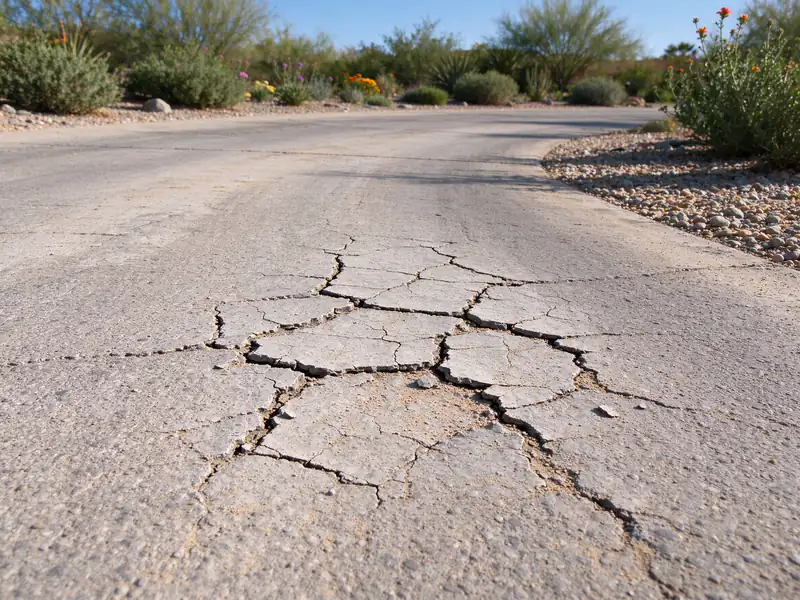
Alligator cracking is a web of connected cracks, usually in the wheel paths, that looks like reptile skin. It is fatigue: the pavement has been bending under loads more than its structure can take, often because the base below is weak, wet or too thin. Filling those cracks or sealcoating over them keeps some water out for a while but doesn’t restore support, so the area keeps breaking into smaller pieces until they come loose. The fix is removing the cracked area and the failed base and rebuilding it. The alligator cracking guide goes deeper into causes and limits.
Potholes
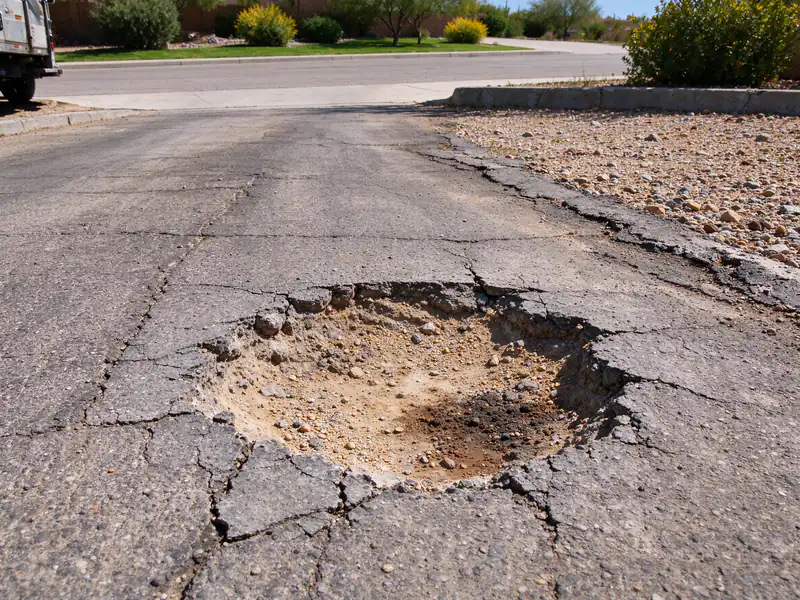
A pothole is where water has reached the base, softened it, and traffic has pushed the loosened asphalt out. In the Valley that water usually arrives in bursts: the NWS monsoon season runs from June 15 to September 30, and Sky Harbor averages 4.1 days a year with half an inch of rain or more. A hole that holds water after each storm keeps growing, because the soft base around it spreads. Patching only the visible hole over a base that is still wet is why some patches fail within a season.
Crumbling edges
An asphalt edge with nothing beside it to hold it up is the weakest part of the drive. Runoff that sheets along the edge in a storm, or a sprinkler line that keeps the shoulder wet, washes fine material out of the base until the edge rides on very little. Tires near the edge then snap it off in pieces. Repair means cutting back to sound asphalt, rebuilding the base, compacting new hot-mix and restoring edge support. If the water keeps coming, driveway drainage work is part of the fix, not an extra.
How the repair is matched to the failure
The method follows the condition of the base, not just the look of the surface:
Crack filling. Separate cracks in sound asphalt are cleaned out and filled with a flexible, hot-applied or cold-applied crack material to keep water out of the base. It is maintenance, and it is wrong for alligator cracking. The driveway crack repair page explains how crack type changes the material.
Pothole patch. Where the base under a hole is still firm, the hole is cleaned, squared, tacked and filled with compacted hot-mix.
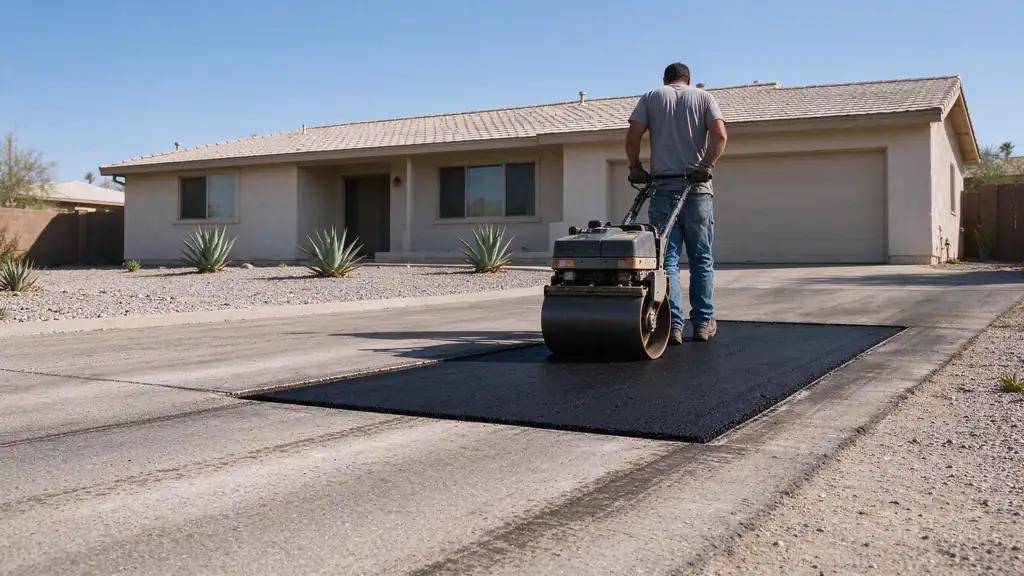
Saw-cut full-depth patch. For alligator cracking, potholes over failed base and broken edges, the area is cut in a square or rectangle past the damage, the asphalt and soft base are dug out, the base is rebuilt and compacted, and new hot-mix goes in lifts that a roller or plate compactor can consolidate. Square cuts give the patch firm, vertical edges to bond to.
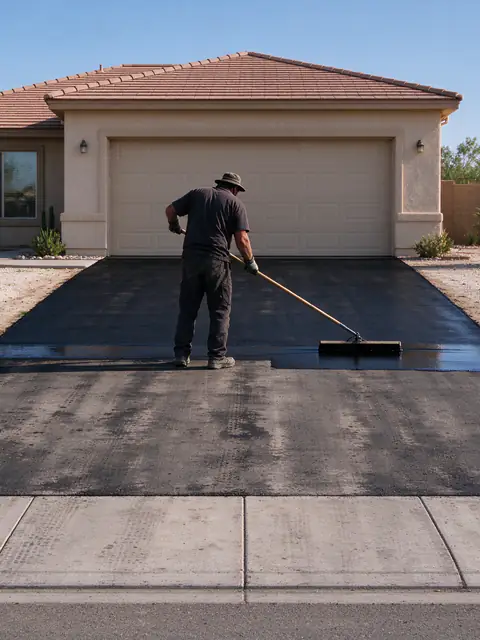
Overlay. A new asphalt layer over the whole drive renews an aged surface, but only where the base is sound and the failed areas have been patched first. Driveway resurfacing covers when an overlay makes sense.
When failure has spread across most of the drive, patch after patch stops being good value and driveway replacement is the honest answer.
Infrared asphalt repair and where it fits
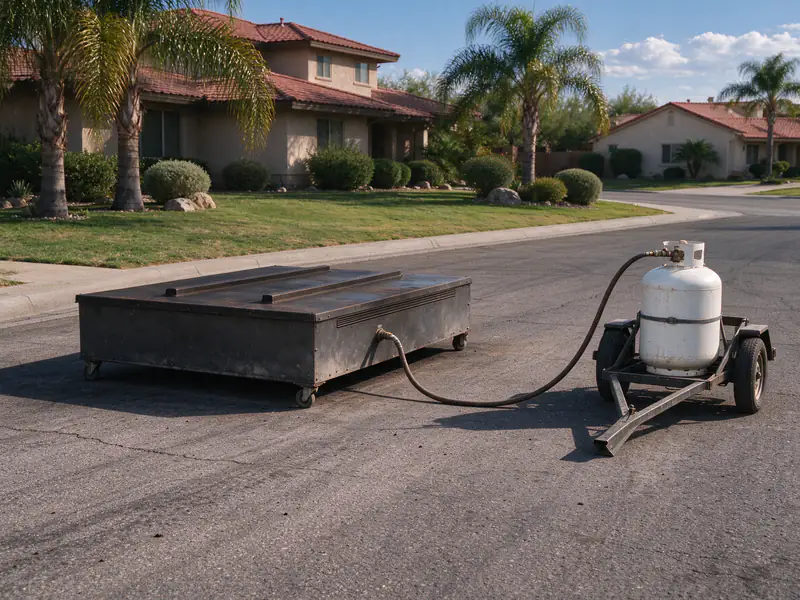
Infrared repair heats the damaged area of the asphalt in place with a radiant heater panel instead of cutting it out. Once the top layer is soft, it is raked loose, a rejuvenating agent and fresh hot-mix are worked in, and the area is compacted. Because the repair and the old asphalt around it are both hot when they are compacted, they fuse without a cold seam, which is the weak line where a conventional patch usually lets water in first.
It suits surface problems over a sound base: low spots that hold water, raveled areas, seams between old patches, and small potholes where the base is firm. It is not a base repair. Heating the top of the asphalt does nothing for wet or washed-out base below it, so alligator cracking from base failure still needs a full-depth patch. Whether infrared is the right method for a given spot is decided on the visit and named in the estimate.
Hot-mix, heat and timing in Phoenix
Hot-mix asphalt has to be placed and compacted while it is hot, because compaction is what locks the stone together and seals out water. A thin patch loses heat fast on a cold surface, so winter work in the Valley is scheduled for the warmest part of the day; normal highs at Sky Harbor drop to about 66°F in December. Summer brings the opposite problem: the patch stays soft longer after it is rolled, so the wait before heavy use is longer. The guide to how heat affects driveways in Phoenix covers both ends of the year.
Permits, the street edge and licensing
The end of the driveway that meets the street sits in the public right-of-way. Under the City of Phoenix Driveway Policy, asphalt driveways there follow MAG Standard Detail 202, and the City’s paving right-of-way permit is priced at $48 per 100 square yards or fraction, plus $240 in City lab tests on paving permits over $500, on top of the $195 residential minimum. The Phoenix driveway permit guide and the driveway apron repair page explain when that applies; other Valley cities run their own permits.
Arizona’s Registrar of Contractors licenses asphalt paving under R-13 for residential work and A-14 for commercial, with CR-69 as the dual class. A contractor generally needs a license when a job tops $1,000 in labor and materials or needs a permit, and the license lookup guide shows how to check one. Shared lots and business entrances are covered on the parking lot repair page.
Insurance and payment notes
Whether a policy pays for pavement damage depends on the policy and the cause, and that decision belongs to the insurer; an estimate doesn’t mean a claim will be accepted. The driveway insurance guide lists the questions to ask. On tax, the Arizona Department of Revenue treats repair work as maintenance, repair, replacement or alteration contracting, so tax on materials is usually built into the price rather than added as an invoice line. For a budget before a visit, the driveway repair cost guide and the cost estimator use the same ranges shown here, and you can ask for an estimate with a few photos.
VIIVIVIVIIIIII
02
What's included
A look at the whole drive, its edges and where water runs before a method is chosen
A measured repair area and a named method for each patch in the estimate
Saw-cutting square, straight edges around each full-depth patch
Removal and haul-off of failed asphalt and soft base
Base rebuilt and compacted where the old base has failed
Tack coat on the cut edges, hot-mix placed in lifts and rolled
Crack filling in the pavement around the patches where it is scoped
The City paving permit when the work reaches the apron or street
VIIVIVIVIIIIII
03
Asphalt driveway repairs compared
Asphalt driveway repairs compared: what each fixes, what it leaves, and a budgeting range
Repair
Best for
Won't fix
Budgeting range
Crack filling
Separate cracks in asphalt that is otherwise sound
Alligator cracking, a soft base or a dip
$0.50 to $3 per linear ft (national), usually with a minimum service charge
Pothole patch
A single hole over base that is still firm
Base that has washed out across a wider area
$100 to $415 per pothole (typical Phoenix area)
Saw-cut full-depth patch
Alligator cracking, potholes with failed base, broken edges
Failure spread across the whole drive
Priced by area after measuring
Infrared repair
Depressions, raveled spots, seams and small holes on a sound base
A failed base under the damaged area
Priced per job after measuring
Overlay
An aged, oxidized surface on a sound base
Base failure, which reflects up through the new layer
$1 to $4 per sq ft (national budgeting example); base repairs extra
Sealcoat
Slowing sun damage on sound, crack-filled asphalt
Any structural damage
$280 to $870 per driveway (national budgeting example)
04
Related resources
Guides that go deeper on asphalt repair decisions in the Valley.
How to recognize fatigue cracking, the base and water problems behind it, how it differs from other asphalt cracks, and why the repair has to go below the surface.
How a rigid slab and a flexible pavement each respond to Valley heat, storms and soils, what each needs to stay sound, how they are repaired, and the City rules that apply at the street.
What a sealcoat does to asphalt under Valley sun, the driveways it helps and the ones it can't, how to time it around heat and monsoon storms, and what to check before paying for it.
Typical Phoenix-area and national budgeting ranges for each kind of driveway repair, what is inside the price, the City permit fees, and worked example budgets.
05
How the work runs
First call or estimate request
Describe the surface, what changed and roughly where the property is. Photos of the damage and the street edge help. The published ranges give you a budget to think about before any visit.
A look at the whole driveway
The visit looks at more than the damaged spot: the slab or asphalt, the joints and edges, where water runs, and the transitions at the garage, sidewalk and street. The damaged area is measured, and anything found that changes the scope, such as soft base or caliche, is explained in the estimate.
Work timed for the heat
Hot-weather practice from the American Concrete Institute caps concrete at 95°F at discharge for general work, so summer pours are planned for the cooler part of the day. Where the job crosses into the street right-of-way, the city's permit is part of the scope.
Cure and handover
How long the car stays off depends on the material and the temperature. That wait is set out before the work starts, so you can plan around it.
VIIVIVIVIIIIII
06
What this work looks like
Alligator cracking in the wheel path of an oxidized asphalt driveway in Glendale
Wheeled infrared asphalt heater panel set over a damaged area of an asphalt driveway in Glendale
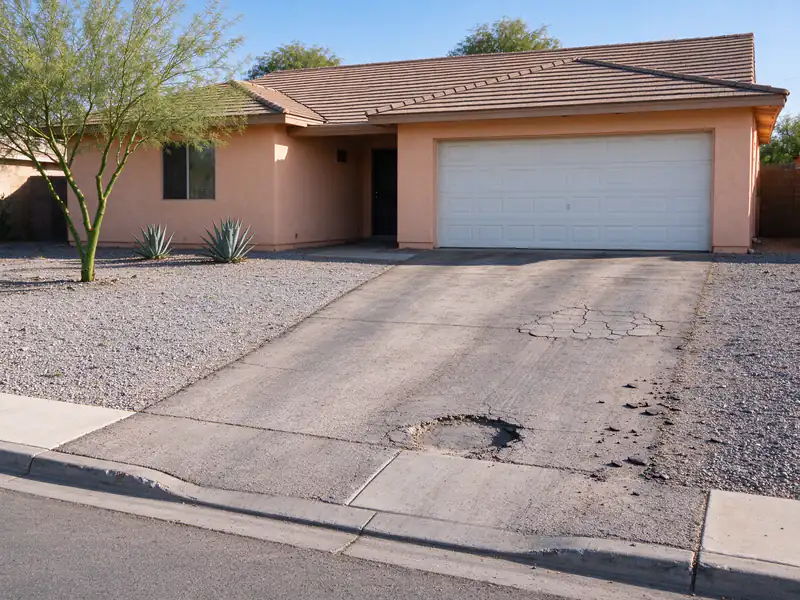
Pothole with washed-out base and raveled edges at the end of an asphalt driveway in Glendale
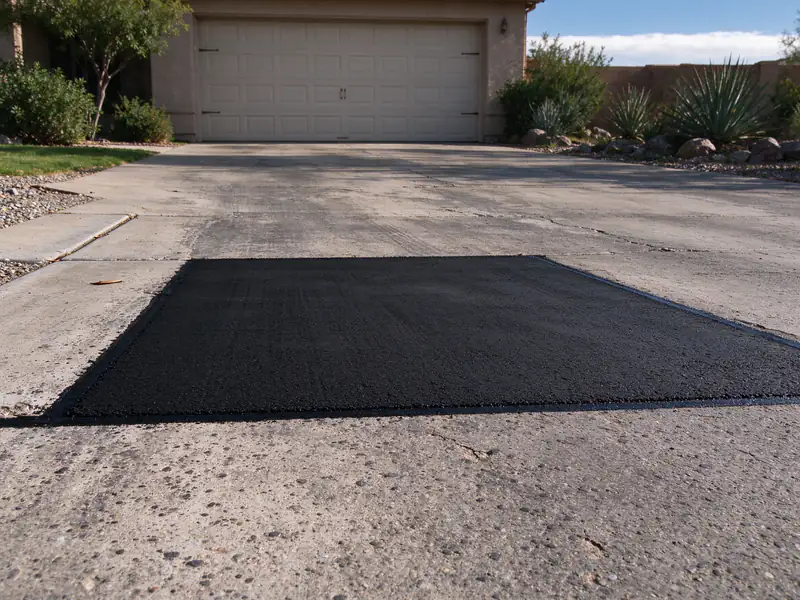
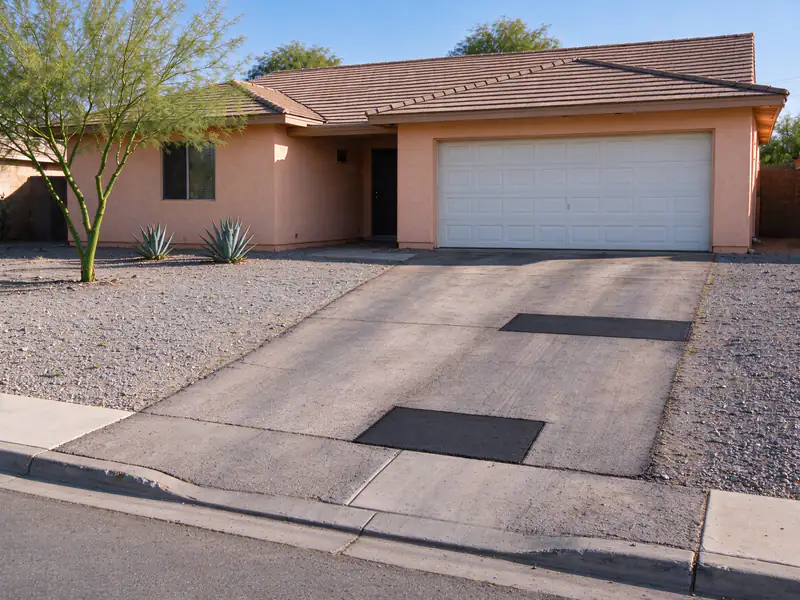
Finished square-edged asphalt patch in a pale gray asphalt driveway in Glendale
BeforeAfter
Potholes, alligator cracks or broken edges? Get an Estimate.
Send photos of the whole drive and each damaged spot. The estimate names the method for each patch, the area it covers and what it won't change.
Can an asphalt driveway be patched during a Phoenix winter?
Yes, with timing. Hot-mix has to be hot to compact, and a cold surface pulls heat out of a thin patch fast. Normal daily highs at Sky Harbor drop to about 66°F in December and 68°F in January (NOAA), so winter patches are placed in the warmest hours. Cold-patch from a bag is a temporary fill in any season, not a repair.
How long should I stay off a fresh asphalt patch?
Hot-mix gains its strength as it cools, so the wait depends on the patch thickness and the weather. In Phoenix summer heat a patch stays soft longer than it would elsewhere, and turning the steering wheel while parked can scuff it. Ask for the wait on the estimate, and keep heavy trucks and trailer stands off the patch for longer than cars.
How do you repair crumbling asphalt edges?
The broken edge is saw-cut back to sound asphalt, the soft base under it is dug out and rebuilt, and new hot-mix is placed and compacted. Then the edge needs support: compacted rock, a header or a firm shoulder, so tires don't break it off again. If runoff or a sprinkler is soaking that edge, the water has to be redirected too.
Is a bag of cold patch good enough for an asphalt pothole?
Only to buy time. Cold patch stays workable because its binder never fully hardens, so it compacts under tires and pushes out of the hole, and it does nothing about the water and soft base that made the pothole. A lasting repair cuts the hole square, rebuilds the base if it has failed, and fills it with compacted hot-mix.
What should I send with a request for an asphalt driveway estimate?
A wide photo of the whole driveway, close photos of each damaged spot, rough dimensions, and a note on how long the damage has been there and whether it is growing. Say where roof, irrigation and street water go, whether the damage reaches the apron or street, and whether trucks, trailers or an RV park on the drive.