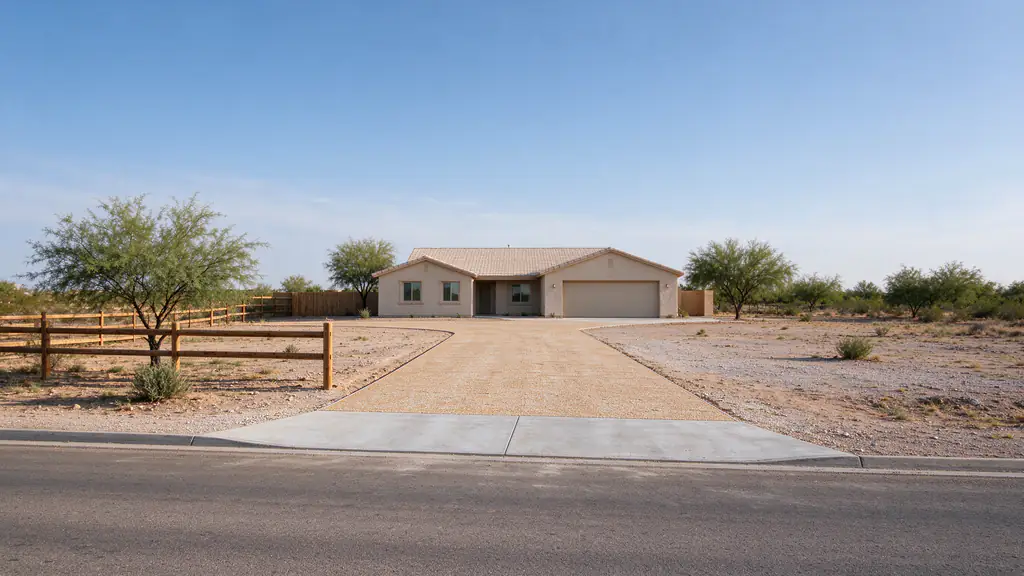
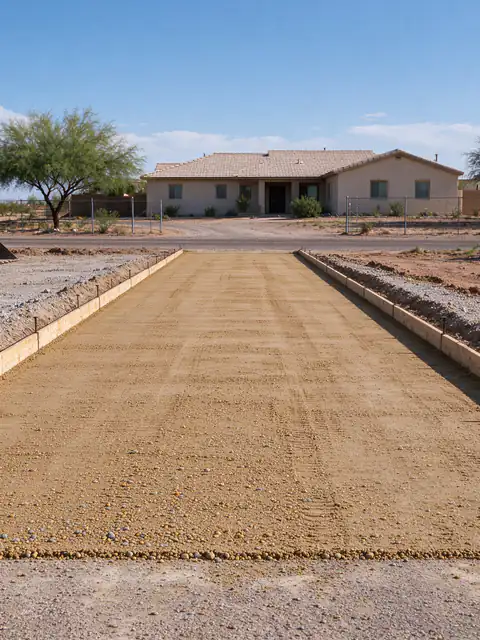
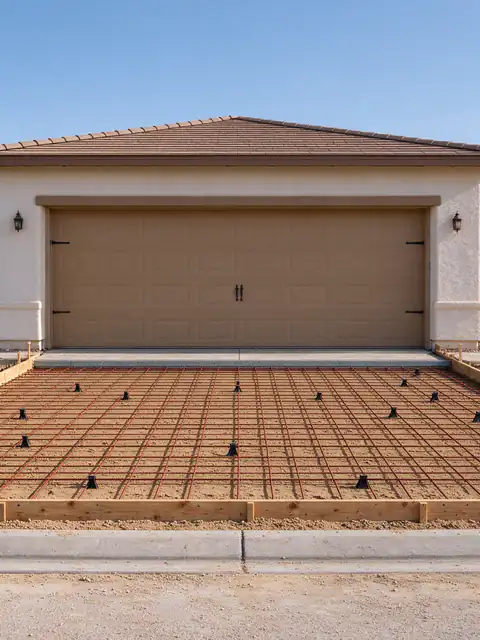
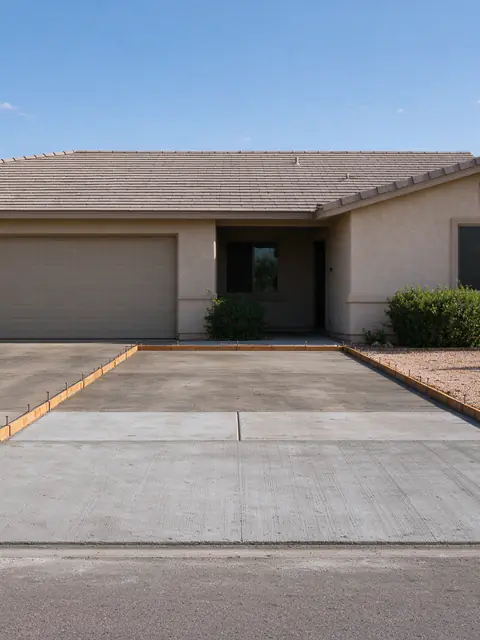
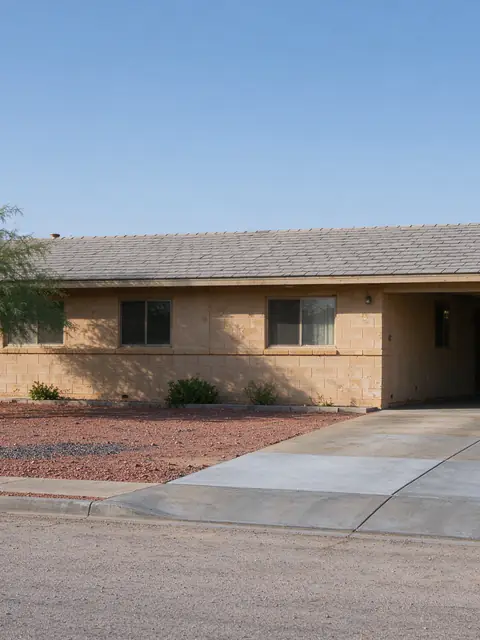
Turning gravel into concrete on a large lot means grading, a compacted base and a new apron at the road, and the Town's plot plan has to show slopes, elevations and thickness. On a rural or estate lot, the plan also shows where the septic system sits, which shapes the route the drive and the trucks can take.
A front-yard septic tank near the work
Queen Creek's plot-plan checklist asks for the septic system's location in the front yard and any dry sewer stub-outs. Loaded concrete trucks and excavators should stay off the tank and leach field, and digging near them starts with their position marked.
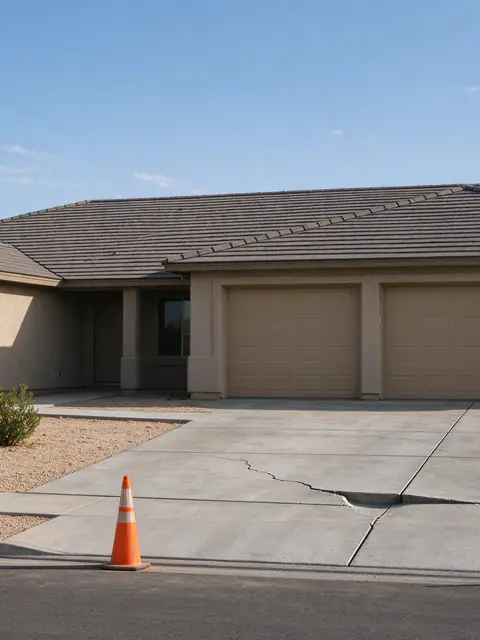
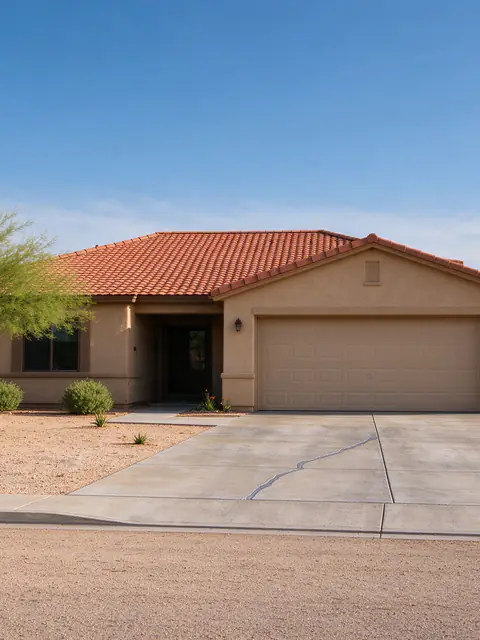
A long crack and the fissure question
The Arizona Geological Survey maps earth fissures in parts of the Chandler Heights and Queen Creek area. A cracked driveway is not evidence of a fissure, and only the AZGS map shows whether one is mapped near a lot. Checking it before a full replacement takes a few minutes.
A new apron that meets the Town's rules
Any work in Queen Creek's right-of-way needs a Public Works encroachment permit and follows MAG specifications and details plus the Town's own supplement. The driveway is also kept at least 2 feet from hydrants, utility poles, drop inlets, light standards, walls and fences.
Before a Queen Creek driveway is replaced, it pays to look at a septic layout and an earth fissure map: where the tank sits in the front yard, and what the Arizona Geological Survey has mapped nearby. Neither is a reason for alarm, and both shape how driveway repair in Queen Creek, AZ, is planned. Sundial Driveway Repair is a service company offering and managing driveway repair and paving in Queen Creek and the rest of the Valley, for houses and commercial sites, and licensed and insured contractors fulfill it.
Septic tanks and fissure maps
Queen Creek’s plot-plan checklist asks for the septic system’s front-yard location and any dry sewer stub-outs, which tells you front-yard septic is an expected condition on rural and estate lots. A tank or leach field near the drive changes the job. Loaded trucks and excavators should stay off it, digging near it starts with its position marked, and the route for a longer drive is drawn around it. That matters most when gravel driveway replacement turns a rock drive into concrete, and the gravel-to-concrete cost guide explains what that conversion involves.
The second map is AZGS’s. The survey maps earth fissures in parts of the Chandler Heights and Queen Creek area, and the Queen Creek fissure reactivated during monsoon rains in August 2005. Fissures are localized ground cracks tied to subsidence, not a town-wide condition, and a cracked slab is not evidence of one. Where one is mapped near a lot, no repair can stop the ground from moving, which is worth knowing before paying for driveway replacement. AZGS publishes those maps for anyone to check, and the repair or replace guide covers the rest of that decision.
The Town’s encroachment permit and plot plan
Queen Creek runs its own process, on both sides of the Maricopa and Pinal county line that crosses the town. A Department of Public Works encroachment permit covers all work in the right-of-way, built to MAG specifications and details plus the Town of Queen Creek Supplement to MAG. Plot plans show driveway elevations at the garage and the street, width, slope percent and material thickness, and the drive keeps 2 feet clear of hydrants, poles, drop inlets, light standards, walls and fences. That is why apron repair and a new driveway extension start with measurements. Permitted work belongs with a contractor holding the right ROC license, and the license lookup guide shows how to check.
Young slabs on milder soil
The Census Bureau’s survey gives Queen Creek a median build year of 2012, with 90.8% of its 23,569 housing units built in 2000 or later and 94.3% single-family detached. USDA soil samples are mild by Valley standards: 17.9% of points show moderate or higher shrink-swell, against 78.4% in neighboring Gilbert, with no cemented layers and flooding at 10.7% as the only road limitation. FEMA maps put 9.3% of sampled points in a special flood hazard area, so check your address on FEMA’s map. Where water does gather, driveway drainage keeps it off the slab edge, and narrow cracks suit crack repair. If your home is in an HOA, the HOA driveway rules guide covers approvals. A site visit covers the slab or gravel surface, its edges and joints, and the path water takes, and the Gilbert and Chandler pages cover nearby cities.
Gravel, cracks or a new apron in Queen Creek? Get an Estimate.
Send photos of the drive and the road edge, rough length and width, and mark the septic tank if you know where it is.
Does Queen Creek require a permit for driveway work at the street?
Yes. The Town's Design Standards and Procedures Manual requires a separate Department of Public Works encroachment permit for all work or construction in the public right-of-way, and that work follows MAG Specifications and Details along with the Town of Queen Creek Supplement to MAG. The current edition and any changes are confirmed with Development Engineering before the estimate is final.
What does Queen Creek want shown on a driveway plot plan?
The Town's checklist asks for driveway elevations at the garage and at the street, the driveway width, its slope in percent and the material thickness. The driveway has to stay at least 2 feet from hydrants, utility poles, drop inlets, light standards, walls, fences and similar structures, and the plan shows any front-yard septic system and dry sewer stub-outs.
Should I check for earth fissures before replacing a Queen Creek driveway?
It is worth a look. AZGS maps earth fissures in parts of the Chandler Heights and Queen Creek area, with detailed maps updated in 2016 and small additions in 2019 near West Hunt Highway and North Thompson Road. Fissures are localized, not town-wide, and no driveway repair can stop ground movement from one. The map, not a crack in your drive, answers the question.
Can concrete trucks drive over a septic system in Queen Creek?
They shouldn't. A loaded concrete truck or excavator can crack a tank lid or crush leach lines, so on lots with front-yard septic the tank and field are located and marked first, and access is planned around them. Where the only route crosses the system, concrete can be pumped in from the road instead.
What does it cost to pave a gravel driveway in Queen Creek?
There's no single conversion price. The new concrete itself falls in the typical Phoenix-area range of about $6 to $11 per square foot for a standard broom-finish pour. Grading, base work and removing old rock are priced separately after measuring, and length, slope, septic access and the apron at the road under a Town permit all move the total.
There is no single published price for a gravel-to-concrete conversion. This guide builds the budget from its parts: the new pour, the site work under it, the street end and the permits.
The signs that point to a repair, the ones that point to a new driveway, the middle option of replacing sections, and the Phoenix soil, water and right-of-way rules that tip the choice.
How association rules sit on top of city codes for driveway repairs, widening, pads and materials, and how to put together a request the board can approve.
Which license classes fit each kind of driveway work, when the small-job exemption applies and when it doesn't, and what to check besides the license itself.
The two numbers behind a concrete driveway replacement, tear-out and new pour, plus what base repair, grade correction, the apron and permits add, with illustrative budgets.