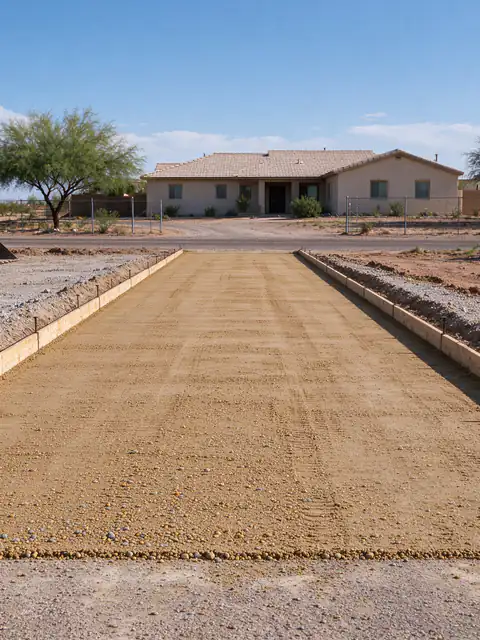
How much does it cost to convert a gravel driveway to concrete?
There is no single published price for a gravel-to-concrete conversion. This guide builds the budget from its parts: the new pour, the site work under it, the street end and the permits.
Last Updated:
Short answerThere is no published range for the whole conversion. The concrete itself has a typical Phoenix-area range of about $6 to $11 per square foot for a standard broom-finish pour. Excavating the gravel, grading, building a compacted base, handling runoff and any street-end permit are priced on top, by the site.
The cost to convert a gravel driveway to concrete has no single published range, but it can be built from parts: a typical Phoenix-area range of about $6 to $11 per square foot for the new pour, plus site work that depends on what is under the gravel. Sundial Driveway Repair is a service company offering and managing gravel driveway replacement across Phoenix and the surrounding Valley, fulfilled by licensed and insured contractors. This guide lays out each part so you can budget the pour and know which lines are still open.
Every figure is labeled as a typical Phoenix-area range or as illustrative arithmetic, and none is a quote. The gravel driveway replacement page covers how the work runs, and the asphalt vs concrete guide helps if you haven’t settled on concrete.
Which parts of a conversion have a published price?
Only the concrete pour has a publishable Phoenix-area range. Removal of old concrete applies only where there is concrete to remove, such as an old apron or concrete strips. Everything under the slab is priced by the site.
Only where an old concrete apron, pad or strips are broken out; thick or reinforced slabs cost more
Typical Phoenix area
Removing or regrading the gravel
No published range
per job
Every conversion; depends on depth, type of rock and haul-off
Priced by the site
Excavation, grading and compacted base
No published range
per job
Every conversion; depends on soil, caliche and the grades at the garage and street
Priced by the site
Drainage and edges
No published range
per job
Where runoff, borders or landscape need rework
Priced by the site
City right-of-way permit
$195 minimum, plus $195 as-built review
per permit
When street-end concrete goes beyond what Phoenix treats as on-site work
City of Phoenix fee
There is no honest way to add those rows into one per-square-foot conversion price, because the open rows can be small on one lot and the largest part of the bill on another. That is why a conversion estimate comes after someone has seen the ground.
What happens to the gravel and the ground under it?
The new slab needs a firm, even, compacted base at the right height, and the gravel layer is where that starts. Crushed aggregate base can sometimes be regraded, topped up and compacted in place. Decorative rock, river rock or gravel mixed into soil is removed and hauled off. Under it, soft spots are dug out, and the subgrade is shaped so the finished concrete meets the garage slab and the street at workable heights with a slope that drains.
Two Phoenix-area soil conditions drive this line. Cemented caliche layers slow excavation and can trap water, and USDA soil survey data flags them more often at foothill and desert edges than on the valley floor; the caliche guide explains what that means for a driveway. Shrink-swell clay moves as it wets and dries, which can call for more base. Findings that change the scope, such as soft base or caliche, are explained before the pour.
What does the street end add?
The section between your property line and the street often decides whether a permit is needed. Under the City of Phoenix Driveway Policy, a single-family lot with existing curb and gutter may have a gravel drive in the right-of-way without a permit. When that section becomes concrete:
On streets with roll or ribbon curb, up to 10.5 feet of concrete drive in the right-of-way counts as part of the on-site work and needs no separate driveway permit. It is 6 inches thick.
A longer right-of-way section takes a driveway permit.
On streets with no sidewalk, curb or ribbon curb, a driveway permit is required, with an at-grade tie-in to the street and Class A concrete 6 inches thick.
A vertical curb that has to be cut for a new entrance is curb cut work, covered on the driveway curb cut page.
Is converting gravel to concrete required in Phoenix?
Not for a single-family home. Phoenix City Code requires vehicles to be parked on a dust-free surface, and on a lot with one single-family or duplex unit, a smooth layer of crushed rock or gravel kept at least 3 inches deep within a permanent border qualifies. A gravel drive that has thinned out, spread into the yard or lost its border may no longer meet that rule, and refreshing it is one option alongside paving it. Commercial parking areas are held to a stricter dust-free standard, which in practice usually means asphalt or concrete. The HOA driveway rules guide covers what an association may add on top.
What moves the cost of a gravel-to-concrete conversion?
Factor
Why it moves the price
What to check
Driveway area
The pour is priced per square foot; small pours carry a minimum
Measured length and width, including any parking pad
Gravel type and depth
Usable aggregate base can stay; decorative or dirty rock is removed and hauled
What the rock is and how deep it goes
Soil, caliche and compaction
Soft spots are dug out; caliche slows digging; base is compacted in lifts
Cement masons and concrete finishers (SOC 47-2051): mean $29.25 an hour in the Phoenix-Mesa-Chandler metro vs $28.87 nationally; median $28.49 vs $27.41 (BLS wage data)
Site and base labor
Removing rock, grading, compacting base, setting forms
Construction laborers (SOC 47-2061): mean $23.40 an hour in the metro vs $25.02 nationally; median $22.56 vs $22.66 (BLS national data)
The Town of Paradise Valley calls for an engineer-sealed grading and drainage plan where 999 sq ft or more of impervious area is added (Town of Paradise Valley)
Dust control
Keeping site dust in check during work
Paradise Valley right-of-way permits call for a Town dust control plan for disturbance of 0.10 acre or less, or a Maricopa County dust permit above that (Town of Paradise Valley)
A wage is not a billing rate. The rate built into a quote also carries insurance, licensing, trucks, equipment and overhead. Concrete finishers in the Phoenix-Mesa-Chandler metro earn a mean $29.25 an hour, about 1% above the $28.87 national mean, so the spread between conversion quotes comes from the site work, not from local wages.
No for gravel. It pays only for removing living grass, and says nothing about driveways; ask Water Services before any lawn-to-driveway work
Permeable-pavement or stormwater incentive
Phoenix, Scottsdale, Tempe, Flood Control District of Maricopa County
None found
Federal tax credit
IRS
None applies
What could a conversion budget look like?
These examples are illustrative. The sizes are assumptions, only the lines with a published range are filled in, and the site work stays open because no published figure supports it.
Example (illustrative)
Assumed scope
Concrete pour
Concrete removal
Still to price on site
Two-car gravel driveway
600 sq ft, broom finish, roll curb at the street
600 × $6 to $11 = $3,600 to $6,600
None
Gravel removal, grading, base, edges
Single-car gravel driveway
360 sq ft, broom finish
360 × $6 to $11 = $2,160 to $3,960
None
Gravel removal, grading, base, drainage
Gravel drive with an old concrete pad at the street
600 sq ft new pour, including a 10 × 12 ft pad replaced
600 × $6 to $11 = $3,600 to $6,600
120 × $1.20 to $1.90 = $144 to $228, more if the pad is thick or reinforced
Site work, plus about $390 in Phoenix permit fees if the street end needs a permit
Read the pour line as the floor of the budget, not the budget. A lot where the existing aggregate base can stay and the grades already work sits close to it; a lot with decorative rock, soft soil or caliche, and a garage slab well above the street, adds meaningfully more.
How do you compare conversion quotes?
Look for the measured area, what happens to the existing gravel, the base material and compaction, how the grades at the garage and street are handled, where the water goes, slab thickness on the lot and at the street, any reinforcement, joint layout, finish, cure time before driving, permits and who obtains them, and exclusions such as landscape restoration. A contractor generally needs a Registrar of Contractors license once a job tops $1,000 or needs a permit; check that the classification covers concrete driveways, using the license lookup guide. Adding a parking pad at the same time is covered on the RV pad and driveway extension pages.
When you’re ready, ask for an estimate with photos of the driveway, the street edge and the garage threshold, and rough measurements.
VIIVIVIVIIIIII
02
More questions on this
Do I need two different contractors to turn gravel into a concrete driveway?
Not necessarily, but the work spans two kinds of licensed scope. In Arizona, the Registrar of Contractors' hardscape classes cover gravel and paver driveways and explicitly exclude concrete driveways, which fall under the concrete classes such as R-9. Grading and excavating has its own classes too. One contractor may hold the classes for the whole job, or the concrete contractor may handle the site work within its scope; check the license against the work.
Can the existing gravel be used as the base under new concrete?
Sometimes. Crushed aggregate base, the angular material that compacts tightly, can often be regraded, topped up and compacted as part of the base. Rounded decorative rock, river rock or gravel mixed with soil doesn't compact into a firm layer and is usually removed. A look at what is actually there, often by digging a small test hole, settles it.
Will a concrete driveway change how water drains on my lot?
It can. Gravel lets some rain soak in where it falls; concrete sends all of it to the edges. A conversion is graded so that water runs toward the street or a planned drainage area and away from the house and neighboring lots, which Maricopa County drainage rules require. Larger conversions in some towns, such as Paradise Valley, can also trigger an engineered grading and drainage plan.
VIIVIVIVIIIIII
03
Get an Estimate for gravel driveways
Tell us the surface, what changed and the nearest cross streets. Photos of the damage and the street edge make the estimate more useful.
The two numbers behind a concrete driveway replacement, tear-out and new pour, plus what base repair, grade correction, the apron and permits add, with illustrative budgets.
What replacing the concrete apron at the street costs, why it costs more per foot than the rest of the drive, the Phoenix and Chandler right-of-way fees, and how a new or widened curb cut is priced.
Typical Phoenix-area and national budgeting ranges for each kind of driveway repair, what is inside the price, the City permit fees, and worked example budgets.
What swapping damaged pavers, resetting a sunken section and cleaning and sealing a paver driveway cost, why the base under the pavers sets the price, and what to look for on a quote.
What sealcoating a residential asphalt driveway costs as a national budgeting example, what crack filling and patching add, what drives commercial lot pricing, and what sealcoat can and can't do for the money.