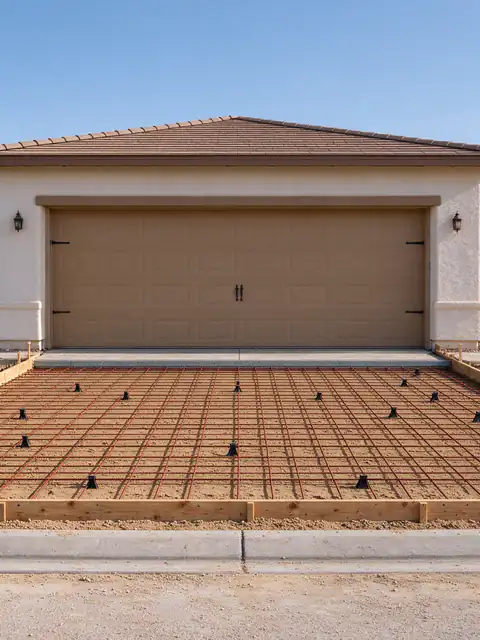
How association rules sit on top of city codes for driveway repairs, widening, pads and materials, and how to put together a request the board can approve.
Last Updated:
Short answerHOA driveway rules in Arizona come from each association's CC&Rs and design guidelines, so they differ from one community to the next. They can control a driveway's material, color, finish, width and parking pads, and often require approval before work starts. City permits and zoning limits still apply alongside them.
HOA driveway rules in Arizona aren’t one set of rules. Each community association writes its own in its CC&Rs (declaration of covenants, conditions and restrictions) and its design or architectural guidelines, so what applies to your driveway is in your association’s documents. Sundial Driveway Repair is a service company offering and managing driveway repair, driveway extensions and replacements across Phoenix and the Valley, fulfilled by licensed and insured contractors. This guide explains what those rules tend to cover and how they fit with city codes.
How common are HOAs in Arizona?
Widespread. The Community Associations Institute estimates that about 2,264,000 Arizonans live in 875,000 homes in more than 9,900 community associations. A share by city isn’t published, so whether your street is in one is something your title documents, your closing papers or the association’s management company will confirm.
What can HOA driveway rules control?
Whatever the documents give the association authority over. Driveway topics that appear in CC&Rs and design guidelines include:
Material, such as whether concrete, asphalt, pavers or gravel are allowed for the front drive.
Color and finish, including stained, stamped or exposed-aggregate concrete and paver colors.
Width and layout, including widening, a second curb cut, a side-yard pad or an RV pad.
Sealing and coatings, such as whether a colored sealer or a sealcoat is permitted.
Parking, such as rules on overnight street parking, RVs, trailers and where vehicles may sit.
Upkeep, an owner’s duty to keep the drive in good repair, and what the board can do if it isn’t.
The documents also say which work needs architectural review. Some treat a like-for-like repair, such as sealing cracks or replacing a broken section in the same material, as ordinary maintenance. Others want anything visible submitted. If the guidelines don’t say, ask in writing before work starts.
What do homeowners run into?
Homeowners report a few situations. Valley owners say associations want approval before a driveway is widened or a pad is added, and CC&Rs that ban overnight street parking are often what pushes owners to add one; replies from other Valley owners suggest writing to the board with plans and a contractor’s estimate. Elsewhere, owners describe getting a letter asking them to patch spalling, then being told by contractors that the slab needs resurfacing or replacement, which leaves them unsure what will satisfy the board. And in Scottsdale and Paradise Valley, owners discussing large-lot gravel drives tie paved ones to HOA requirements.
Each of these comes down to the same step: read what the documents actually require, then match the repair to both the rule and the cause. A board letter about spalling is asking for a surface that looks sound; if the slab underneath is sound, driveway resurfacing or a partial-depth patch may meet it, and if it isn’t, the repair vs replacement guide explains why a patch won’t last.
How do HOA rules fit with city rules?
They stack. HOA approval doesn’t replace a city permit, and a city permit doesn’t satisfy the HOA. A few city rules come up on HOA driveway jobs:
Right-of-way work. In Phoenix, the apron and curb usually sit in the public right-of-way, and work there beyond the City’s 10.5-foot allowance on roll or ribbon curb streets needs a permit. The Phoenix driveway permit guide covers it. Mesa issues right-of-way permits only to contractors licensed by the Arizona Registrar of Contractors.
Front-yard paving limits. Mesa’s single-family zoning allows one driveway up to 19 feet wide on lots under 75 feet wide (plus a 10-foot drive to a qualifying side yard), up to 29 feet on wider lots, and caps combined paved areas at 50% of the front yard. Other cities set their own limits, confirmed per address.
Parking surfaces. Phoenix requires parked vehicles to sit on a dust-free surface; on a single-family lot, bordered gravel at least 3 inches deep qualifies. An HOA can be stricter than that, not looser.
Private-street communities add one more wrinkle: the HOA may own the street and the apron, in which case the association, not the city, sets the rules at the curb. The apron responsibility guide explains how to tell.
What should an HOA driveway request include?
Enough for the board to say yes without a second round. A useful submittal has:
A site sketch with the driveway’s dimensions, any widening or pad, and distances to the property line and side yard.
Materials and finish, including concrete color, stamp pattern, paver style or gravel type, with a photo or sample where the guidelines ask for one.
Drainage, showing where water from the drive and roof will go, especially for a new pad.
The contractor’s estimate, naming the method, the area, any right-of-way portion and what it excludes, plus the contractor’s Arizona ROC license number. The license lookup guide shows how to check one.
Any city permit the work needs, or a note that none is required.
What about color matching?
Plan for it rather than hoping. A replaced section or a filled crack in old concrete won’t match the color of the slab around it, and no one can promise an exact match on a partial repair. Where the guidelines control color, ask the board whether a visible difference is acceptable, whether a sealer or stain over the whole drive is allowed to even it out, or whether a full replacement is the only option. The asphalt vs concrete guide and the gravel to concrete cost guide help when the material itself is changing.
If your HOA has sent a notice or you are preparing a request, send photos of the driveway and the relevant page of your guidelines, or call the number at the top of this page.
VIIVIVIVIIIIII
02
More questions on this
Do I need HOA approval to replace my driveway with the same material?
It depends on your association's documents. Some treat a like-for-like replacement as maintenance that needs no review, while others want any exterior work submitted, especially if the color or finish could change. The design guidelines should say which work needs architectural review. When in doubt, a short written request before work starts costs less than redoing it.
Can my HOA require me to fix my driveway?
If your CC&Rs require owners to keep driveways in good repair, the documents also set out how the association enforces it, such as a notice with a deadline, and what happens if the work isn't done. Read the notice for exactly what it asks, such as patching spalling or replacing a broken section, and ask the board in writing if the repair method is unclear.
What can I do if my HOA turns down my driveway plan?
Ask the board for the decision in writing, with the rule or guideline it rests on. The fix may be a change the rules allow, such as a different color, a narrower width or a material on the approved list. Your CC&Rs describe any appeal or reconsideration process, and a revised submittal that answers each stated reason is a sensible next step.
VIIVIVIVIIIIII
03
Get an Estimate for driveway replacement
Tell us the surface, what changed and the nearest cross streets. Photos of the damage and the street edge make the estimate more useful.
How the City's Driveway Policy for Single Family Development and its right-of-way fee schedule decide whether your driveway job needs a permit, and what it costs when it does.
A way to sort driveway problems into the ones worth fixing before a sale, the ones to document, and the ones to leave, without guessing at what a buyer will pay.
The apron usually sits on public land, yet the repair often falls to the homeowner. Here is how ownership, upkeep and permits split between you, the city and anyone who dug it up.
There is no single published price for a gravel-to-concrete conversion. This guide builds the budget from its parts: the new pour, the site work under it, the street end and the permits.
How a rigid slab and a flexible pavement each respond to Valley heat, storms and soils, what each needs to stay sound, how they are repaired, and the City rules that apply at the street.