111days a year reach 100°F or more at Sky HarborNOAA climate normals
0.6nights a year drop to freezing at Sky Harbor, so heat and water, not frost, drive most damageNOAA
June 15 to September 30 is monsoon seasonNational Weather Service
Phoenix treats up to 10.5 ft of concrete drive past a roll curb as on-site work, with no separate driveway permit
Concrete for a residential driveway in the Phoenix right-of-way is 6-inch Class A
Last Updated:
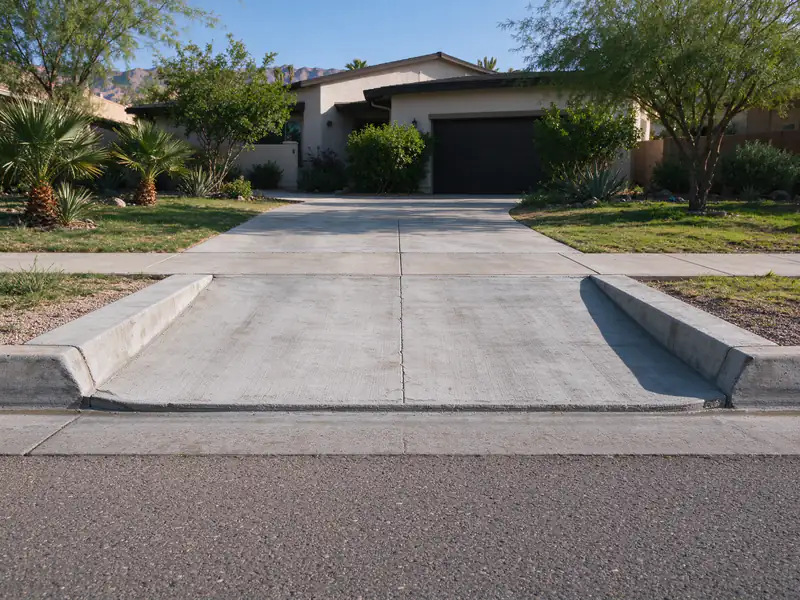
A driveway curb cut is the opening in a street’s curb that lets a car reach the drive: the curb is cut out and replaced by a lowered, depressed section with sloped wings at each end, joined to a new apron and sidewalk crossing. Because the curb, gutter and sidewalk belong to the public right-of-way, every curb cut in the Valley runs through the city that owns the street. Sundial Driveway Repair is a service company offering and managing driveway curb cuts across Phoenix and its suburbs, for homes and commercial properties, and the work is fulfilled by licensed and insured contractors.
People usually need one for three reasons: adding a second drive or a side-yard drive, widening an existing drive, or moving the entrance. A cut that already exists but has cracked or settled is apron work, covered on the driveway apron repair page. This page covers creating, widening or closing the opening.
What happens on the first visit
The first visit looks at the whole driveway and the street edge together: the surface, joints and edges of the existing drive, where water runs, and how the drive meets the garage, the sidewalk and the street. For a curb cut the street side gets extra attention. Is the curb rolled, vertical or missing? Is the sidewalk attached to the curb or set back behind a strip of landscaping? Where are the water meter box, fire hydrant, light pole, mailbox and storm drain inlet relative to the new opening?
The estimate then names the method, the area, the right-of-way portion and what it excludes, such as color match with the existing drive. The city permit is part of the scope, because a curb cut always reaches the right-of-way. If digging turns up soft base or caliche under the old curb and apron, the finding and its effect on the scope are explained before work goes further.
Rolled curb, vertical curb and no curb
The type of curb decides whether a cut is needed at all. A rolled curb, the low rounded kind, is built for wheels to cross. There is nothing to cut: the drive meets it with an apron. In Phoenix, the Driveway Policy for Single Family Development treats up to 10.5 feet of concrete drive in the right-of-way behind a roll or ribbon curb as part of the on-site work, with no separate driveway permit; a longer run needs one. Gilbert’s supplement to the MAG specifications likewise applies MAG Standard Detail 250 to entrances other than rolled curb.
A vertical curb is different. It is a full-height face meant to stop wheels and channel water, so a driveway entrance has to be built into it. The Phoenix single-family policy doesn’t address vertical-curb streets, so that work is handled as concrete in the right-of-way under the City’s fee schedule and its Parking Requirements Guideline, which calls for driveways to be built to City standards (C.O.P. Detail 1, 2 or 3) under a permit from Planning & Development. Streets with no curb at all need a driveway permit and an at-grade tie-in to the pavement under MAG Standard Detail 205.
How a curb cut is built
Permit and layout
The work starts on paper. Most cities want a sketch or plan showing the driveway width, the lot width and the opening’s position. Surprise’s Residential Driveway Plan Review and Permit Application, for example, asks for the driveway width, the lot width and length, and the distance from the property line to the driveway centerline, and the City Engineer approves it. Queen Creek’s plot plans show driveway elevations at the garage and street, width, slope and material thickness, and they keep driveways at least 2 feet from hydrants, utility poles, drop inlets, light standards and walls. Phoenix keeps a single-family driveway at least 4 feet from the curb radius return on a corner lot.
Saw-cutting and removal
Before any cutting, a utility locate marks the public lines in the street and sidewalk; private lines on the lot are not covered by it and are checked separately. The curb and gutter are saw-cut at each end of the new opening so the remaining curb keeps a clean face, then broken out along with any sidewalk and apron in the way. Where the street pavement meets the gutter, some cities require a patch: Surprise has the pavement saw-cut and removed at least 4 feet wide and replaced with asphalt from its approved mix list to match the existing depth.
Forming and pouring
The depressed curb, the wings and the apron are formed and poured to the city’s detail. The detail sets how far the curb drops, how long the wings are and how steeply the apron rises, and that profile is what keeps a car from scraping. Where a sidewalk crosses the drive, Phoenix requires an accessible walkway with a cross slope no steeper than 50:1, so the walk stays nearly level side to side. In Surprise, where the sidewalk is detached or the curb is rolled, the sidewalk across the drive is replaced at 5 inches deep. Summer pours are planned for the cooler hours and kept damp while they cure, and the wait before driving on the new apron is stated before work starts.
Rules that decide whether a cut is allowed
The permit is only part of it; zoning and street design can also limit where and how wide a cut goes. Mesa caps driveway width by lot frontage: under 75 feet wide, one drive up to 19 feet plus a second up to 10 feet if it leads to a side yard at least 12 feet wide; 75 feet or wider, 29 feet, or 19 plus 10. Paved areas can cover no more than half the front yard. Buckeye’s older town design standard allowed one driveway per lot frontage unless a 50-foot separation was possible. In Phoenix, an existing driveway that falls out of use must be replaced with curb, gutter and sidewalk to City standards, which matters when a cut is moved rather than added.
Who may do the work is set locally too. Mesa issues right-of-way permits only to contractors licensed by the Arizona Registrar of Contractors with insurance on Mesa’s certificate form, and Avondale wants the contractor’s ROC license number, a certificate of insurance and a sealed performance bond. Glendale may ask for a 100% performance bond, Paradise Valley a $2,000,000 liability certificate naming the Town, and Fountain Hills an approved traffic control plan. For Peoria and some other towns, no published residential curb-cut rule was found, so the requirements are confirmed per address. The Phoenix driveway permit guide explains the City process, and the ROC license lookup guide shows how to check a contractor yourself.
A curb cut is often one piece of a bigger plan. A driveway extension or a side-yard concrete RV pad usually needs a wider or second opening, and an HOA can have its own say on both, as the HOA driveway rules guide explains. If the existing drive is failing anyway, pairing the cut with a driveway replacement lets the new slopes meet cleanly.
Cost, insurance and payment notes
No published range covers curb cut work itself, so it is priced per job after measuring. What moves the number: the length of curb removed, the depressed curb and wings, the apron and sidewalk area, any street patch at the gutter, utility boxes that need adjusting, haul-off, traffic control on a busy street, and the city’s permit and review fees. Those fees are public. Phoenix charges $44 per 100 linear feet for a concrete right-of-way permit, with a $195 minimum for a residential single lot ($390 for other construction) and a $195 as-built review on concrete permits. Chandler’s encroachment permit has a $97 base fee plus $41.17 to inspect a concrete driveway entrance. The apron replacement cost guide shows how apron figures and permit fees add up.
A planned curb cut is an improvement, not the repair of damage. If a cut is being rebuilt after damage, only the insurer decides whether the policy pays, and the insurance guide covers the questions to ask. On tax, Arizona Department of Revenue rules decide whether a job is taxed as repair-type contracting, with tax built into the materials price, or another way; that is general information, not tax advice. When you have the lot details ready, ask for an estimate.
VIIVIVIVIIIIII
02
What's included
A check of the street edge: rolled, vertical or no curb, and where the sidewalk sits
Utility locate and a check for meters, hydrants, poles and inlets near the new opening
The right-of-way permit and the drawing or sketch the city asks for
Saw-cutting and removal of the curb, gutter and any sidewalk in the way
Forming and pouring the depressed curb, wings, apron and sidewalk crossing to the city detail
Street pavement patching at the gutter line where the city requires it
Haul-off of removed concrete and asphalt
VIIVIVIVIIIIII
03
Curb cut situations compared
Curb cut situations compared: what each involves and how it is priced
Situation
What it involves
Permit
Price basis
Street with rolled or ribbon curb
Usually no cut at all: the drive crosses the rolled curb, and only the apron is built
Phoenix: none for the first 10.5 ft of concrete in the right-of-way; other cities confirmed per address
Priced as apron work; $8 to $18 per sq ft (national budgeting example)
New opening in a vertical curb
Saw-cut and remove the curb and gutter, build a depressed curb with wings, apron and sidewalk crossing
A right-of-way permit from the city that owns the street
Priced per job after measuring; no published range
Widening an existing curb cut
Extend the depressed curb and wings, widen the apron, check zoning width limits
Right-of-way permit; zoning review where width rules apply
Priced per job after measuring; no published range
Closing an unused curb cut
Replace the opening with full-height curb, gutter and sidewalk
Right-of-way permit
Priced per job after measuring; no published range
04
Related resources
Guides that go deeper on curb cuts decisions in the Valley.
How the City's Driveway Policy for Single Family Development and its right-of-way fee schedule decide whether your driveway job needs a permit, and what it costs when it does.
The apron usually sits on public land, yet the repair often falls to the homeowner. Here is how ownership, upkeep and permits split between you, the city and anyone who dug it up.
What replacing the concrete apron at the street costs, why it costs more per foot than the rest of the drive, the Phoenix and Chandler right-of-way fees, and how a new or widened curb cut is priced.
05
How the work runs
First call or estimate request
Describe the surface, what changed and roughly where the property is. Photos of the damage and the street edge help. The published ranges give you a budget to think about before any visit.
A look at the whole driveway
The visit looks at more than the damaged spot: the slab or asphalt, the joints and edges, where water runs, and the transitions at the garage, sidewalk and street. The damaged area is measured, and anything found that changes the scope, such as soft base or caliche, is explained in the estimate.
Work timed for the heat
Hot-weather practice from the American Concrete Institute caps concrete at 95°F at discharge for general work, so summer pours are planned for the cooler part of the day. Where the job crosses into the street right-of-way, the city's permit is part of the scope.
Cure and handover
How long the car stays off depends on the material and the temperature. That wait is set out before the work starts, so you can plan around it.
VIIVIVIVIIIIII
06
What this work looks like
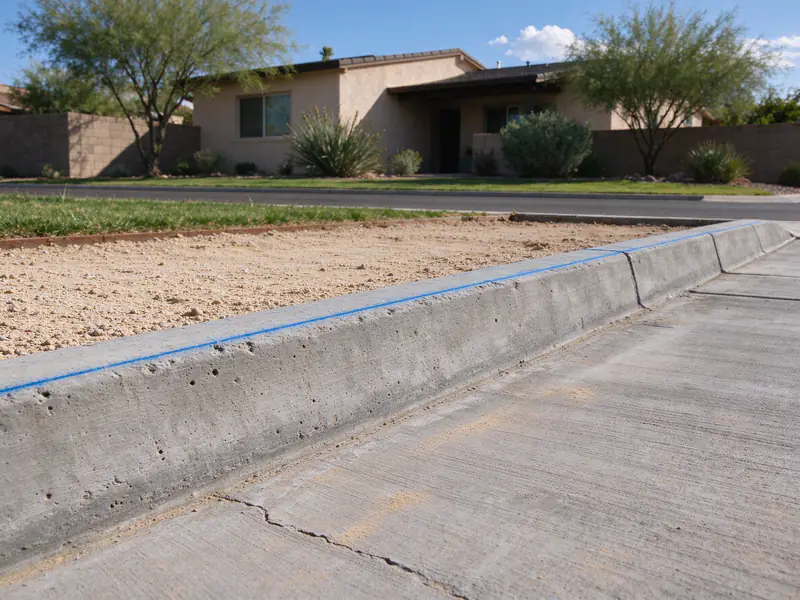
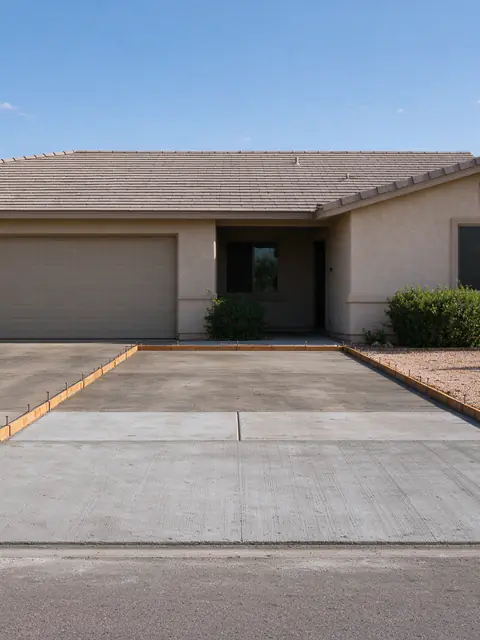
Vertical curb in Mesa marked with a chalk line before a driveway curb cut
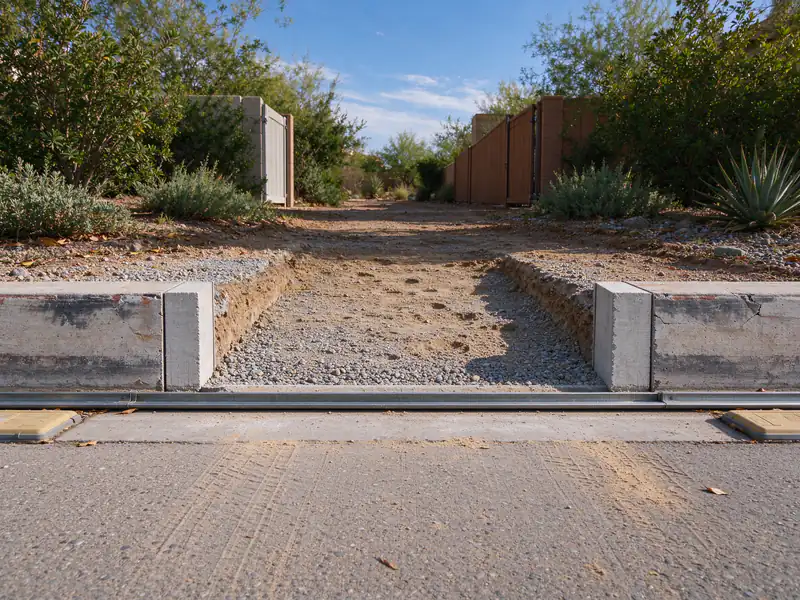
Curb section removed between two saw cuts for a new Mesa driveway entrance
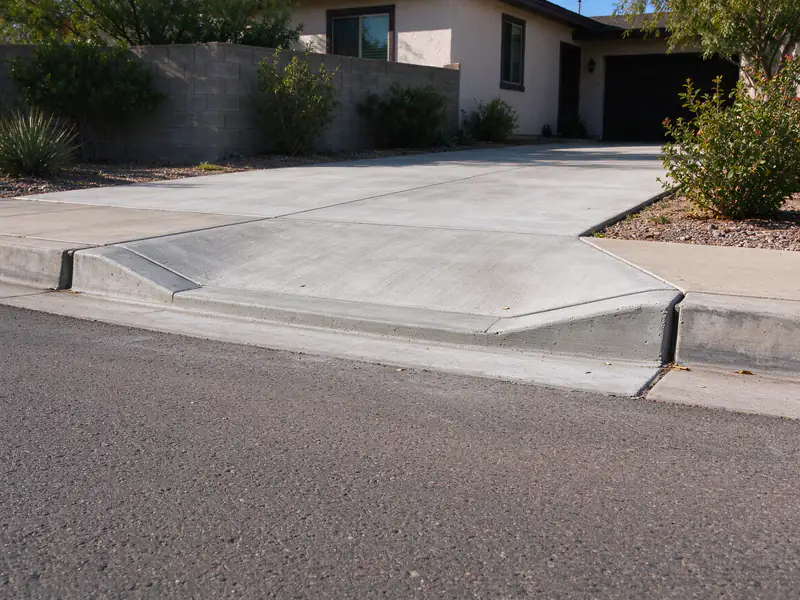
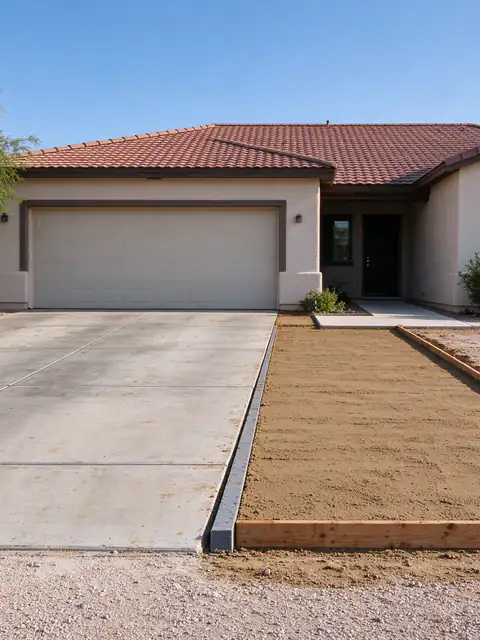
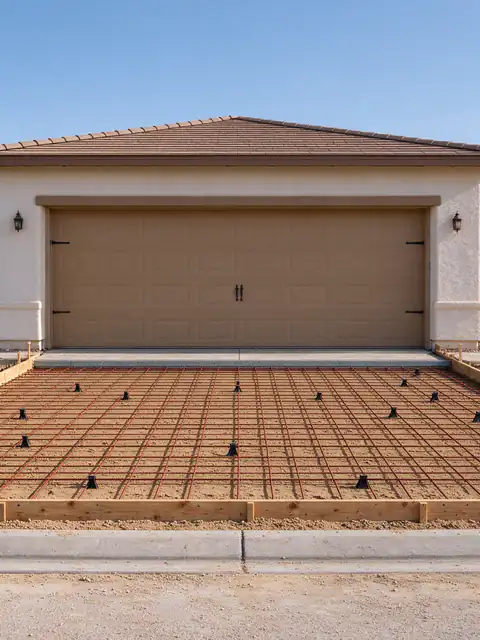
Wood forms for a depressed curb, wings and apron at a Mesa curb cut
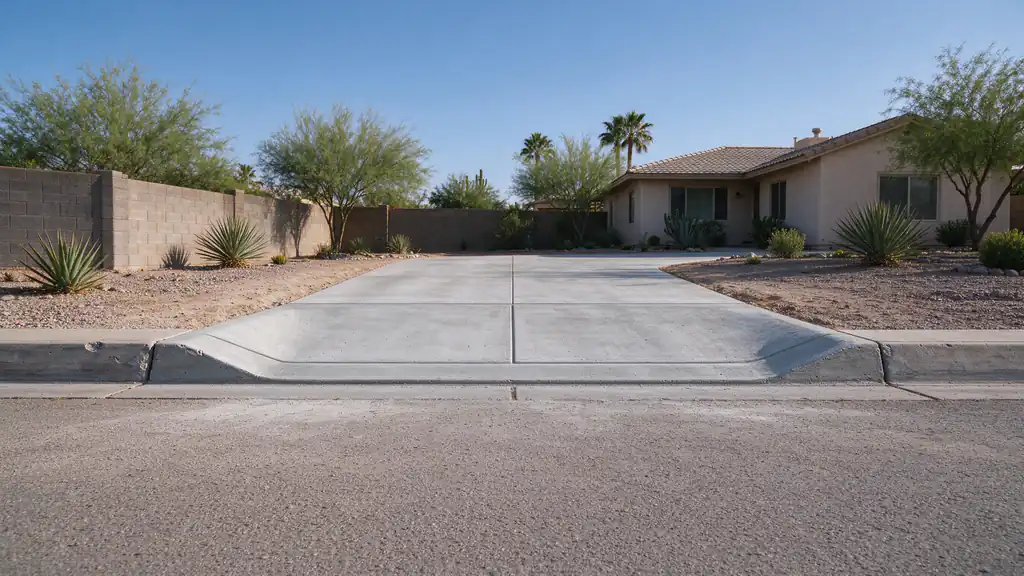
Finished curb cut in Mesa seen from the street, the curb dropped at the apron with sloped wings at each end
Need a new or wider curb cut? Get an Estimate.
Send a photo of the curb, your lot width and the opening you want. The estimate names the city detail, the permit and what the right-of-way part of the job includes.
Not without a permit, and in Mesa not as a homeowner at all. The curb belongs to the public right-of-way, so any cut needs the city's right-of-way permit. Mesa issues those only to contractors licensed by the Arizona Registrar of Contractors, and Arizona's handyman exemption never applies to work that needs a permit, whatever the price.
Is it legal to grind down the curb so my car stops bottoming out?
Grinding the curb changes public property, so it needs the city's permission like any other curb work. The city also decides the profile, which is why a scraping problem is usually fixed by rebuilding the depressed curb and apron to the current detail rather than shaving the top of the old curb. Ask for the slope at the curb to be measured before choosing the fix.
Does a street with a rolled curb need a curb cut for a driveway?
Usually not. A rolled or ribbon curb is shaped for cars to cross, so the drive meets it with an apron and no opening is cut. In Phoenix, up to 10.5 feet of concrete drive in the right-of-way behind that kind of curb counts as part of the on-site work and needs no separate driveway permit. Gilbert uses MAG Detail 250 only for entrances other than rolled curb.
What city fees come with a new driveway curb cut?
It depends on the city. Phoenix charges $44 per 100 linear feet for a concrete right-of-way permit, with a $195 minimum on a residential single lot and a $195 as-built review. Chandler's encroachment permit starts at $97 plus $41.17 to inspect a concrete driveway entrance. Avondale lists $95 for a concrete driveway and Cave Creek $250 per driveway cut. Plan review can add more.
What should I send to get a curb cut estimate?
A photo of the curb from the street, the lot width, how wide you want the opening, and where the existing drive and any side gate sit. Mark anything near the spot: a water meter box, fire hydrant, light pole, mailbox or storm drain inlet. If you live in an HOA, include its approval or the request you've sent, since the city won't settle that part.