111days a year reach 100°F or more at Sky HarborNOAA climate normals
0.6nights a year drop to freezing at Sky Harbor, so heat and water, not frost, drive most damageNOAA
June 15 to September 30 is monsoon seasonNational Weather Service
Phoenix treats up to 10.5 ft of concrete drive past a roll curb as on-site work, with no separate driveway permit
Concrete for a residential driveway in the Phoenix right-of-way is 6-inch Class A
Last Updated:
Driveway replacement in Phoenix means removing the old pavement, fixing what failed underneath it, and building a new drive from the base up, with the slope set so water runs away from the garage. It is the answer when damage runs through the structure rather than sitting on top of it, and it is also called driveway reconstruction. Sundial Driveway Repair is a service company offering and managing driveway replacement across Phoenix and its suburbs, in concrete or asphalt, for homes and commercial properties, and the work is fulfilled by licensed and insured contractors.
A replacement is a chance to correct what the first builder got wrong: thin or poorly compacted base, a slope toward the house, joints in the wrong places, or a slab too light for what parks on it. Replacing a driveway on the same base and grade that failed tends to rebuild the same problems.
What happens on the first visit
The first visit looks at the whole drive before replacement is on the table: the surface, the joints, the edges, where water runs, and the garage, sidewalk and street transitions. Cracks are checked for width, offset and whether they cross panels. Hollow areas are found by tapping, and sometimes a section is cut out to see the base. Slope is checked along the drive and across it, because a drive that holds water at the garage needs its grade changed, not just new concrete.
Findings that change the scope, such as soft base or caliche, are explained. The estimate names the method, the area, the pavement type and thickness, any right-of-way portion and what it excludes, such as matching older concrete left in place. If you want to judge your drive first, the driveway condition assessment walks through the same signs.
When replacement is the right call
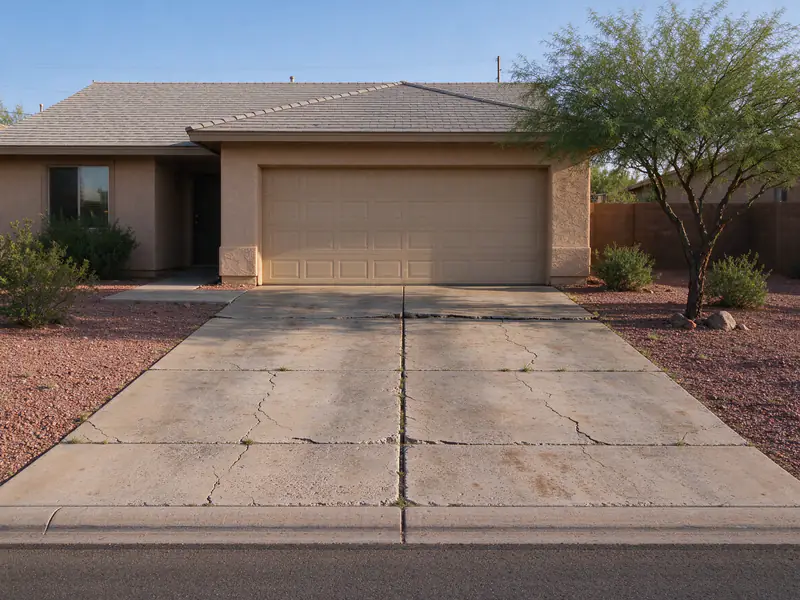
Replacement makes sense when the problem is the structure. The usual signs are cracking that crosses most panels, several panels that have dropped or tilted, base that is soft or washed out in more than one place, and a slope that sends water to the garage or holds it in the middle. One of those can often be repaired. When they come together, repeated repairs cost more over time than one rebuild, and each repair still sits on the failed base. The repair vs replacement guide sets out where that line usually falls.
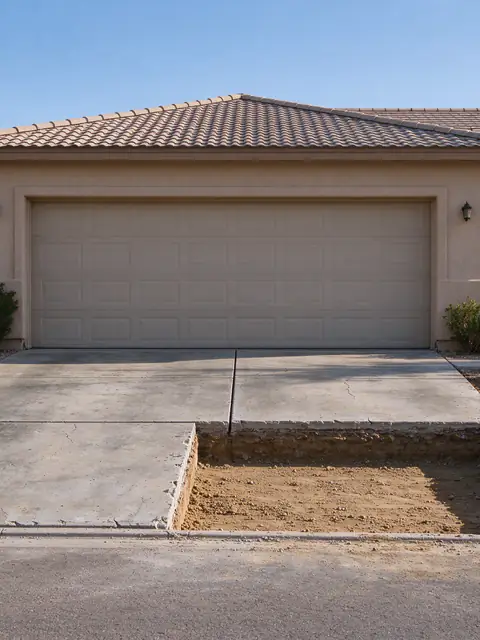
Partial replacement sits between the two. On a concrete drive, broken or sunken panels can be saw-cut at their joints, removed, and rebuilt on new base while the sound panels stay. That is the right scope when the damage is local, and it is covered on the concrete driveway repair and sunken driveway repair pages. The tradeoff is appearance: new concrete is lighter than old, and the difference narrows only slowly. If an even look matters, the full drive is the reliable way to get it.
Age is context, not proof. In Phoenix, 41.6% of housing units were built before 1980 (U.S. Census Bureau, American Community Survey), and where a driveway is original to a house of that age, its base and joints were built to the habits of that time. Whether that particular drive needs replacing still comes down to what the visit finds.
How a new concrete driveway is built
The City of Phoenix driveway policy assumes concrete in the right-of-way, so the steps below follow a concrete rebuild, in the order of its layers.
Removal and the aggregate base
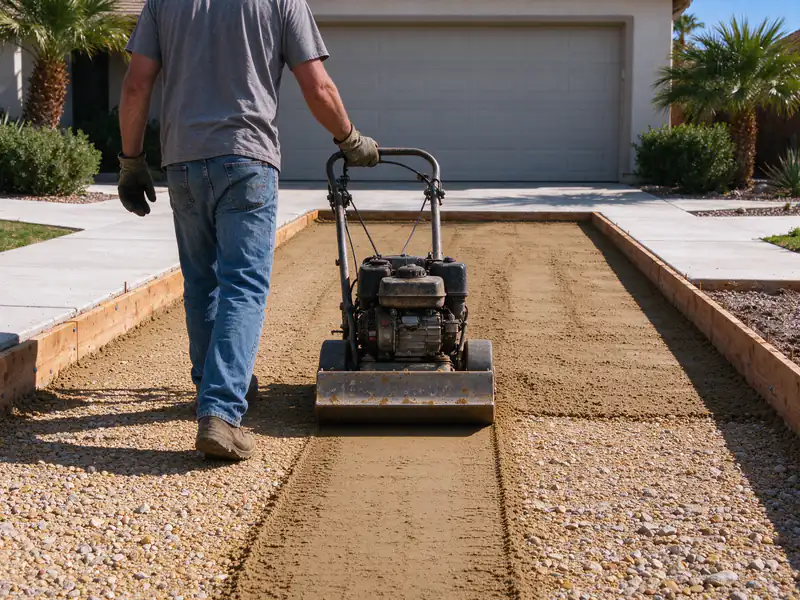
The old slab is saw-cut at its limits, broken out and hauled away. The subgrade under it is checked, and soft or wet soil is dug out. A layer of aggregate base course is then placed and compacted in lifts with a plate compactor or roller. That base spreads wheel loads, gives the slab even support and lets water drain away from its underside, and a base that was thin or poorly compacted is one way a drive fails early.
The soil under the base matters too. USDA soil survey samples show moderate or higher shrink-swell clay at 78.4% of points in Gilbert and 76.9% in Chandler, and that clay swells when wet and shrinks as it dries, moving any slab on it. Along foothill and desert edges, cemented caliche layers show up instead, at 29.2% of sample points in Phoenix’s Rio Vista village and 20.5% in Peoria. Caliche slows excavation and can hold water near the surface. The caliche guide covers what it changes.
Slope and where the water goes
Forms are set to grades that move water. The drive falls away from the garage toward the street or a planned outlet, with enough slope that water doesn’t sit, and not so much that cars scrape at the curb. Where a public sidewalk crosses the drive, Phoenix requires an accessible walkway with a cross slope no steeper than 50:1, so the drive flattens through that strip.
Some lots can’t drain to the street by slope alone, such as a garage set below the street. Then a channel drain across the drive, piped to an approved outlet, collects the water before it reaches the door. That is planned with the grades, and the driveway drainage page covers when it’s needed and where the water can legally go.
Thickness, reinforcement and heavy vehicles
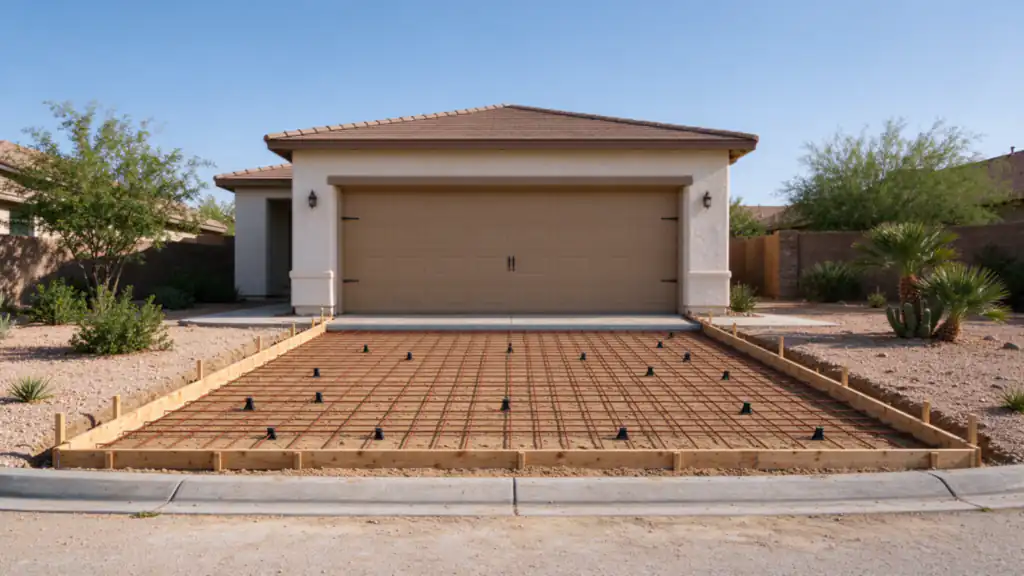
Thickness and reinforcement follow what the slab will carry. A drive that only sees cars needs less than one that holds a loaded pickup, a trailer, or an RV parked on stands, because concentrated weight bends a slab and cracks it where support is weak. Steel bar or welded wire holds cracks tight and helps carry those loads; fibers mainly help with early shrinkage cracks. No reinforcement makes concrete crack-free, and the right section depends on the loads and soil, so it is set per job. In the Phoenix right-of-way the City sets it: residential driveway concrete there is 6 inches thick, Class A. If a parking pad for an RV is part of the plan, the concrete RV pad page covers that design.
Pour, finish, joints and cure
Concrete is placed, screeded, floated, broom-finished, and control joints are cut so shrinkage cracks form along straight lines. Heat shapes the schedule: ACI 305.1 caps concrete at 95°F at discharge for general work, and normal July highs at Sky Harbor reach 106.5°F, so summer pours are planned for the cooler hours and kept damp while they cure. The wait before driving is stated before work starts; the guide on how long before driving on a new driveway explains why it varies.
Replacing an asphalt driveway
An asphalt replacement follows the same logic with different materials. The old asphalt and failed base are removed, the subgrade is corrected, aggregate base is compacted, and hot-mix is placed in lifts and rolled while it is hot enough to compact. In the Phoenix right-of-way, asphalt drives follow MAG Standard Detail 202 under the City’s driveway policy. Area, the depth of base work, asphalt thickness, haul-off and access set the price, and it is quoted after measuring. If only parts of the drive have failed, asphalt driveway repair may be enough, and the asphalt vs concrete guide helps if you are deciding which material to rebuild in. A gravel drive moving to a paved surface is its own job, covered on gravel driveway replacement.
Permits, width and who does the work
Work entirely on the lot often needs no City permit, but the street end is different. On Phoenix streets with roll or ribbon curb, up to 10.5 feet of concrete drive in the right-of-way counts as part of the on-site work; longer runs need a driveway permit, and streets with no curb need one with an at-grade tie-in per MAG Standard Detail 205. The City’s residential right-of-way minimum is $195, and concrete and paving permits add a $195 as-built review. The Phoenix driveway permit guide, driveway apron repair and driveway curb cut pages cover that strip. Suburbs set their own rules; Mesa, for example, issues right-of-way permits only to licensed contractors, as the Mesa page explains.
Replacement is also when people widen a drive. Zoning and HOAs set the limits, so check before planning a wider footprint; the driveway extension page and the HOA driveway rules guide cover both. Arizona’s Registrar of Contractors licenses concrete driveway work under R-9 and asphalt paving under R-13, and the license lookup guide shows how to check a contractor.
Insurance, tax and payment notes
Whether insurance pays toward a replacement depends on the policy and the cause, and that decision belongs to the insurer; nothing in an estimate means a claim will be accepted. On tax, the Arizona Department of Revenue treats replacement work as maintenance, repair, replacement or alteration contracting, so tax on materials is usually built into the price. The driveway replacement cost guide breaks down these ranges, the cost estimator gives a budget first, and you can ask for an estimate when you are ready.
VIIVIVIVIIIIII
02
What's included
A look at the whole drive, its base, slope and drainage before replacement is recommended
A measured area, the pavement type and thickness, and the method named in the estimate
Saw-cutting at the limits so the new work meets the garage, sidewalk and street cleanly
Breakout and haul-off of the old pavement
Soft or failed subgrade dug out, and aggregate base placed and compacted
Forms and grades set so the new drive sheds water away from the garage
Reinforcement where the design calls for it, placement, finishing and control joints
Curing, with the wait before driving stated before work starts
The City right-of-way permit when the work reaches the apron, sidewalk or curb
VIIVIVIVIIIIII
03
Replacing part of a driveway or all of it
Replacing part of a driveway or all of it: what each fixes, what it leaves, and a budgeting range
Scope
Best for
Won't fix
Budgeting range
Replace one or two sections
Broken or sunken panels in an otherwise sound drive
Color match with the older panels next to it
$10 to $15 per sq ft (typical Phoenix area); very small sections price as a minimum job
Replace the concrete drive
Cracking across most panels, failed base, poor slope
Nothing structural; it is the full rebuild
$6 to $11 per sq ft new pour, plus $1.20 to $1.90 per sq ft removal (typical Phoenix area); grading adds more
Replace the asphalt drive
Widespread alligator cracking and base failure
Nothing structural; it is the full rebuild
Priced after measuring: area, base work, thickness and haul-off set it
Resurface instead
A worn surface on a level, solid drive
Settlement, active cracks or a failed base
$5 to $10 per sq ft concrete (typical Phoenix area)
04
Related resources
Guides that go deeper on driveway replacement decisions in the Valley.
The signs that point to a repair, the ones that point to a new driveway, the middle option of replacing sections, and the Phoenix soil, water and right-of-way rules that tip the choice.
The two numbers behind a concrete driveway replacement, tear-out and new pour, plus what base repair, grade correction, the apron and permits add, with illustrative budgets.
How a rigid slab and a flexible pavement each respond to Valley heat, storms and soils, what each needs to stay sound, how they are repaired, and the City rules that apply at the street.
The wait depends on the material, the mix, the weather and the load. Here is what each one does, why Phoenix heat changes the picture, and how to protect new pavement in the first weeks.
How caliche forms, where soil surveys flag it around Phoenix, why a compacted subgrade matters more than the caliche itself, and how a cemented layer changes drainage, excavation and the price of a repair.
Which license classes fit each kind of driveway work, when the small-job exemption applies and when it doesn't, and what to check besides the license itself.
05
How the work runs
First call or estimate request
Describe the surface, what changed and roughly where the property is. Photos of the damage and the street edge help. The published ranges give you a budget to think about before any visit.
A look at the whole driveway
The visit looks at more than the damaged spot: the slab or asphalt, the joints and edges, where water runs, and the transitions at the garage, sidewalk and street. The damaged area is measured, and anything found that changes the scope, such as soft base or caliche, is explained in the estimate.
Work timed for the heat
Hot-weather practice from the American Concrete Institute caps concrete at 95°F at discharge for general work, so summer pours are planned for the cooler part of the day. Where the job crosses into the street right-of-way, the city's permit is part of the scope.
Cure and handover
How long the car stays off depends on the material and the temperature. That wait is set out before the work starts, so you can plan around it.
VIIVIVIVIIIIII
06
What this work looks like
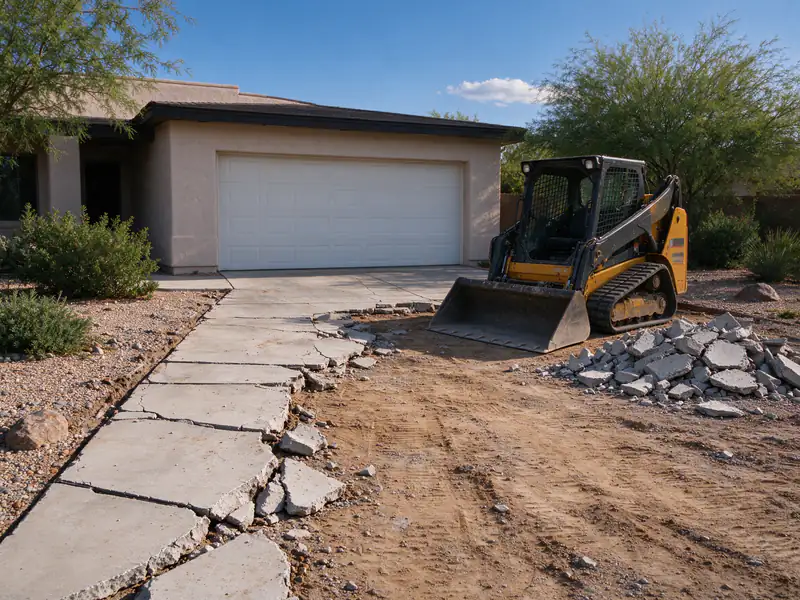
Old concrete driveway broken up and partly removed beside a parked skid steer in Gilbert
Plate compactor working the aggregate base inside driveway forms in Gilbert
Freshly screeded concrete inside wood driveway forms in Gilbert
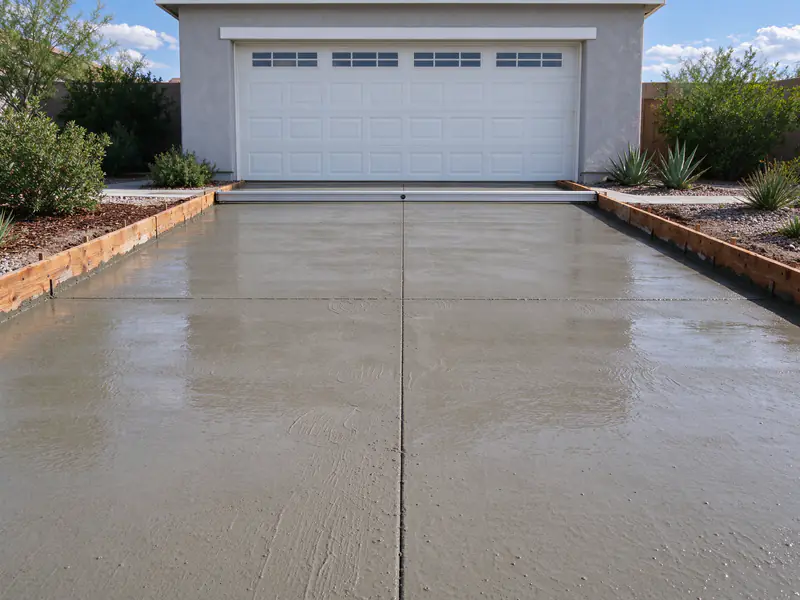
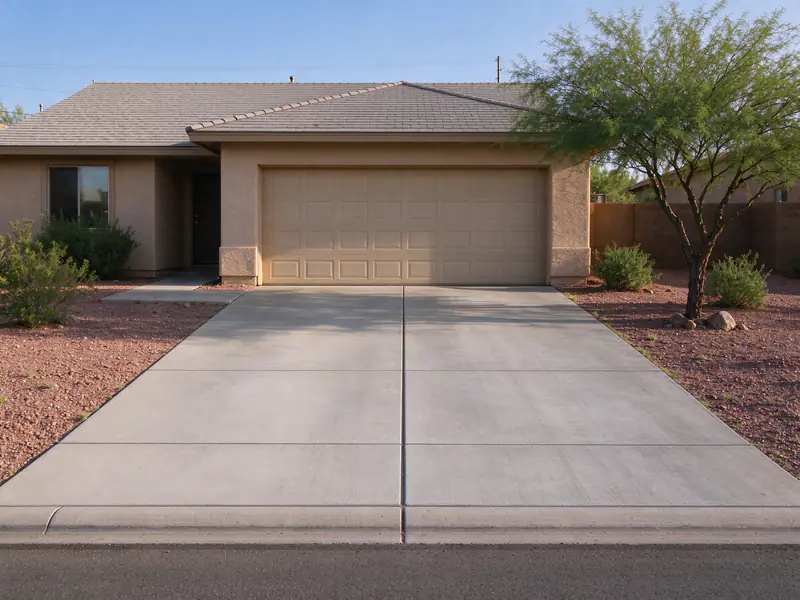
Finished new broom-finished concrete driveway with clean control joints in Gilbert
BeforeAfter
Driveway past patching? Get an Estimate.
Send photos of the whole drive and rough dimensions. The estimate names the scope, the base and slope work, any right-of-way portion and what it excludes.
What findings mean a driveway should be replaced rather than repaired?
Cracking that runs across most panels instead of a few, panels that have dropped or tilted in several places, base that is soft or washed out under large areas, and slope that sends water toward the garage. Any one of those can sometimes be repaired; several together usually cost more to patch over time than to rebuild once.
Do I need rebar in a new concrete driveway?
It depends on the loads, the soil and the design, so no single answer fits every drive. Steel bar or welded wire holds cracks tight and helps a slab carry heavy wheels; fibers mainly help with early shrinkage cracking. None of them stops concrete from cracking. Inside the Phoenix right-of-way, the City's driveway details set the section.
Can a driveway be widened while it is being replaced?
Usually that is the best time, since forms, base and concrete are already on site. Limits come from zoning, the right-of-way and any HOA: Mesa, for instance, caps driveway width by lot width and limits paving to half the front yard. A wider curb opening at the street is separate right-of-way work that needs city approval.
What happens to the old concrete when a driveway is torn out?
It is broken up, loaded and hauled away, and the removal is its own line on the estimate. Thick slabs, slabs with steel in them, small sections that need hand work and caliche below all take longer to remove. Ask whether haul-off is included and where the work stops, so the old apron or sidewalk edge isn't left half broken.
What should I gather before asking for a driveway replacement estimate?
Wide photos of the whole drive and close photos of the worst areas, rough dimensions, and notes on where water goes when it rains or the sprinklers run. Say what parks on the drive, whether you want it wider or a different material, and whether you are in an HOA, and note whether the work reaches the apron, sidewalk or curb.