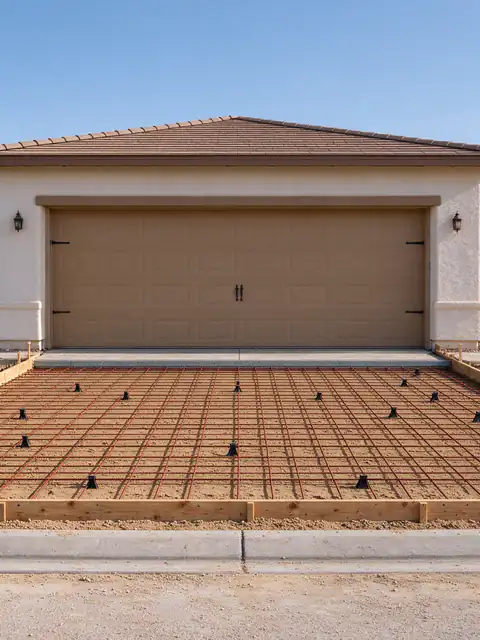
How long before driving on a new concrete driveway?
The wait depends on the material, the mix, the weather and the load. Here is what each one does, why Phoenix heat changes the picture, and how to protect new pavement in the first weeks.
Last Updated:
Short answerHow long before driving on a new concrete driveway depends on the mix, the slab thickness and the weather while it cures, so the wait for your job is stated before work starts. Foot traffic comes first, cars later, and heavy trucks last. Asphalt, lifted slabs and patches each follow their own timing.
How long before driving on a new concrete driveway is set by how quickly the slab gains strength, and that depends on the mix, its thickness and the weather while it cures. There isn’t one number that fits every pour, which is why the wait for each job is stated before work starts. Sundial Driveway Repair offers and manages driveway replacement and repair across Phoenix and its suburbs, with the work fulfilled by licensed and insured contractors, and this guide explains what sets that wait and how to protect new pavement while it cures.
Why does concrete need time before it carries a car?
Because hard and strong aren’t the same thing. Concrete sets within hours as the cement begins to react with water, and by the next morning the surface feels like stone. But that reaction, called hydration, continues for weeks, and the slab’s strength climbs the whole time. Mixes are specified by the strength they reach at 28 days; residential driveway concrete in the City of Phoenix right-of-way, for example, is Class A, and the Town of Paradise Valley calls for Class A at 3,000 psi in its right-of-way. A slab that is a few days old has only part of that strength.
A car is a concentrated load on four small contact patches, and the slab has to spread it into the base without bending too far. Where it can’t, it cracks, and edges and corners crack first because they have support on fewer sides. That is why the wait is longer for cars than for people, longer again for delivery trucks, moving vans and RVs, and why the edges need the most care.
What makes the wait longer or shorter?
Factor
Effect on the wait
Why
Mix design
Some mixes gain strength faster
Cement content and admixtures change how fast hydration runs
Slab thickness
Thicker slabs carry load better at a given strength
More depth spreads the load
Temperature
Heat speeds early strength gain; cool weather slows it
Hydration is a chemical reaction that runs faster when warm
Curing
Good curing protects strength, especially at the surface
Water that evaporates early can’t hydrate the cement
Load
Cars wait less than heavy trucks
Heavier wheels need more strength
Base condition
A firm, compacted base helps a young slab
A soft base makes the slab bend under each wheel
How does Phoenix heat change it?
It cuts both ways. Hot weather speeds up hydration, so a summer slab gains early strength faster. But the same heat, plus low humidity and wind, pulls water out of the surface before the cement can use it. That causes plastic shrinkage cracks and a weak, dusty top layer that scales and flakes later, and the spalling guide explains how.
Summer pours in Phoenix routinely fall in hot-weather conditions. Sky Harbor’s normal daily highs run from 104.2°F in June to 106.5°F in July (NOAA climate normals), while hot-weather practice from the American Concrete Institute (ACI 305.1) caps concrete at 95°F at discharge for general work. So summer pours are planned for the cooler hours of the day and kept damp while they cure, and the cure wait is stated before work starts. The guide to how heat affects driveways in Phoenix goes further into both sides.
Cool weather slows strength gain. Valley winters are mild, but a pour in December or January, when Sky Harbor’s normal highs sit in the upper 60s, gains strength more slowly than one in spring, and the wait can stretch.
What about repairs, lifted slabs and asphalt?
Each one follows its own timing.
A replaced concrete section is new concrete and follows the same logic as a full pour, though a small section with the car parked elsewhere is easier to protect. Concrete driveway repair covers how sections are cut out and replaced.
A lifted slab is old, fully cured concrete, so the wait is about the material injected under it, not the slab. Polyurethane foam and cement slurry set at very different speeds, which the mudjacking vs polyjacking guide compares, and the driveway leveling page covers the work.
New asphalt cools and stiffens instead of curing, so it carries cars sooner than concrete. In Phoenix heat, though, the binder stays soft for a long time, and wheels turned in place, parked weight and kickstands can mark it. Placement temperatures matter too: an ADOT inspector checklist for its standard specifications places asphaltic concrete only when the surface is at least 85°F and the air at least 70°F and rising. The asphalt driveway repair page covers patching and rebuilding.
Sealcoat needs to dry before tires go on it, and heat and humidity change how long that takes. The sealcoating worth it guide covers when it helps.
Crack sealant in concrete joints needs to set before traffic so tires don’t pull it out.
How do you protect a new driveway while it cures?
A few habits make a real difference in the first weeks:
Keep the curing cover or curing compound in place, and don’t hose off or pressure-wash the new slab until the contractor says so.
Set out cones, tape or a board across the drive so delivery drivers and visitors don’t pull in.
When you start driving on it, drive straight in and out, and keep wheels off the edges and corners.
Hold off heavy deliveries, such as a roofing truck, a dumpster or a moving van, until the longer wait for heavy loads has passed.
Keep sprinklers from soaking the edge of the new slab, which softens the base right where the slab is weakest.
On asphalt, avoid turning the wheel while stopped, and put a plywood pad under kickstands, jacks and trailer tongues.
What should the estimate tell you?
The wait for your driveway should be written down before work starts, in plain terms: when you can walk on it, when the car can go back on it, and when heavier vehicles can. It should also say how the slab will be cured and what to avoid in the first weeks. If you are planning a driveway replacement around a move, a party or summer heat, ask for the timing first so the schedule works. The driveway replacement cost guide helps with the budget side, and the number at the top of this page is the fastest way to ask about a specific job.
VIIVIVIVIIIIII
02
More questions on this
Can I walk on a new concrete driveway the next day?
Usually, for light foot traffic, once the surface has set hard and the contractor has said so. Avoid dragging anything across it, keep pets and bikes off, and don't disturb the curing cover or let anyone hose off the curing compound. Walking is a much lighter load than a car, which is why it comes first.
How long should I stay off a new asphalt driveway in the summer?
Follow the time the contractor gives, and expect to treat it gently for longer in summer. Fresh asphalt stays soft while it is hot, so in the first weeks avoid turning the steering wheel while the car is stopped, parking in exactly the same spot every day, and putting kickstands, jacks or trailer tongues directly on the surface.
What happens if I drive on new concrete too soon?
The slab may crack, especially at edges and corners, or the surface can scuff and mark before it has hardened enough to resist it. Damage from early loading is permanent and isn't something sealing fixes. If you must cross the drive early, the safest route is straight across the middle of a panel, never along an edge.
VIIVIVIVIIIIII
03
Get an Estimate for driveway replacement
Tell us the surface, what changed and the nearest cross streets. Photos of the damage and the street edge make the estimate more useful.
The physics of a slab that grows and shrinks every day, why heat does its worst damage to concrete in the first hours, how asphalt binder softens and ages under Valley sun, and what owners can do through a long summer.
The signs that point to a repair, the ones that point to a new driveway, the middle option of replacing sections, and the Phoenix soil, water and right-of-way rules that tip the choice.
How each lifting method works, where they really differ, how Phoenix clay and storm water affect the choice, and the cases where lifting isn't the answer at all.
What a sealcoat does to asphalt under Valley sun, the driveways it helps and the ones it can't, how to time it around heat and monsoon storms, and what to check before paying for it.
How a rigid slab and a flexible pavement each respond to Valley heat, storms and soils, what each needs to stay sound, how they are repaired, and the City rules that apply at the street.