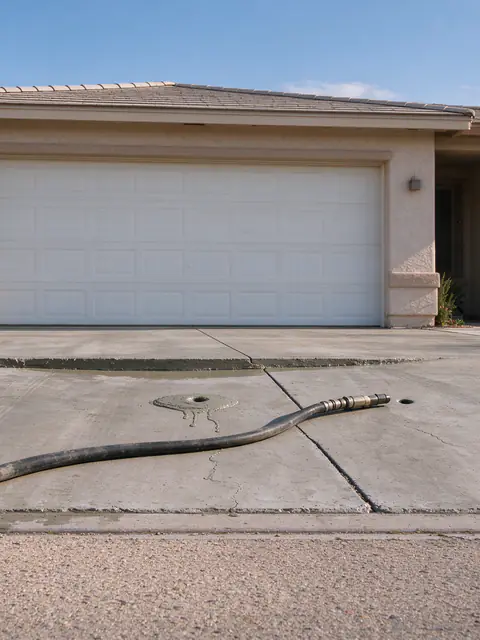
Avondale clay loam is the leading soil in South Mountain village's survey sample. Clay that swells when wet and shrinks as it dries moves a slab with each cycle, and a panel can drop where water collects. A sound panel that settled in one piece can often be lifted; a broken one is cut out and replaced on new base.
A sloped drive below the mountain
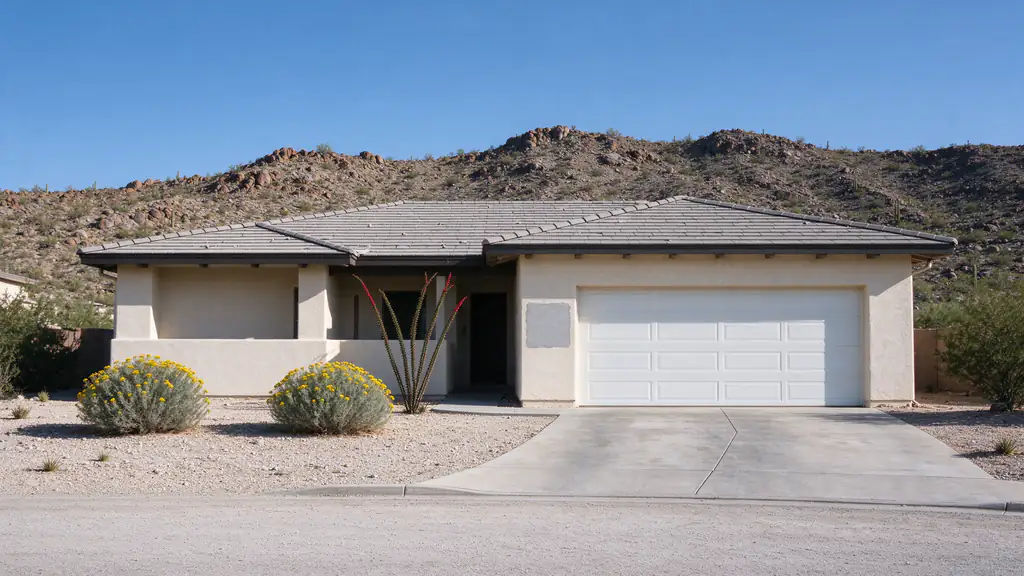
Near the preserve, the ground changes to gravelly sandy loam and rock outcrop. A sloped drive sends storm runoff down its length and can undercut the low edge. The repair plan deals with where the water goes, not just the concrete, and a drive cut into rock costs more to dig out.
Apron work behind a roll curb
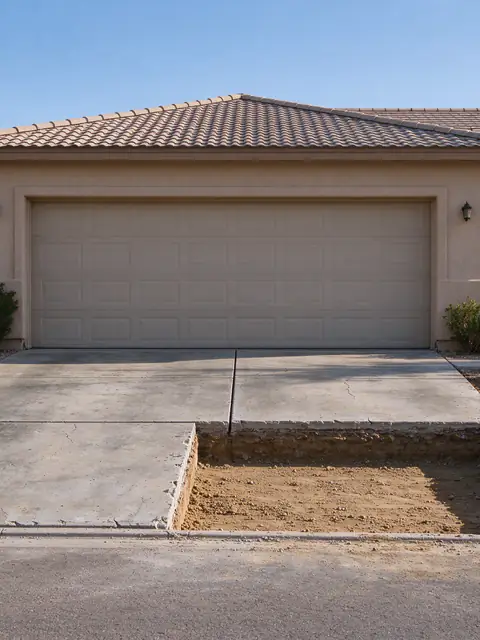
Under Phoenix's driveway policy, a concrete drive that reaches no more than 10.5 feet into the right-of-way behind rolled or ribbon curb counts as on-lot work and needs no permit of its own. Past that length a permit applies, and the City specifies 6-inch concrete. The estimate states where your job falls.
A street with no curb at all
Where a street has no curb, gutter or sidewalk, the City of Phoenix wants a paved at-grade tie-in built to MAG Standard Detail 205, under a driveway permit, with an off-site flow analysis and erosion protection. That is a different job from patching an apron behind a curb, and it is priced that way.
Two kinds of ground meet in the South Mountain village. The flats lie on clay loam that swells and shrinks, while lots near the preserve sit on gravelly soil and rock, and driveways on each fail in different ways, so driveway repair in South Phoenix starts with which ground your house sits on. As a service company, Sundial Driveway Repair offers and manages driveway work in South Phoenix and around the metro for residential and commercial owners, with licensed and insured contractors fulfilling every job. Either way, the curb, permit and fee rules are the City of Phoenix’s.
Clay on the flats, rock near the mountain
USDA soil survey samples inside the village boundary put 42.6% of points in moderate or higher shrink-swell soils, led by Avondale clay loam. On those flats, a slab rises when the clay soaks up water and drops back as it dries, and the damage shows up as cracks that cross panels or a panel that drops where water gathers. A sound panel that settled in one piece is a candidate for lifting a sunken slab; a broken one is cut out and replaced as part of concrete driveway repair.
Toward South Mountain the survey changes. Antho gravelly sandy loam and Rock outcrop-Cherioni complex take over, and 14.9% of sample points carry slope and hard bedrock as road limitations. Bedrock makes digging slower and dearer, while slope turns a monsoon storm into runoff that runs the length of the drive and eats at its low edge. That is why driveway drainage can belong in the same scope, and the heavy-rain guide explains how a base washes out. Cemented layers turned up at only 4.3% of points; where one is hit, the caliche guide covers what it changes.
The houses vary as much as the soil. Tract-level Census estimates put about 37.1% of the village’s 44,057 housing units before 1980 and 41.7% from 2000 or later, with 72.0% single-family detached. A slab from the 1960s at the end of its life and a newer drive cracking early on clay can sit a few streets apart. Age frames the question but proves nothing about one driveway; the visit does that.
What the first visit sorts out
The full length of the drive gets a look: the surface, joints and edges, where storm and sprinkler water travels, and the joins with the garage, sidewalk and street. Crack width and offset are noted, along with whether a crack carries into the next panel; a tap test locates voids, and now and then a small section is opened to expose the base. If that turns up soft base or rock that changes the job, the estimate explains it, then lists the method, the area, the right-of-way share and what is left out.
Phoenix rules at the curb
Because the village is part of Phoenix, the City’s driveway policy decides when a permit is needed: not for a short concrete run behind rolled curb, but yes for longer runs and for streets with no curb at all. The Phoenix driveway permit guide walks through each case, and apron repair covers the street end. City Code Section 31-54 makes the owner of an abutting lot responsible for keeping the sidewalk in repair. Published driveway repair cost ranges help set a budget, and the Central Phoenix and Tempe pages cover neighboring areas.
Driveway damage in South Phoenix? Get an Estimate.
Send photos of the damage and the curb edge, and say whether the drive slopes. That tells the estimate which Phoenix rule and which repair fit.
Which office issues driveway permits in South Phoenix?
The City of Phoenix. South Mountain is one of the City's 15 urban villages, so driveway permits come from the Planning and Development Department, and sidewalk notices and maintenance agreements from Street Transportation. Phoenix's single-family driveway policy and its right-of-way fee schedule apply here exactly as they do anywhere else in the city.
Do driveways near South Mountain need hillside review?
Sometimes. Under Phoenix Zoning Ordinance Section 710, any lot or part of a lot with a natural slope of 10% or more is in a hillside development area and goes through hillside review, and grading and drainage plans there are civil plans. Repairing a slab in place rarely changes grade, but a rebuild that regrades a steep lot can. Whether yours qualifies is confirmed per address.
What does a South Phoenix driveway repair cost?
Budget from the Valley-wide figures: sealing concrete cracks typically runs $0.50 to $5 a linear foot in the Phoenix area, mudjacking a settled panel $4 to $10 a square foot, and replacing a broken section $10 to $15 a square foot. When a City permit is part of the job, Phoenix charges at least $195 for a residential single-lot permit, plus a $195 as-built review on concrete work.
Does it freeze enough in South Phoenix to crack a driveway?
Not often. NOAA's South Phoenix station averages 8.5 nights a year at or below 32°F, against 0.6 at Sky Harbor, nearly all of them in December through February. Those are short overnight freezes that thaw by midday, not the long freezes that drive frost heave. Heat, clay movement and storm water do far more to a slab here than cold does.
Can I use gravel for the part of my drive in the South Phoenix right-of-way?
Only where the lot already has curb and gutter. Phoenix lets single-family lots with existing curb and gutter build gravel drives in the right-of-way without a permit, using ABC or quarter- to three-quarter-inch rock per MAG Detail 202, treated with a dustproofing product. Where the street has no curb, the City wants a paved tie-in under a driveway permit instead.
How the City's Driveway Policy for Single Family Development and its right-of-way fee schedule decide whether your driveway job needs a permit, and what it costs when it does.
What a monsoon storm does to the layers under a driveway, how to tell a washed-out base from a slab that is only cracked, and which repairs hold once the water is dealt with.
How caliche forms, where soil surveys flag it around Phoenix, why a compacted subgrade matters more than the caliche itself, and how a cemented layer changes drainage, excavation and the price of a repair.
Typical Phoenix-area and national budgeting ranges for each kind of driveway repair, what is inside the price, the City permit fees, and worked example budgets.