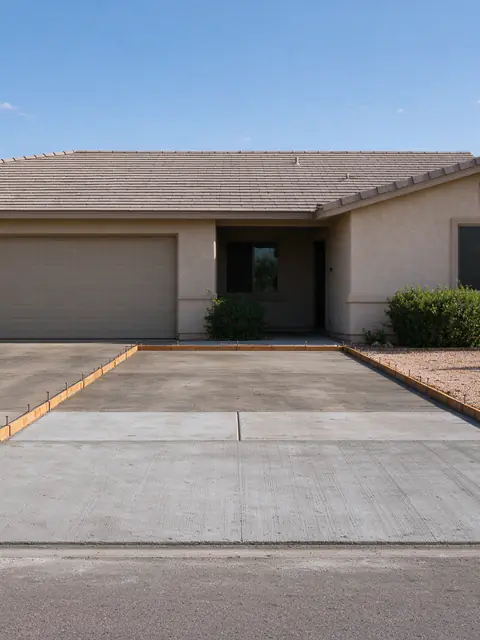
When do you need a City of Phoenix driveway permit?
How the City's Driveway Policy for Single Family Development and its right-of-way fee schedule decide whether your driveway job needs a permit, and what it costs when it does.
Last Updated:
Short answerYou need a City of Phoenix driveway permit when the work reaches the public right-of-way beyond what the City treats as on-site work. On roll or ribbon curb streets, up to 10.5 feet of concrete drive in the right-of-way needs no separate permit. Longer runs, streets without curb, and right-of-way concrete or paving work do.
A City of Phoenix driveway permit comes into play when driveway work crosses from your lot into the public right-of-way, the strip that usually holds the apron, the curb and the sidewalk crossing. Whether you need one depends on the kind of curb your street has and how far the concrete runs. Sundial Driveway Repair offers and manages driveway apron repair, curb cuts and other driveway work in Phoenix, fulfilled by licensed and insured contractors, and when a job reaches the right-of-way, the City permit is part of the scope.
Which part of a driveway does the City regulate?
The right-of-way. On a typical residential street, it runs from the street to a line somewhere behind the curb, and it often takes in the sidewalk and the apron, the sloped piece of drive between the sidewalk and the gutter. Where exactly that line falls on your lot is shown on the plat, and the apron responsibility guide explains how to find it.
Work behind that line, such as sealing cracks, lifting a sunken panel or replacing a section near the garage, falls outside the City’s driveway permit rules. Whether a given on-lot project needs any other City review is confirmed per address. Two exceptions are worth knowing: a lot with a natural slope of 10% or more falls in a hillside development area under Phoenix Zoning Ordinance Sec. 710 and needs hillside review, and grading that changes drainage may need its own plan.
What does the Phoenix Driveway Policy say?
The City’s Driveway Policy for Single Family Development (Planning & Development document TRT/DOC/00071, Rev. 03/26) sorts residential streets into types and sets a rule for each.
Your street has
What the policy says
Permit
Roll or ribbon curb, drive up to 10.5 ft long in the right-of-way
Incidental to on-site work; concrete 6 in. thick
No separate driveway permit
Roll or ribbon curb, drive longer than 10.5 ft in the right-of-way
Concrete 6 in. thick
Separate driveway permit
No sidewalk, curb and gutter or ribbon curb
At-grade tie-in per MAG Standard Detail 205; off-site flow analysis and erosion protection; Class A concrete 6 in. thick, or asphalt per MAG Standard Detail 202
Driveway permit
Existing curb and gutter, gravel drive
ABC or 1/4 to 3/4 in. rock per MAG Standard Detail 202 and Specifications 310 and 702, with a dust-proofing treatment
No permit
Non-concrete or non-asphalt material, or a non-broom finish, beyond 10.5 ft in the right-of-way
Needs a Street Transportation maintenance agreement
Agreement plus permit
Read the policy itself on the City of Phoenix site before you plan: it is short, and the City updates it from time to time. The practical upshot is that the 10.5-foot allowance covers a lot of ordinary apron work on roll-curb streets, while a long run in the right-of-way, a street without curb, or a decorative finish such as stamped or exposed-aggregate concrete past 10.5 feet brings the City in. A stamped concrete drive that continues more than 10.5 feet into the right-of-way is one case that needs that maintenance agreement.
The policy doesn’t address streets with a vertical curb, where the drive enters through a curb cut. That work means saw-cutting and removing curb and gutter and pouring an apron in the right-of-way, which the City’s fee schedule treats as concrete right-of-way work. The driveway curb cut page covers what that job involves, and the details for a given street are confirmed with the City.
What other City rules apply to a driveway?
The City’s Parking Requirements Guideline adds a few standards that come up on driveway jobs. On a corner lot, a single-family driveway sits at least 4 feet from the curb radius return. An accessible walkway with a cross slope no steeper than 50:1 is kept across every driveway, which matters when an apron is rebuilt across the sidewalk. And an existing driveway that is no longer used is replaced with curb, gutter and sidewalk to City standards, which comes up when a drive is moved or a second curb cut is closed during a driveway extension.
Parking surfaces have their own rule. Phoenix requires parked vehicles to sit on a “dust free” surface such as asphalt or concrete; on a lot with one single-family or duplex unit, a smooth layer of crushed rock or gravel at least 3 inches deep within a permanent border also qualifies, and rear yards of those lots are exempt. That rule is behind many gravel driveway replacement projects.
What does a Phoenix driveway permit cost?
The City’s Planning & Development fee schedule (Ordinance G-7465) sets the right-of-way fees.
Fee
Amount
Minimum right-of-way permit fee, residential single-lot construction
Paving right-of-way permit (asphalt, temporary driveway, paving replacement, seal coat)
$48 per 100 sq yd or fraction, plus $240 in City lab tests on paving permits over $500
As-built review on concrete, paving, water and sewer right-of-way permits
$195 per permit
Investigation fee for right-of-way work done without a permit
$250 or the permit fee, whichever is greater, up to $2,500 per day
For a small residential concrete job, such as an apron under 100 linear feet, the per-foot charge falls below the minimum, so the schedule works out to about $390: the $195 minimum plus the $195 as-built review. That is an estimate from the published schedule, before any plan review for driveway cut details, and the City confirms the figure for a given job. The fees are listed on the City of Phoenix fee schedule, which changes from time to time. The apron replacement cost guide puts those fees alongside the cost of the concrete itself.
Who pulls the permit, and why does licensing matter?
On a contracted job, the permit is part of the scope the estimate describes, along with the method, the area and what falls in the right-of-way. Licensing ties in here. Arizona’s small-job exemption from contractor licensing under ARS 32-1121 doesn’t apply when a job needs a permit, so right-of-way work calls for a contractor licensed by the Arizona Registrar of Contractors in a classification that fits, such as R-9 for residential concrete. The contractor license lookup guide shows how to check one.
Skipping the permit doesn’t save the fee. The investigation fee starts at $250 and can reach $2,500 a day, and an apron that doesn’t meet the City’s thickness or tie-in rules may have to come out.
What about cities around Phoenix?
They run their own systems. Mesa issues right-of-way permits only to ROC-licensed contractors, Chandler charges a $97 encroachment permit base fee, and Scottsdale, Tempe, Gilbert and Glendale each have their own right-of-way process, confirmed with each city. The Mesa and Chandler pages cover those details, and the driveway repair cost guide lists the published fees side by side. The Phoenix driveway policy and permit fees post tracks changes to the City’s rules.
If you aren’t sure whether your job touches the right-of-way, a photo of the curb and the sidewalk at the end of your drive usually settles it. Send one, or call the number at the top of this page.
VIIVIVIVIIIIII
02
More questions on this
How much is a Phoenix right-of-way permit for a driveway apron?
The City's fee schedule sets a $195 minimum for residential single-lot right-of-way work and adds a $195 as-built review to every concrete and paving permit. For a small concrete apron under 100 feet, that works out to about $390 before any plan review. The Planning & Development Department confirms the figure for a given job.
Can I put a gravel driveway in the Phoenix right-of-way without a permit?
On a single-family lot with existing curb and gutter, the City's Driveway Policy allows a gravel drive in the right-of-way without a permit, using ABC or 1/4 to 3/4 inch rock per MAG Standard Detail 202 and Specifications 310 and 702, treated with a dust-proofing product. Other street types and materials follow the permit rules.
What if my street has a vertical curb instead of a roll curb?
The Driveway Policy's 10.5-foot rule is written for roll and ribbon curb streets and for streets without curb. A drive entering through a vertical curb needs a curb cut and an apron built in the right-of-way, which falls under the City's concrete right-of-way permit. The permit desk confirms the details for a given address.
VIIVIVIVIIIIII
03
Get an Estimate for apron repair
Tell us the surface, what changed and the nearest cross streets. Photos of the damage and the street edge make the estimate more useful.
The apron usually sits on public land, yet the repair often falls to the homeowner. Here is how ownership, upkeep and permits split between you, the city and anyone who dug it up.
What replacing the concrete apron at the street costs, why it costs more per foot than the rest of the drive, the Phoenix and Chandler right-of-way fees, and how a new or widened curb cut is priced.
Which license classes fit each kind of driveway work, when the small-job exemption applies and when it doesn't, and what to check besides the license itself.
How association rules sit on top of city codes for driveway repairs, widening, pads and materials, and how to put together a request the board can approve.
Typical Phoenix-area and national budgeting ranges for each kind of driveway repair, what is inside the price, the City permit fees, and worked example budgets.