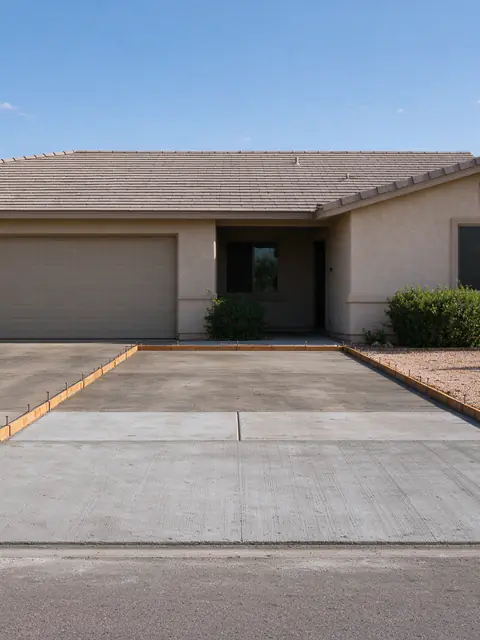
What replacing the concrete apron at the street costs, why it costs more per foot than the rest of the drive, the Phoenix and Chandler right-of-way fees, and how a new or widened curb cut is priced.
Last Updated:
Short answerAs a national budgeting example, a concrete driveway apron costs about $8 to $18 per square foot. In Phoenix, apron work in the street right-of-way can also need a City permit; a small residential concrete permit works out to about $390 from the City's fee schedule. Chandler charges a $97 encroachment base fee plus inspection fees.
Driveway apron replacement cost runs about $8 to $18 per square foot as a national budgeting example for concrete, and in Phoenix a City right-of-way permit adds about $390 for a small residential job. Sundial Driveway Repair is a service company offering and managing driveway apron repair and curb cuts across Phoenix and the surrounding Valley, fulfilled by licensed and insured contractors. This guide explains why the apron costs what it does, what the Phoenix and Chandler permits charge, and how a curb cut is priced.
The apron is the section of driveway between the street and your lot, usually including the depressed curb and the stretch across or up to the sidewalk.
Work
Range
Unit
What it covers
Range type
Concrete driveway apron
$8 to $18
per sq ft
Removing and repouring a concrete apron to the city standard; permit extra
National budgeting example
Phoenix right-of-way permit, small residential concrete job
About $390
per permit
$195 minimum plus $195 as-built review, before any plan review
Permit, saw-cutting, curb and gutter removal, apron pour, inspection
Priced by the site
The apron figure is a single national example rather than a Phoenix rate, so treat it as a budgeting guide. The $390 permit figure is arithmetic from the City’s published schedule; the Planning & Development Department confirms the amount for a given job.
Why does the apron cost more per foot than the rest of the driveway?
Three things raise it. The concrete is thicker: the City of Phoenix Driveway Policy calls for 6 inches of concrete in the right-of-way, Class A on streets with no curb, where an on-lot slab is commonly thinner. The shapes are harder: the apron has to drop to the gutter line, tie into the curb, carry an accessible walkway across the drive where the sidewalk crosses it, and meet the slab on your lot without a lip. And the work is in the street, so it follows a city standard detail, is inspected, and may need traffic control while the gutter is open.
Phoenix’s parking requirements guideline adds that an accessible walkway with a cross slope no steeper than 50:1 must be provided across driveways. That is one reason a steep or warped apron is often rebuilt rather than patched. The area is small, too, so setup, forming and inspection are spread across fewer square feet.
What do apron and curb cut permits cost in Phoenix and Chandler?
In Phoenix, a concrete driveway in the right-of-way on a street with roll or ribbon curb is part of the on-site work up to 10.5 feet long and needs no separate driveway permit. A longer right-of-way section, a street with no curb, or a vertical curb that has to be cut takes a permit. The City’s concrete right-of-way permit covers driveway, sidewalk, valley gutter and apron, curb and gutter, sidewalk ramp and curb return work.
Elsewhere in the Valley, fees are confirmed with each city. Mesa issues right-of-way permits only to contractors licensed by the Arizona Registrar of Contractors, with insurance on the City’s form. The Town of Paradise Valley requires a right-of-way permit with a $2,000,000 liability certificate naming the Town, and Glendale may require a performance bond for right-of-way work.
How is a new or widened curb cut priced?
A curb cut has no published price, so it is built from its steps. Each one is a line to look for on the quote:
Permit and plan. The city reviews the location and width. Phoenix’s guideline keeps single-family driveways at least 4 feet from the curb radius return on corner lots.
Saw-cutting. The curb, gutter and any sidewalk are cut at clean joints, and the street pavement where the city requires it.
Removal and haul-off. The vertical curb and gutter section, sidewalk panels and old apron come out.
Base and forming. The base is compacted and the depressed curb, gutter and apron are formed to the city’s standard detail.
Pour, finish and cure. The apron is poured at the required thickness and kept closed to traffic until it cures.
Inspection and as-builts. The city inspects the work; in Phoenix the as-built review is $195 per concrete permit.
Widening an existing cut follows the same steps on a shorter run of curb. Closing an old one runs them in reverse, rebuilding a standard curb, gutter and sidewalk. The curb cut page covers the work in detail.
What moves the price of an apron replacement?
Factor
Why it moves the price
What to check
Apron area
Priced per square foot, with a small total area carrying setup and inspection
Width at the curb and depth to the property line or sidewalk
Municipal apron rules
Each city sets thickness, details and permit steps
Roll curb, ribbon curb and vertical curb follow different rules
What the street edge looks like
Demolition and disposal
Thick apron concrete takes longer to break and haul
Slab thickness at the cut edge
Drainage
The gutter line must keep carrying street water past the drive (driveway drainage)
Ponding at the gutter
Traffic control
Work in the street may need cones, signs or a plan
Street traffic, parking, bus routes
Utilities
A utility cut through the apron can force full panel replacement in some towns
Recent utility work
Landscape restoration
Rock, irrigation and plants along the edges
What borders the apron
What’s inside a Phoenix driveway apron replacement price?
Part of the price
What sets it
Local figure and source
Concrete finishing labor
Forming, placing and finishing curb, gutter and apron
Cement masons and concrete finishers (SOC 47-2051): mean $29.25 an hour in the Phoenix-Mesa-Chandler metro vs $28.87 nationally; median $28.49 vs $27.41 (BLS wage data)
Demolition and site labor
Saw-cutting, breakout, haul-off, base prep
Construction laborers (SOC 47-2061): mean $23.40 an hour in the metro vs $25.02 nationally (BLS national data)
About $390 for a small residential concrete job in Phoenix; $97 base plus inspection items in Chandler
Work done without a permit
Penalty or investigation fee
Phoenix: $250 or the permit fee, whichever is greater, up to $2,500 per day. Chandler: $1,000
Sales tax
How Arizona taxes repair contracting
Built into materials rather than added as an invoice line on repair and replacement work (Arizona Department of Revenue)
Traffic control and landscape restoration
Cones, signs, resetting rock and irrigation
No public figure; scope to check on the quote
A wage is not a billing rate. A quote’s hourly cost also carries insurance, licensing, trucks, equipment and overhead. Concrete finishers in the Phoenix-Mesa-Chandler metro earn a mean $29.25 an hour, about 1% above the $28.87 national mean, so local wages don’t account for a high apron quote; city standards, thickness and the small area do.
Are there rebates or cost-shares for apron work?
None was found. The City of Phoenix has no sidewalk repair cost-share program, no permeable-pavement incentive turned up for Phoenix, Scottsdale, Tempe or the county flood control district, and no federal tax credit applies to driveway work.
What could an apron budget look like?
These are illustrative arithmetic from the figures above, with assumed sizes. They are not quotes.
Example (illustrative)
Assumed scope
Arithmetic
Illustrative budget
Phoenix apron, two-car width
12 × 16 ft concrete apron in the right-of-way, permit needed
192 sq ft × $8 to $18 (national budgeting example), plus about $390 in City fees
About $1,930 to $3,850
Phoenix apron, single-car width
10 × 10 ft, permit needed
100 sq ft × $8 to $18 (national budgeting example), plus about $390
About $1,190 to $2,190
Chandler apron
10 × 12 ft concrete apron
120 sq ft × $8 to $18 (national budgeting example), plus $97 base fee and inspection items such as $41.17 for a driveway entrance
About $1,068 to $2,309, depending on which inspection items apply
Crack sealing only
15 linear ft of cracks in a sound apron
15 × $0.50 to $5
$7.50 to $75, so a minimum charge sets the bill
How do you compare apron quotes?
Look for the measured area, the city standard detail the work follows, the concrete thickness and class, how the gutter and sidewalk transitions are handled, the permit and who obtains it, inspection, haul-off, traffic control, cure time before driving and exclusions. In Arizona, a contractor generally needs a Registrar of Contractors license once a job tops $1,000 in labor and materials or needs a permit, and R-9 covers residential concrete; Mesa won’t issue the permit to anyone else. The license lookup guide shows how to check. If the apron is part of a larger job, the replacement cost guide covers the rest of the drive.
How much does it cost to repair a driveway apron instead of replacing it?
Less, when the damage is minor. Sealing cracks in an apron that is otherwise sound runs a typical Phoenix-area $0.50 to $5 per linear foot, usually with a minimum charge. Once the apron is broken, sunken at the gutter or lifting at the sidewalk, it is normally cut out and repoured to the city standard, at a national budgeting example of about $8 to $18 per square foot plus any permit.
Does Phoenix charge separately for the curb, sidewalk and apron on one permit?
Not under separate fee lines. The City of Phoenix concrete right-of-way permit covers driveway, sidewalk, valley gutter and apron, curb and gutter and similar work, charged at $44 per 100 linear feet or fraction, with a $195 residential minimum and a $195 as-built review. For a small residential apron, that works out to about $390 before any plan review.
Why does a driveway apron cost more per square foot than the driveway itself?
Because it is thicker, more shaped and built in the street. Phoenix calls for 6 inches of concrete in the right-of-way; the apron has to drop to the gutter, tie into the curb and sidewalk, and carry an accessible walkway across the drive. It follows a city standard detail and is inspected, and its small area spreads setup, forming and permit costs over fewer square feet.
VIIVIVIVIIIIII
03
Get an Estimate for apron repair
Tell us the surface, what changed and the nearest cross streets. Photos of the damage and the street edge make the estimate more useful.
The two numbers behind a concrete driveway replacement, tear-out and new pour, plus what base repair, grade correction, the apron and permits add, with illustrative budgets.
Typical Phoenix-area and national budgeting ranges for each kind of driveway repair, what is inside the price, the City permit fees, and worked example budgets.
There is no single published price for a gravel-to-concrete conversion. This guide builds the budget from its parts: the new pour, the site work under it, the street end and the permits.
What mudjacking and polyurethane foam lifting cost per square foot, why small jobs price as a minimum, what drainage and joint work add, and where lifting stops being the cheaper choice.
What a bonded concrete overlay and an asphalt overlay cost, what prep is priced on top, how the numbers compare with replacement, and the conditions that make resurfacing money poorly spent.