111days a year reach 100°F or more at Sky HarborNOAA climate normals
0.6nights a year drop to freezing at Sky Harbor, so heat and water, not frost, drive most damageNOAA
June 15 to September 30 is monsoon seasonNational Weather Service
Phoenix treats up to 10.5 ft of concrete drive past a roll curb as on-site work, with no separate driveway permit
Concrete for a residential driveway in the Phoenix right-of-way is 6-inch Class A
Last Updated:
A concrete RV pad is a slab built to hold a motorhome, travel trailer, fifth wheel or boat, usually beside the driveway or through a gate into the side yard. It differs from a driveway extension in one important way: an RV is heavy and stays put for weeks or months, so the slab, the base and the access are planned around that load. Sundial Driveway Repair is a service company offering and managing concrete RV pads across Phoenix and its suburbs, and the work is fulfilled by licensed and insured contractors.
An RV pad plan comes down to three questions: whether the lot allows it, how the RV gets there, and what the slab needs to carry. Each one changes the price, so they are worked out in that order.
What happens on the first visit
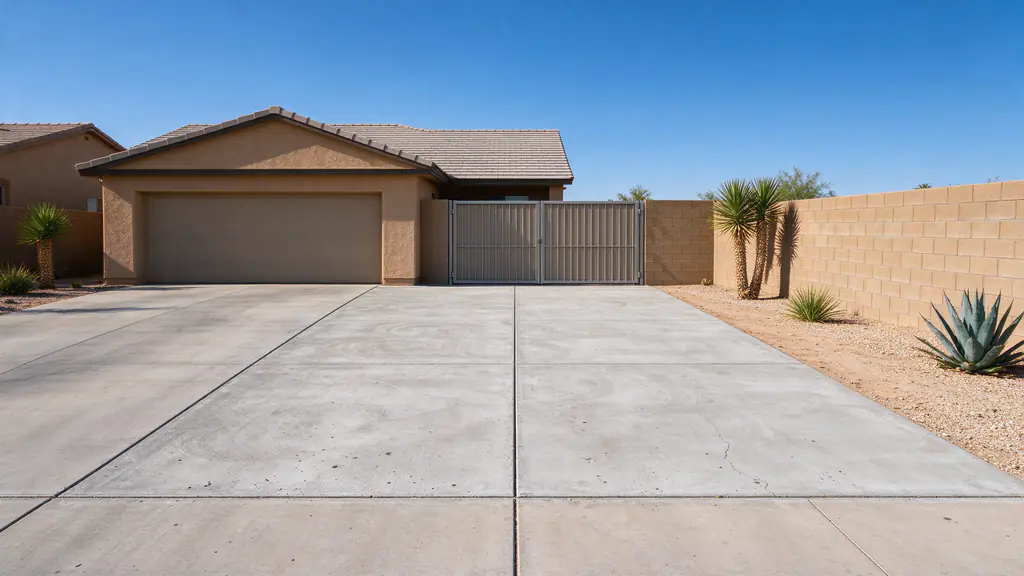
The first visit looks at the whole driveway and the route to the pad: the surface, joints and edges of the existing drive, where water runs, and how the drive meets the garage, sidewalk and street. The side yard gets the same attention. Its width, the gate opening, the slope toward or away from the house, and what is buried there (sprinkler lines, gas lines, a septic tank) all affect the layout. If the RV will cross the existing drive, that slab is checked for cracks and hollow spots by tapping, since a thin drive can crack under a heavy rig long before the new pad does.
The estimate names the method, the pad area, the slab and base being proposed, any right-of-way portion and what it excludes, such as the wall and gate work or matching the color of the old drive. If digging finds soft base or caliche, the finding and its effect on the scope are explained before the pour.
Can you put an RV pad on your lot?
HOA and city rules
In an HOA, start there. Homeowners report that associations want plans before a pad or a driveway extension is added, and CC&Rs can limit RV parking itself, so a pad that can’t be used is no bargain. The HOA driveway rules guide covers how those reviews usually go. City rules come next. Mesa, for example, allows a second driveway up to 10 feet wide only if it leads to an interior side yard at least 12 feet wide, and caps all front-yard paving at 50%. Where a city’s rule wasn’t found in a published source, including front-yard parking rules in Scottsdale and Tempe, it is confirmed per address. The Mesa page and the Peoria page cover local conditions in those cities.
Gravel or concrete under the dust rules
Phoenix requires parked vehicles to sit on a dust-free surface: asphalt, concrete, or an approved equivalent. On a lot with one single-family home or duplex, a smooth layer of crushed rock or gravel kept at least 3 inches deep inside a permanent border also qualifies, and the rear yard is exempt. Maricopa County Rule 310.01 adds a size trigger: at residential buildings with four or fewer units, parking, maneuvering and entry areas of 3,000 square feet or more must be paved or stabilized by a method the city, town or county authorizes. So gravel can be legal. It just tends to rut under RV tires, lets leveling jacks sink, and grows weeds, which is why concrete suits heavier rigs. If you already park on rock, gravel driveway replacement covers the conversion.
Drainage and impervious area
A pad along the side of a house sits in what is often the lot’s drainage path, and a slab sheds water faster than gravel. It is sloped away from the foundation and toward a place the water can go. Maricopa County requires lots to be graded so drainage doesn’t harm adjacent property. In Paradise Valley, adding 999 square feet or more of impervious area calls for an engineer-sealed grading and drainage plan, and it may be required from 750 square feet; a long RV pad plus its approach can reach that quickly. Driveway drainage covers how runoff is handled when hard surface is added.
Getting the RV to the pad
Access decides the layout. The RV has to turn from the street or the existing drive into the side yard without dropping a wheel off the edge, and the turn often needs more width at the mouth than the pad itself. If it needs its own opening at the street, the apron and curb work is a driveway curb cut, which brings in the city’s right-of-way permit. In Phoenix, behind a roll or ribbon curb, up to 10.5 feet of concrete drive in the right-of-way counts as on-site work with no separate driveway permit.
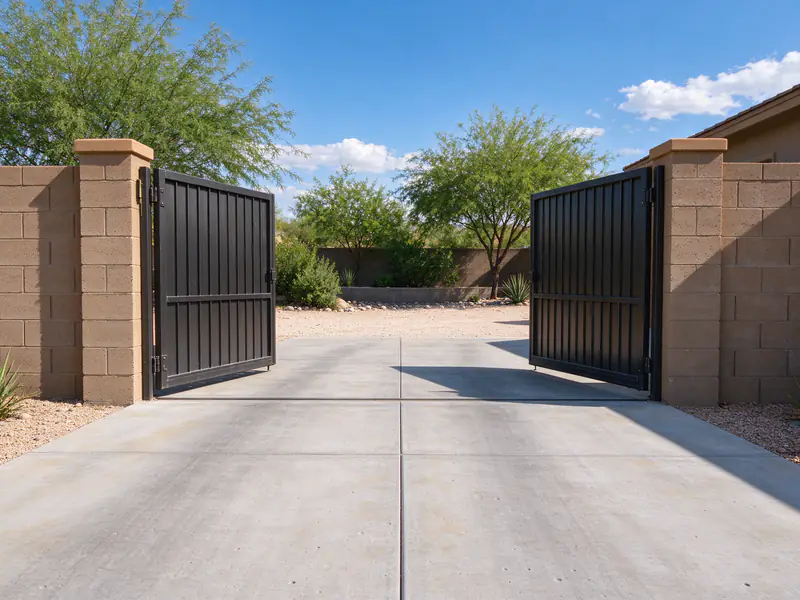
The pour needs access too. A side yard behind a block wall may be too narrow for a concrete truck to reach, so concrete may have to be pumped or moved in smaller loads, which adds cost. Opening a block wall and hanging an RV gate is a separate trade, and homeowners report needing two contractors for the job; that work isn’t part of this service, and its order is settled before the pad is formed.
What the slab and base need to carry
Load and thickness
An RV pad carries a static load: the same tires and the same leveling jacks on the same spots for months. Jacks and stabilizers concentrate weight on small plates, and a heavy coach turning on the slab twists it at the edges. Thickness and reinforcement are chosen for the vehicle’s weight, how it is parked and the soil under it, so they are named in the estimate rather than taken from a standard chart. The vehicle’s weight rating is the most useful number to have ready. Any part of the route that lies in the Phoenix right-of-way follows the City’s rule of Class A concrete, 6 inches thick.
Base and soil
The base is where RV pads succeed or fail. A thick slab on soft ground still cracks when the soil under one corner gives way. In USDA soil samples across Peoria, 46.2% of points show moderate or higher shrink-swell clay, 20.5% sit on cemented layers within 150 cm, and low strength is the most common road-building limitation, at 56.4% of points. Those are city-wide samples, not a reading of any one yard, but they explain why the subgrade is checked and compacted before the base goes in. Caliche, the cemented layer found mostly along the metro’s foothill and desert edges, slows excavation and can hold water above it; the caliche guide explains how it is handled.
Joints, cure and the first trip on
Control joints are saw-cut so shrinkage cracks follow straight lines, and they are laid out so the RV’s tires don’t sit right on them. Summer pours are planned for the cooler hours and kept damp while curing, since hot-weather practice from the American Concrete Institute caps concrete at 95°F at discharge and July highs at Sky Harbor average 106.5°F. A loaded RV should wait longer than a car before driving on the new slab; the cure wait is stated before work starts, and the guide to driving on new concrete explains why.
Cost and payment notes
No published range covers RV pads on their own, so they are priced per job. The typical Phoenix-area range for a standard broom-finish concrete driveway, about $6 to $11 per square foot for the new pour, is a reference point, not an RV pad price: a thicker or more heavily reinforced slab, or one poured through a narrow side yard, can land above it. The other drivers are the pad’s area, excavation and any caliche, removal of old gravel, base depth, drainage work, the street opening and permit, and restoring rock and irrigation around the edges. The gravel-to-concrete cost guide shows how those pieces add up, and the cost estimator gives a starting figure.
A new pad is an improvement, so insurance isn’t part of the picture. On tax, the Arizona Department of Revenue treats an alteration under 25% of a home’s full cash value as maintenance, repair, replacement or alteration contracting, where tax is built into the materials price; that is general information, not tax advice. When you know the RV and the route, ask for an estimate.
VIIVIVIVIIIIII
02
What's included
A look at the existing drive, the side yard, the gate opening and where water runs
A check of HOA, city width and parking-surface rules for the lot
Utility locate, plus a check for sprinkler lines, gas lines and any septic system
Excavation, haul-off and a compacted aggregate base sized for the pad
Slab thickness and reinforcement chosen for the vehicle and the soil, named in the estimate
Forming, placing, finishing and curing the pad, with control joints
The apron, curb and permit work when the pad needs a new or wider street opening
VIIVIVIVIIIIII
03
RV parking surfaces compared
RV parking surfaces compared: what each suits and what to check
Surface
Best for
Watch for
Price basis
Bordered gravel pad
Light trailers and occasional parking on a single-family lot
Ruts under tires, jacks sinking, weeds, dust rules on larger areas
Priced per job; gravel work has no published local range
Concrete pad, standard drive section
Cars, small trailers and light loads beside the drive
May be too thin for a heavy motorhome parked for months
Standard broom-finish pour about $6 to $11 per sq ft (typical Phoenix area)
Concrete pad built for heavier loads
Motorhomes, fifth wheels and boats on tandem trailers
Thicker slab and more steel; access for the concrete truck
Priced per job after measuring; can land above the standard pour range
Converting an existing gravel pad
A side yard that already holds an RV on rock
Removing old rock, regrading and drainage
See the gravel-to-concrete cost guide
04
Related resources
Guides that go deeper on rv pads decisions in the Valley.
How association rules sit on top of city codes for driveway repairs, widening, pads and materials, and how to put together a request the board can approve.
The wait depends on the material, the mix, the weather and the load. Here is what each one does, why Phoenix heat changes the picture, and how to protect new pavement in the first weeks.
There is no single published price for a gravel-to-concrete conversion. This guide builds the budget from its parts: the new pour, the site work under it, the street end and the permits.
05
How the work runs
First call or estimate request
Describe the surface, what changed and roughly where the property is. Photos of the damage and the street edge help. The published ranges give you a budget to think about before any visit.
A look at the whole driveway
The visit looks at more than the damaged spot: the slab or asphalt, the joints and edges, where water runs, and the transitions at the garage, sidewalk and street. The damaged area is measured, and anything found that changes the scope, such as soft base or caliche, is explained in the estimate.
Work timed for the heat
Hot-weather practice from the American Concrete Institute caps concrete at 95°F at discharge for general work, so summer pours are planned for the cooler part of the day. Where the job crosses into the street right-of-way, the city's permit is part of the scope.
Cure and handover
How long the car stays off depends on the material and the temperature. That wait is set out before the work starts, so you can plan around it.
VIIVIVIVIIIIII
06
What this work looks like
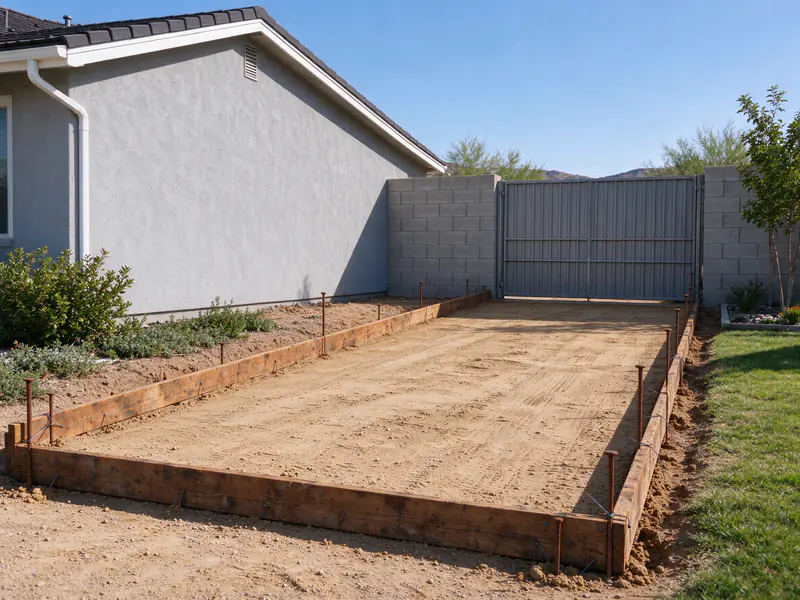
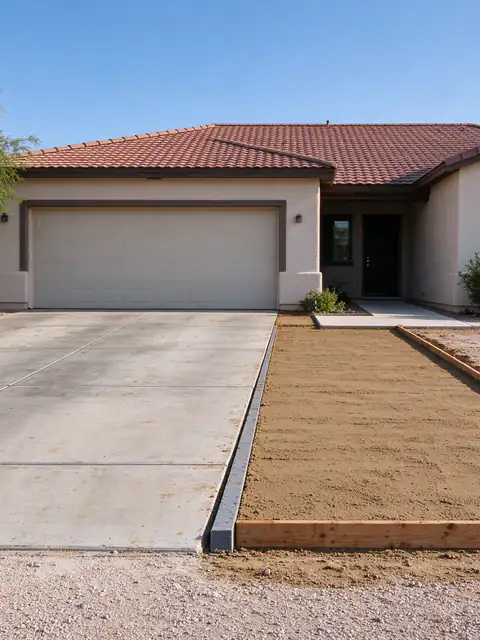
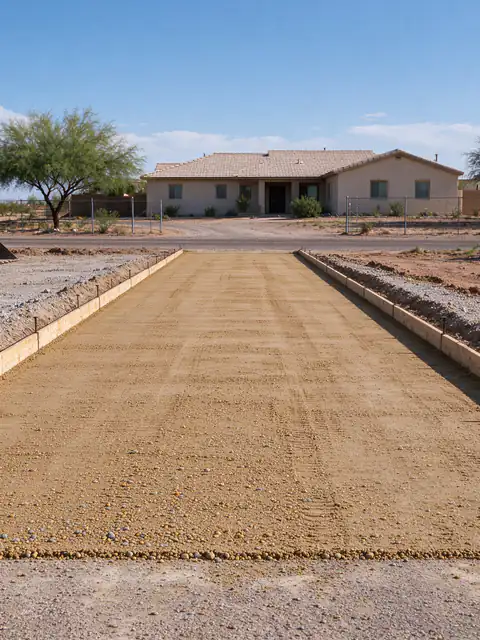
Wood forms over compacted base for a concrete RV pad in Peoria
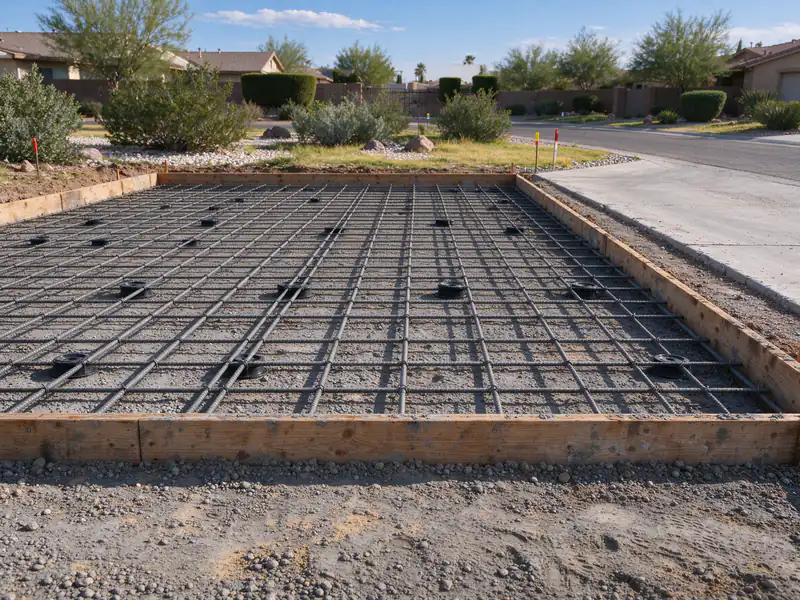
Rebar on chairs inside the forms for a concrete RV pad in Peoria
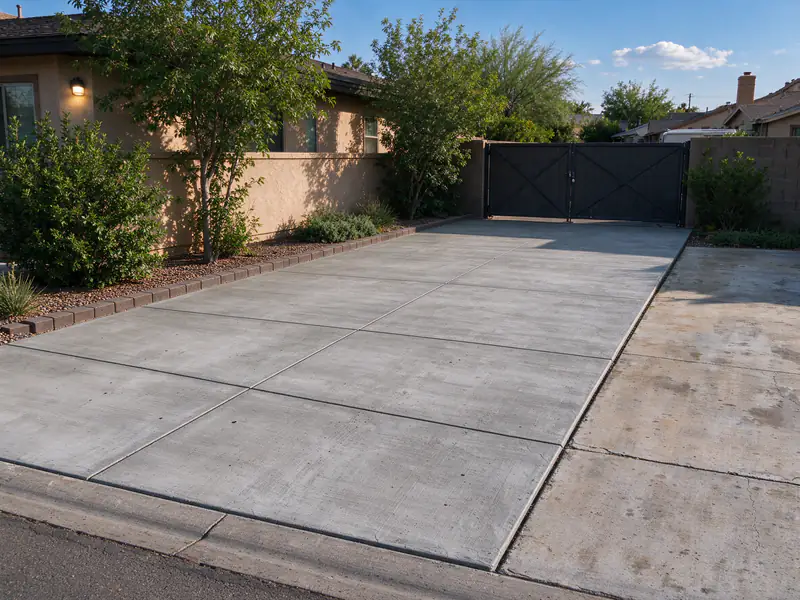
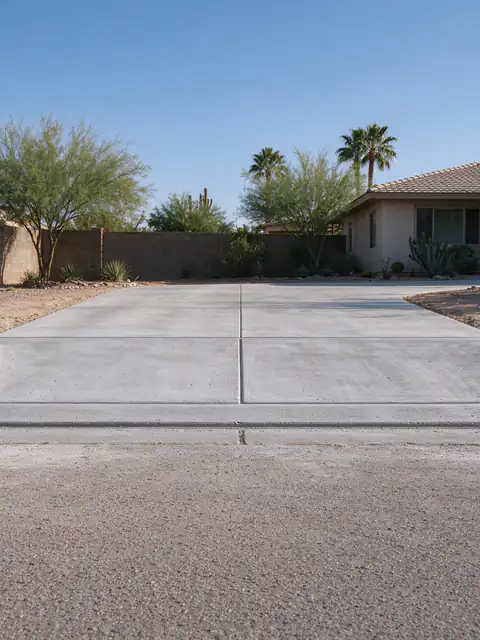
Finished concrete RV pad along the side of a Peoria house
Concrete RV pad running through an open steel gate in a block wall in Peoria
Planning an RV pad? Get an Estimate.
Send the RV's length and weight rating, photos of the side yard and gate, and any HOA rules. The estimate names the slab, the base, the access and what it leaves out.
It depends on what parks on it and what it sits on, so the thickness and reinforcement are chosen for the job rather than copied from a chart. A heavy motorhome parked in one spot for months loads the slab very differently from a utility trailer. Have the vehicle's weight rating ready. Any part of the drive in the Phoenix right-of-way is Class A concrete, 6 inches thick, by City rule.
Is a gravel RV pad allowed in Phoenix?
On a single-family lot, it can be. Phoenix's dust-free parking rule accepts a smooth layer of crushed rock or gravel kept at least 3 inches deep inside a permanent border, and rear yards of those lots are exempt. Maricopa County adds that residential parking and maneuvering areas of 3,000 square feet or more must be paved or stabilized by a method the city or county authorizes.
Who cuts the block wall for an RV gate?
That is a separate trade from the concrete. Homeowners report needing two contractors when an RV drive also means opening a block wall and hanging a gate, and the wall and gate work isn't part of this service. Sort out the order before booking: the wall opening, its footings and the gate posts usually need to be settled before the pad is formed through the gap.
Can an RV pad go over a septic tank or sprinkler lines?
Keep heavy loads off a septic tank and its lines; the pad is laid out to avoid them, which is why the system's location matters before design. Queen Creek's plot plans expect septic systems in the front yards of rural and estate lots. Sprinkler lines under the pad area are rerouted before the base goes in, since reaching them later means cutting concrete.
What details help with an RV pad estimate?
The RV or trailer's length and weight rating, the pad size you want, and photos of the side yard from the street and from the back. Measure the gate opening and the side-yard width, and mark sprinkler valves, utility boxes, the AC unit and any septic tank. Note whether the RV will turn in from the existing drive or needs its own curb opening.