111days a year reach 100°F or more at Sky HarborNOAA climate normals
0.6nights a year drop to freezing at Sky Harbor, so heat and water, not frost, drive most damageNOAA
June 15 to September 30 is monsoon seasonNational Weather Service
Phoenix treats up to 10.5 ft of concrete drive past a roll curb as on-site work, with no separate driveway permit
Concrete for a residential driveway in the Phoenix right-of-way is 6-inch Class A
Last Updated:
Driveway crack repair keeps water and grit out of a crack so the base underneath stays dry and firm. It works on concrete and asphalt, but only when the crack is the problem and not a symptom of a slab that is still moving. Sundial Driveway Repair is a service company offering and managing driveway crack repair across Phoenix and the surrounding Valley, for homes and commercial properties, with the work fulfilled by licensed and insured contractors. The job starts by sorting cracks into the ones that only need sealing and the ones that point to something underneath.
That sorting matters because a sealed crack and a fixed driveway are not the same thing. Sealant is flexible and thin. It can stop rain and irrigation water from reaching the base, and it can ride along as a crack opens and closes, but it carries no load and lifts nothing. A crack over a void or a settling panel needs the support fixed first, which is the work of sunken driveway repair or concrete driveway repair.
What happens on the first visit
The first visit looks at the whole drive, not just the crack you called about: the surface and finish, every joint, the edges, where water runs, and the transitions at the garage, sidewalk and street. Each crack is checked for width, for offset (whether one side sits higher than the other) and for whether it stays inside a control joint or runs across a panel. Hollow spots are found by tapping beside the crack, and on asphalt, soft or depressed areas next to a crack are noted.
The estimate names the treatment for each group of cracks, the total length, and what the work excludes, such as color match. If a crack turns out to sit over soft base or caliche, that finding is explained and the larger repair is priced separately, so you can see what sealing would and wouldn’t do. The driveway condition assessment walks through the same questions if you want to sort the cracks yourself first.
Reading the crack before choosing a repair
Hairline and shrinkage cracks
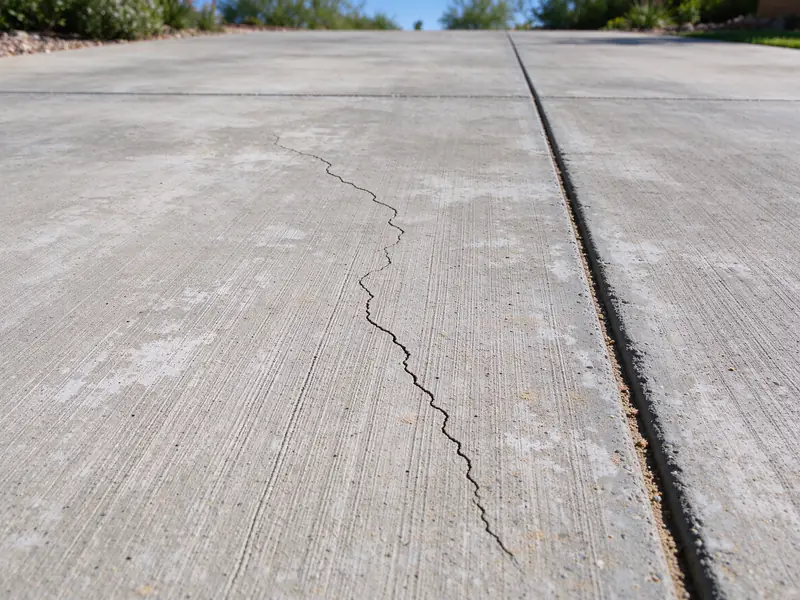
Concrete shrinks as the water in it dries out and the cement paste hardens. Control joints are saw-cut or tooled into the slab so that shrinkage cracks happen at the joint, in a straight line, but they can’t catch every one. Fine, shallow cracks that wander across the surface of a young slab are usually shrinkage. Hot, dry and windy placement makes them more likely, because the surface dries faster than the concrete below it. Phoenix Sky Harbor reaches 100°F or more on 111 days a year (NOAA climate normals), which is why hot-weather practice from the American Concrete Institute caps concrete at 95°F at discharge, and why the guide to how heat affects driveways matters for new pours. A hairline crack with level edges that hasn’t changed in months is dormant.
Longitudinal cracks
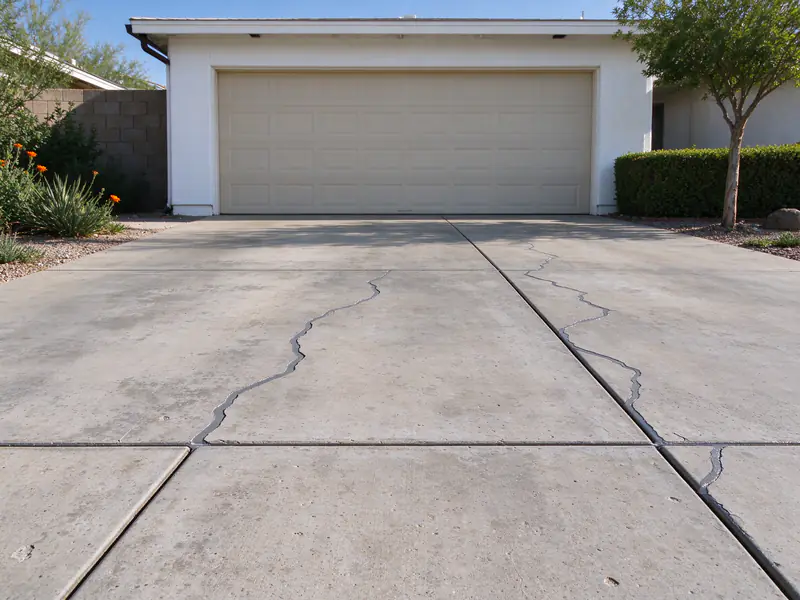
A crack running the length of the drive, roughly parallel to the direction you drive, often follows a line where support changes: the edge of an old utility trench, a fill line beside the garage footing, or the wheel path on asphalt. On concrete it can also mean the slab is wider than its joints allow for. Longitudinal cracks with level edges can be sealed. One that is widening, or has a lower side, says the ground under one half is behaving differently from the other, and the visit looks for the reason.
Transverse cracks
A crack running across the drive, from edge to edge, is usually the slab relieving stress where joints are spaced too far apart, or on asphalt, the binder shrinking and hardening with age. Heat drives the movement. Concrete expands in the afternoon sun and contracts overnight. At Sky Harbor the normal July high is 106.5°F while normal summer lows sit between 78.1 and 84.5°F (NOAA), so a slab in full sun goes through that swing every day for months. A transverse crack that opens and closes with that cycle is a working crack and needs a sealant that can stretch.
When a crack is a base problem
Some cracks are the visible end of a support failure. Offset at the crack, a crack that keeps reopening after it was filled, a web of cracks radiating from one point, or a hollow sound beside the crack all point below the slab. In USDA soil survey samples, more than three of every four points in Gilbert and Chandler show moderate or higher shrink-swell clay, which rises and drops with moisture and cracks a slab where its support changes. The guide to why driveways crack and sink traces those causes. For this kind of crack, the honest scope is to find the movement first: a section is sometimes cut out to see the base, and the repair becomes lifting, base repair or a new panel, with the crack sealing done last if at all.
Crack filling and crack sealing are different jobs
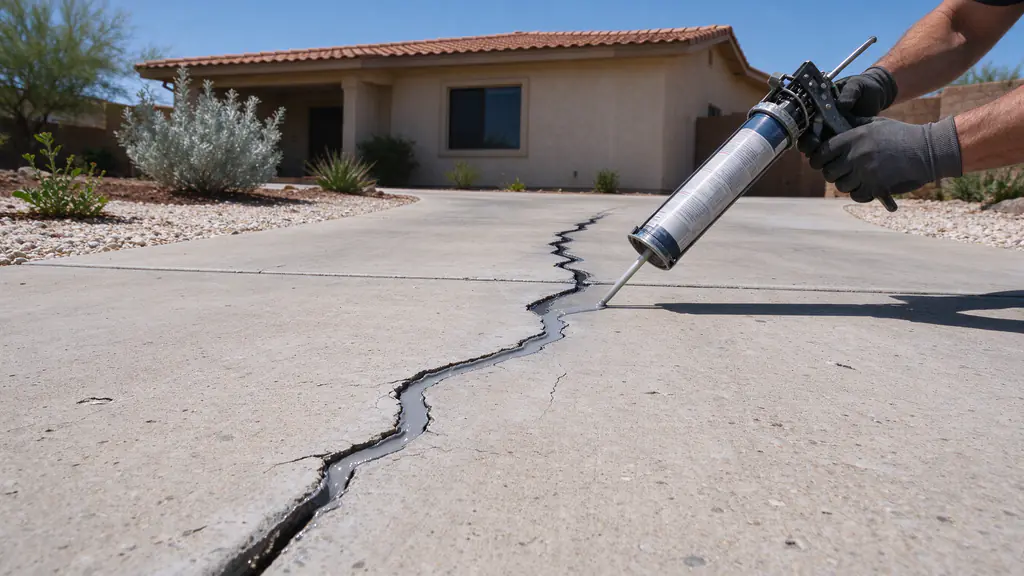
People use the terms interchangeably, but pavement practice separates them. Crack filling places material into a crack that moves little, mainly to keep water and debris out. The crack is cleaned and filled, with little or no shaping. Crack sealing is for working cracks. The crack is routed or sawn to a clean, uniform channel, called a reservoir, blown out and dried, and a flexible sealant is placed so it bonds to both walls and can stretch as the crack opens. On wide concrete cracks a foam backer rod sets the depth, so the sealant bonds only to the sides and not the bottom, which lets it flex instead of tearing.
Choosing between them comes down to movement. Filling a working crack wastes the money, because rigid or thin filler pops loose the first summer. Routing and sealing a dormant hairline crack is more work than it needs. That is why the visit checks each crack rather than pricing the whole drive at one rate.
Choosing the sealant
Concrete and asphalt take different materials. On concrete, self-leveling polyurethane or silicone sealants that meet ASTM C920 stay elastic, grip the crack walls and come in gray tones that sit close to weathered concrete. On asphalt, hot-applied rubberized sealants meeting ASTM D6690 are melted in a kettle and poured into the crack, where they bond to the asphalt and stay flexible; cold-pour emulsion fillers suit narrower, slow-moving asphalt cracks. Using an asphalt product on concrete, or a rigid patching mortar in a working crack, is a mismatch that fails early.
Sun ages every sealant, and Valley summers are long, so sealant lines need checking and renewing over time. Where the drive is asphalt, asphalt driveway repair covers what crack sealing can’t do, such as alligator cracking from a failed base. Cracks at the joint between the drive and the garage slab or sidewalk are often failed joints rather than cracks, and expansion joint repair treats those.
What crack repair costs and what moves it
A typical Phoenix-area range for filling and sealing concrete driveway cracks is about $0.50 to $5 per linear foot, and small jobs usually carry a minimum service charge. For asphalt, a national budgeting range for crack filling is about $0.50 to $3 per linear foot, also with a minimum charge. Those ranges cover sealing and filling; they don’t cover lifting, base repair or resurfacing. The total length of cracking, how wide the cracks are, whether they need routing and backer rod, and how much cleaning and weed removal comes first all move the price. On a short list of cracks, the minimum charge, not the per-foot rate, usually sets the bill. The driveway repair cost guide shows how these ranges compare with other repairs, and the cost estimator works from the same figures.
Licensing, insurance and payment notes
In Arizona, a contractor generally needs a Registrar of Contractors license when a job tops $1,000 in labor and materials or needs a permit. A small crack job can fall under that line, which is why the state’s handyman exemption exists, but it applies only to minor work under $1,000 with no permit, not split up to stay under the limit. Residential concrete work falls under the R-9 classification and residential asphalt under R-13, and the license lookup guide shows how to check one. Whether homeowners insurance pays for any of it depends on the policy and the cause, and that decision belongs to the insurer. When you’re ready, ask for an estimate.
VIIVIVIVIIIIII
02
What's included
A check of every crack for width, offset and whether it crosses panels or stays in a joint
A named method for each crack type: clean and fill, rout and seal, or base repair first
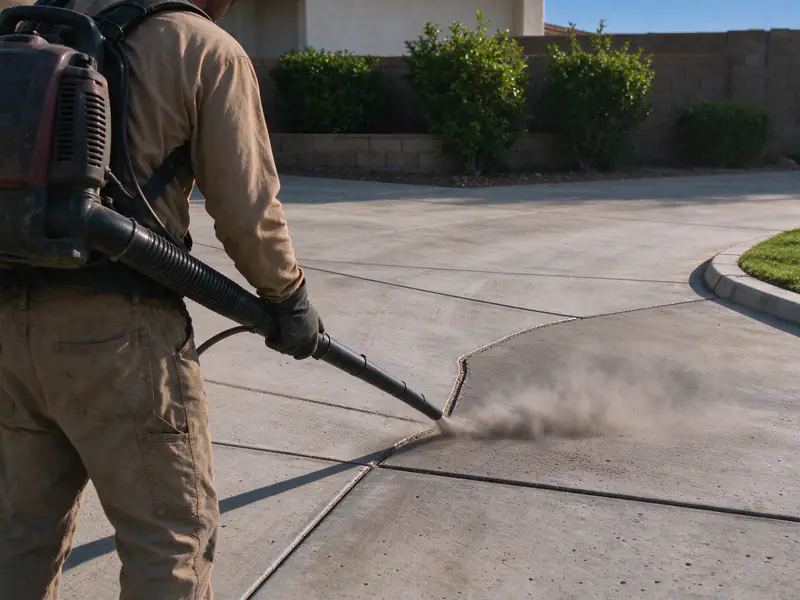
Crack cleaning: debris, weeds and loose edges removed and the crack blown dry
Routing where a working crack needs a sealant reservoir
A sealant matched to the pavement: elastomeric sealant on concrete, hot-applied rubberized sealant on asphalt
A note in the estimate of any crack that signals base or settlement trouble, with the larger repair it needs
VIIVIVIVIIIIII
03
Driveway crack treatments compared
Driveway crack treatments compared: what each fixes, what it leaves, and a budgeting range
Treatment
Best for
Won't fix
Budgeting range
Clean and fill (concrete)
Hairline and narrow dormant cracks with level edges
A crack that keeps opening or has one side lower
$0.50 to $5 per linear ft (typical Phoenix area), plus a minimum charge on small jobs
Rout and seal (concrete)
Working cracks that open and close with heat and moisture
Settlement, heave or a void under the slab
Priced after the crack length and width are measured
Asphalt crack filling
Wider, slow-moving cracks in a sound asphalt surface
Alligator cracking or a failed base
$0.50 to $3 per linear ft (national budgeting range), usually with a minimum charge
Asphalt hot-pour crack sealing
Working cracks in asphalt that open in winter and close in summer
Potholes, rutting or broken edges
Priced after the crack length is measured
Base repair, then a new section
Cracks with offset, widening or a hollow sound beside them
Nothing structural; it rebuilds the support
$10 to $15 per sq ft to replace a concrete section (typical Phoenix area)
04
Related resources
Guides that go deeper on crack repair decisions in the Valley.
How caliche forms, where soil surveys flag it around Phoenix, why a compacted subgrade matters more than the caliche itself, and how a cemented layer changes drainage, excavation and the price of a repair.
The physics of a slab that grows and shrinks every day, why heat does its worst damage to concrete in the first hours, how asphalt binder softens and ages under Valley sun, and what owners can do through a long summer.
Typical Phoenix-area and national budgeting ranges for each kind of driveway repair, what is inside the price, the City permit fees, and worked example budgets.
05
How the work runs
First call or estimate request
Describe the surface, what changed and roughly where the property is. Photos of the damage and the street edge help. The published ranges give you a budget to think about before any visit.
A look at the whole driveway
The visit looks at more than the damaged spot: the slab or asphalt, the joints and edges, where water runs, and the transitions at the garage, sidewalk and street. The damaged area is measured, and anything found that changes the scope, such as soft base or caliche, is explained in the estimate.
Work timed for the heat
Hot-weather practice from the American Concrete Institute caps concrete at 95°F at discharge for general work, so summer pours are planned for the cooler part of the day. Where the job crosses into the street right-of-way, the city's permit is part of the scope.
Cure and handover
How long the car stays off depends on the material and the temperature. That wait is set out before the work starts, so you can plan around it.
VIIVIVIVIIIIII
06
What this work looks like
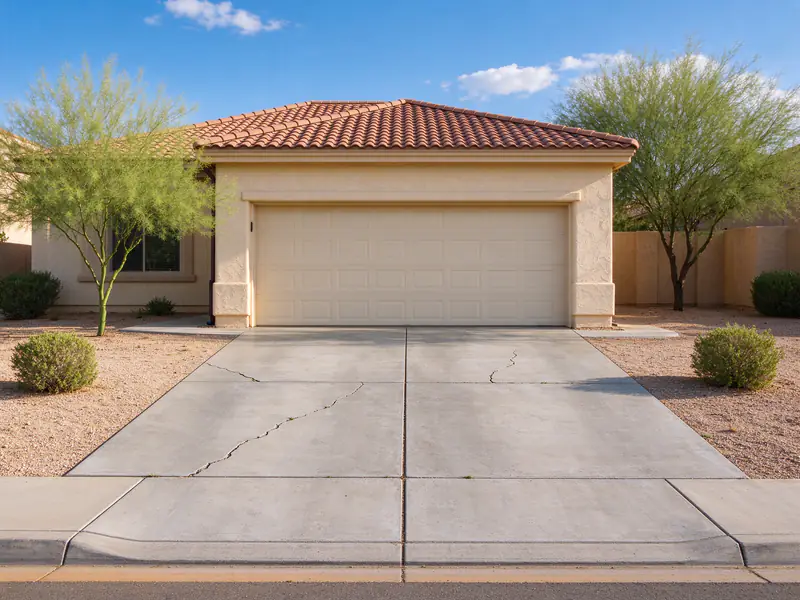
Hairline crack wandering beside a saw-cut control joint in a Chandler concrete driveway
Hot rubberized sealant being applied to cracks in an asphalt driveway in Chandler
Dust being blown out of a routed crack in a concrete driveway in Chandler before sealing
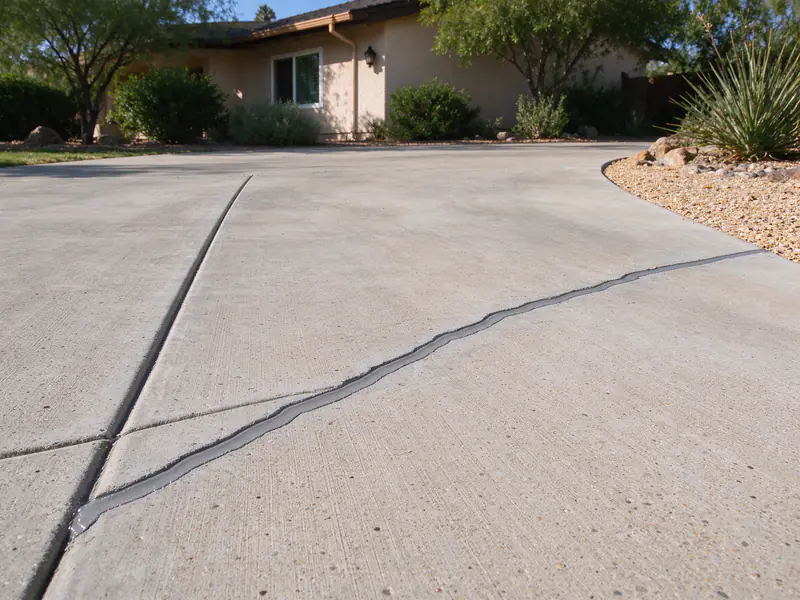
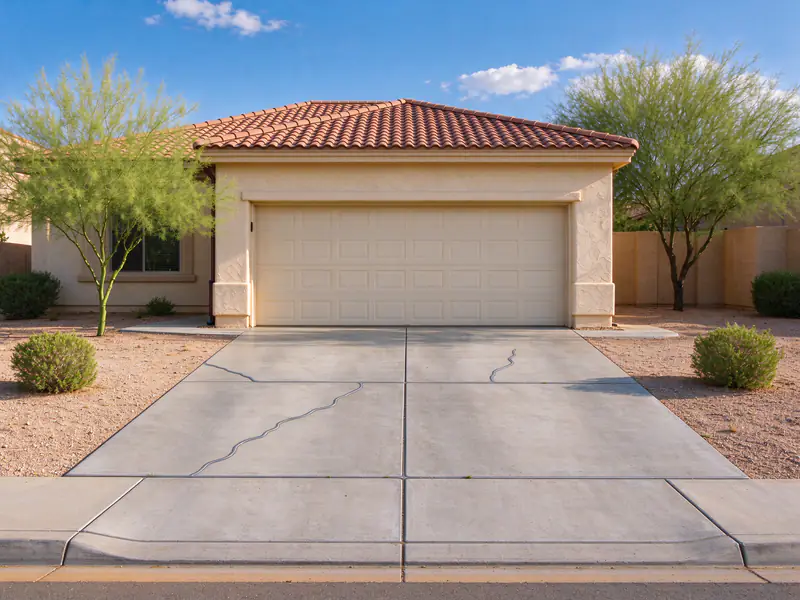
Concrete driveway in Chandler with cracks sealed as narrow gray lines
BeforeAfter
Cracks in your driveway? Get an Estimate.
Send photos of each crack with a coin for scale and say whether it has grown. The estimate names the treatment for each crack and flags any that need base repair first.
Should crack sealant sit flush with the driveway surface?
On concrete, a self-leveling sealant usually sits just below the surface so tires don't pull at it. On asphalt, hot-pour sealant is often left as a thin band slightly over the crack edges, which helps it bond to the worn shoulders of the crack. A sealant that bulges well above the surface gets scuffed off; one that sinks deep into an unprepared crack has usually lost its backing.
Can a driveway crack be made invisible?
No. A sealed crack shows as a narrow line of sealant, and gray sealants come closer to weathered concrete than black ones but never disappear. A cosmetic topping over a working crack splits again along the same line. If the look matters more than the crack, replacing the panel from joint to joint, or resurfacing a slab that is level and sound, are the options that change the appearance.
Is it worth sealing hairline cracks in a concrete driveway?
Only some of them. A hairline shrinkage crack that is too narrow to take sealant, and lets no water into the base, may be best left alone and watched. A crack wide enough to catch grit and water, or one that runs where roof or irrigation water crosses the slab, is worth cleaning and sealing, because the water under it is what turns a cosmetic crack into a support problem.
Will a crack come back after it is sealed?
The sealant line stays, and on a working crack the sealant is meant to stretch as the crack opens and closes. What comes back is a crack that was sealed while the slab was still settling or heaving: it tears the sealant or opens a new crack beside it. Sealant also ages in the sun and needs renewing over time, which is maintenance rather than a failed repair.
What helps when asking for a crack repair estimate?
A wide photo of the driveway and close photos of each crack with a coin for scale, rough lengths, whether the crack has grown since you first saw it, and whether one side sits higher than the other. Say whether the drive is concrete or asphalt, where downspouts and sprinklers run, and whether any crack reaches the apron, sidewalk or curb.