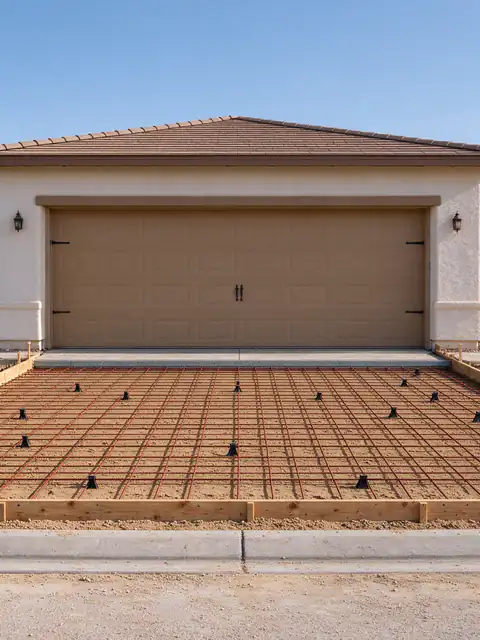
How much does driveway replacement cost in Phoenix?
The two numbers behind a concrete driveway replacement, tear-out and new pour, plus what base repair, grade correction, the apron and permits add, with illustrative budgets.
Last Updated:
Short answerA typical Phoenix-area range for replacing a concrete driveway is about $6 to $11 per square foot for a standard broom-finish pour, plus about $1.20 to $1.90 per square foot to break out and haul off the old slab. Grading, base repair, drainage correction, the street apron and permits are priced on top.
Driveway replacement cost in the Phoenix area comes down to two published numbers and one open question: about $6 to $11 per square foot to pour a standard concrete driveway, about $1.20 to $1.90 per square foot to remove the old one, and whatever the ground underneath needs. Sundial Driveway Repair is a service company offering and managing driveway replacement across Phoenix and the surrounding Valley, fulfilled by licensed and insured contractors. This guide breaks a replacement price into its parts so a quote can be read line by line.
Every figure is labeled as a typical Phoenix-area range or a national budgeting figure, and none is a quote. If the slab may only need part of the work, the driveway repair cost guide covers section repairs, lifting and resurfacing, and the repair vs replacement guide helps decide which side of that line a driveway sits on.
What are the published ranges for replacing a driveway?
A concrete replacement is quoted as tear-out plus new pour, with base work, grading and permits as separate lines. The ranges below are kept as separate parts on purpose: what sits under the old slab decides how much the job grows beyond them.
A rip-and-repave asphalt driveway; no reliable Phoenix-area band exists
National budgeting example
Base repair, grading, drainage correction
Open-ended
per job
Rebuilding soft or washed-out base, cutting through caliche, re-sloping water away from the garage
Priced after the site is seen
The two concrete numbers are not added together into a single rate here, because removal is the line that moves most with the slab you already have. A thin, unreinforced slab on open ground sits near the bottom of the removal range; a thick apron, wire mesh or rebar, a tight side yard, or a cemented layer under the slab pushes it up. The driveway replacement page covers how the work itself runs.
How do demolition and haul-off change the price?
Demolition is its own line because it is its own job: saw-cutting the edges where the new work meets the garage slab, sidewalk or curb, breaking the old concrete, loading it and hauling it away. The Phoenix-area range of about $1.20 to $1.90 per square foot fits an ordinary slab. It climbs where the slab is thicker than expected, where reinforcement has to be cut, where debris has to be wheeled out because equipment can’t reach, or where the excavator meets caliche. Federal soil survey data from the USDA Natural Resources Conservation Service flags cemented layers at 29.2% of sampled points in Phoenix’s Rio Vista village, 20.5% in Peoria and 18.2% in the Town of Paradise Valley, against 0% of sampled points in Tempe, Chandler and Gilbert. A soil map is not a finding for one lot, but it explains why removal on a foothill-edge property can cost more. The caliche guide explains what that layer does to digging and drainage.
Disposal is part of the same line. Ask whether the quote includes hauling, whether clean concrete goes to a recycler, and whether soil removed to lower the grade is priced separately.
What does grade and drainage correction add?
Grade correction is the line that turns a replacement from a cosmetic swap into a fix, and it has no published unit price because it depends entirely on the lot. When the old drive sank near the garage, ponded water, or shed monsoon runoff toward the house, a new slab poured to the same grade inherits the same problem. Correcting it can mean removing soft soil, bringing in and compacting new aggregate base, re-sloping the subgrade so water runs to the street, or adding a channel drain where slope alone can’t do it. Maricopa County drainage rules require lots to be graded so drainage does not adversely affect adjacent property, so a replacement that redirects water has to send it somewhere acceptable.
These costs show up after breakout, when the base can be seen. A good estimate says so in advance and explains any change in scope, such as soft base or caliche, before the pour. The driveway drainage page covers the drainage side, and why driveways crack and sink in Phoenix explains how water and soil undermine a slab in the first place.
What moves the price of a driveway replacement?
These are the factors that separate a low quote from a high one for the same footprint:
Factor
Why it moves the price
What to check
Driveway area
Per-square-foot rates scale with area; very small replacements carry minimum charges
Measured length and width of each section being replaced
Pavement type
Concrete and asphalt use different crews, materials and equipment
Which surface you are replacing and which you want
Existing slab thickness and reinforcement
Thick or reinforced slabs take longer to break and haul
Slab edges, cores or a test cut; rebar or mesh
Base condition and compaction
Soft or washed-out base must be removed and rebuilt in compacted lifts before the pour
What the slab was sitting on after breakout
Caliche and soil
Cemented layers slow excavation; shrink-swell clay may call for more base
Digging resistance; local soil type
Grade and drainage corrections
Re-sloping, added base or a drain changes the job beyond a like-for-like pour
Ponding, slope toward the garage, downspout discharge
Garage, sidewalk and street transitions
Edges take saw-cutting and hand finishing; the right-of-way section is 6 in. thick (apron cost guide)
Where the new work meets existing concrete
Finish
Stamped, colored or exposed aggregate concrete costs more than broom finish (stamped concrete repair)
The finish you want and any HOA rules
Access
Narrow side yards, gates and long wheelbarrow runs slow every step
What’s inside a Phoenix driveway replacement price?
A replacement price bundles labor, equipment, concrete, base material, disposal and any City permit. Some of those inputs have a public figure; others are scope to confirm on the quote.
Part of the price
What sets it
Local figure and source
Concrete finishing labor
Placing, screeding, finishing and curing the new slab
Cement masons and concrete finishers (SOC 47-2051): mean $29.25 an hour in the Phoenix-Mesa-Chandler metro vs $28.87 nationally; median $28.49 vs $27.41 (BLS wage data)
Demolition and base labor
Breakout, loading, hauling, subgrade prep and compaction
Construction laborers (SOC 47-2061): mean $23.40 an hour in the metro vs $25.02 nationally; median $22.56 vs $22.66 (BLS national data)
Asphalt paving operation
Paving and rolling on an asphalt replacement
Paving, surfacing and tamping equipment operators (SOC 47-2071): mean $29.10 an hour in the metro vs $28.37 nationally; median $26.77 vs $25.64 (BLS)
Replacement falls under maintenance, repair, replacement or alteration contracting, so tax is normally built into materials rather than added as an invoice line (Arizona Department of Revenue)
Landscape restoration and irrigation
Resetting rock, edging, sprinkler lines and plants along the new edges
No public figure; scope to check on the quote
A wage is not a billing rate: the hourly cost inside a quote also carries workers’ compensation and liability insurance, licensing, trucks, equipment, fuel and overhead. The wage data does rule one thing out. Concrete finishers in the Phoenix-Mesa-Chandler metro earn a mean $29.25 an hour, about 1% above the $28.87 national mean, and paving equipment operators earn a mean $29.10, about 3% above the $28.37 national mean. Neither gap explains a high replacement bid; slab removal, base work and access do.
What do permits add to a replacement in Phoenix and nearby cities?
Like-for-like replacement on the lot usually needs no permit. The City of Phoenix Driveway Policy treats up to 10.5 feet of concrete drive in the right-of-way as on-site work on streets with roll or ribbon curb; longer runs, streets with no curb, and vertical curb that has to be cut take a permit. The Phoenix driveway permit guide covers each case.
For a small residential concrete permit in the Phoenix right-of-way, the schedule works out to about $390 ($195 minimum plus $195 as-built review), before any plan review. The City’s Planning & Development Department confirms the figure for a given job.
Are there rebates for replacing a driveway?
No program found pays toward driveway replacement in the Phoenix area.
Not established. The program pays per square foot of living grass removed and says nothing about driveways; ask Water Services before removing any lawn
Sidewalk repair cost-share
City of Phoenix Street Transportation
None found
Permeable-pavement or stormwater incentive
Phoenix, Scottsdale, Tempe, Flood Control District of Maricopa County
None found; only design guidance exists
Federal tax credit
IRS
None applies to driveway work
What could a replacement budget look like?
These are illustrative arithmetic from the published ranges, not quotes. The sizes are assumptions, and the pour and removal lines are shown separately because base repair, grading and permits sit on top of both.
Example (illustrative)
Assumed scope
New pour
Removal
Not included
Two-car concrete driveway
600 sq ft, broom finish, like-for-like
600 × $6 to $11 = $3,600 to $6,600
600 × $1.20 to $1.90 = $720 to $1,140
Base repair, grade correction, apron permit
Single-car driveway
360 sq ft, broom finish
360 × $6 to $11 = $2,160 to $3,960
360 × $1.20 to $1.90 = $432 to $684
Base repair, landscape restoration
Two failed panels only
240 sq ft section replacement
240 × $10 to $15 = $2,400 to $3,600, removal included
Included
Color match with the old concrete
Asphalt rip and repave
One residential driveway
$3,000 to $10,000 (national budgeting example)
Included in the example
Base rebuild beyond the example’s scope
The section example shows why a partial replacement can make sense: the per-square-foot rate is higher, but the footprint is a fraction of the whole. A new section won’t match the color of weathered concrete next to it, which is the usual trade-off, and the extension page covers adding width while the drive is torn out anyway.
How do you compare two replacement quotes?
Read them for scope first. A complete quote states the measured area, the slab thickness at the lot and in the right-of-way, how the old slab is removed and where it goes, the base material and how it is compacted, any grade or drainage correction, the finish, joint layout, the cure time before driving, any permit and who pulls it, and what is excluded. In Arizona, a contractor generally needs a Registrar of Contractors license once a job tops $1,000 in labor and materials or needs a permit; R-9 covers residential concrete and R-13 residential asphalt paving. The license lookup guide shows how to check, and the asphalt vs concrete guide helps if the quotes propose different materials. For when you can park on the new slab, see how long before driving on a new driveway.
For a budget on your own driveway, the cost estimator works from the same published ranges, and you can ask for an estimate with photos and rough measurements when you’re ready.
VIIVIVIVIIIIII
02
More questions on this
Is it cheaper to replace only part of a concrete driveway?
Often, when the damage is confined to a few panels. Replacing a section runs about $10 to $15 per square foot in the Phoenix area, which is more per square foot than a full new pour, but you pay for far fewer square feet. Once the failed panels add up to a large share of the drive, or the base has failed under most of it, a full replacement usually makes more sense.
Does reinforcement add to the cost of a new concrete driveway?
Yes, when it is used. Rebar, wire mesh or fibers add material and placing time, and that pushes a new pour toward or above the top of the $6 to $11 per square foot Phoenix-area range. Whether a slab needs reinforcement depends on its thickness, loads and base, so it is a project decision. No reinforcement makes concrete crack-free; joints are what control where cracks form.
Can the old concrete be recycled instead of sent to a landfill?
Clean broken concrete without much soil or rebar can often go to a concrete recycler rather than a landfill, and some jobs reuse crushed material as fill. Whether that lowers the haul-off line depends on the disposal options near the job and how clean the debris is, so ask how the quote handles disposal.
VIIVIVIVIIIIII
03
Get an Estimate for driveway replacement
Tell us the surface, what changed and the nearest cross streets. Photos of the damage and the street edge make the estimate more useful.
Typical Phoenix-area and national budgeting ranges for each kind of driveway repair, what is inside the price, the City permit fees, and worked example budgets.
What a bonded concrete overlay and an asphalt overlay cost, what prep is priced on top, how the numbers compare with replacement, and the conditions that make resurfacing money poorly spent.
What replacing the concrete apron at the street costs, why it costs more per foot than the rest of the drive, the Phoenix and Chandler right-of-way fees, and how a new or widened curb cut is priced.
There is no single published price for a gravel-to-concrete conversion. This guide builds the budget from its parts: the new pour, the site work under it, the street end and the permits.
What mudjacking and polyurethane foam lifting cost per square foot, why small jobs price as a minimum, what drainage and joint work add, and where lifting stops being the cheaper choice.